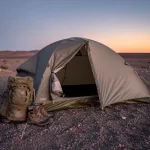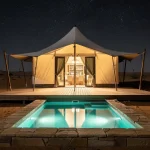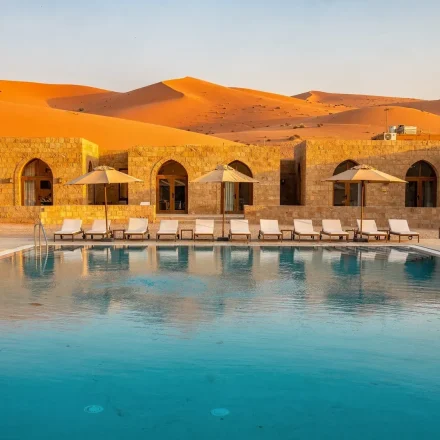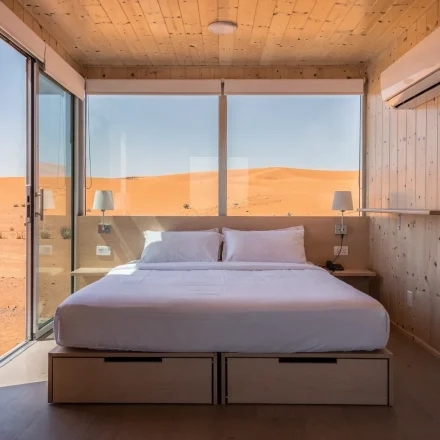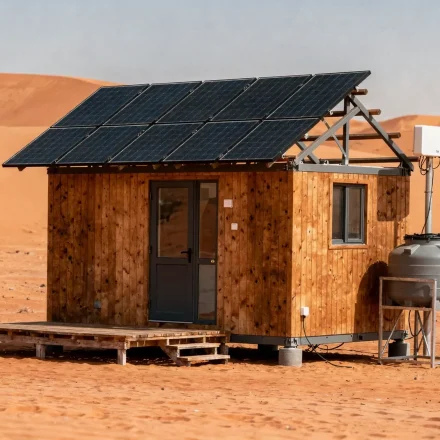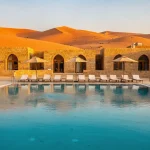
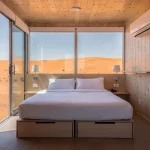

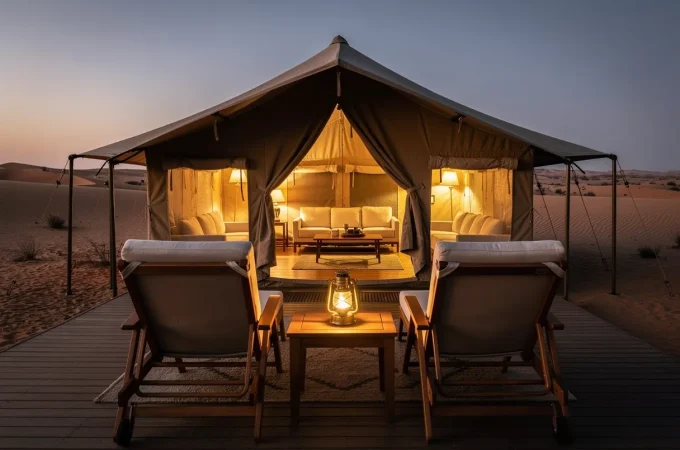
A real bed and a plumbed private bathroom. Those two things define a luxury desert glamping tent, and they are what your money buys over a classic safari tent. Everything else at this tier follows from them.
Table Of Content
- What a Luxury Desert Glamping Tent Actually Is
- The Bathroom Is the Whole Point
- Where the Water Actually Comes From
- Air Conditioning in a Canvas Box
- The Bed, and What Actually Changes
- Your Private Deck, and Which Way It Faces
- How It Compares Up and Down the Class
- Who It Suits
- Booking Notes
- FAQ
- What is the difference between this and an ultra-luxury suite tent?
- Does a luxury desert glamping tent always have air conditioning?
- Is the en-suite bathroom fully enclosed?
- Why does this tier sell out fastest?
- Is it a good fit for a couple or a honeymoon?
- Can I book this tier with children?
What a Luxury Desert Glamping Tent Actually Is
Start with the canvas, because that part does not change. This is still a walk-in fabric tent on a frame, usually raised on a platform, and it still breathes the way canvas does.
What changes is everything inside it. A proper bed frame replaces the camp bed. A plumbed en-suite replaces the walk to a washblock. Cooling arrives, lighting improves, and a private deck appears outside the door.
The word itself is younger than most people assume. The Oxford English Dictionary defines glamping as camping with accommodation and facilities more luxurious than traditional camping, and dates its first record to 2005. The dictionary added it in 2016. So the tier is barely two decades old as a named category.
The Bathroom Is the Whole Point

If you check one thing before booking, check this. The bathroom is where the tier is won or lost.
At the classic safari tent below, you get a shared washblock or a screened bucket shower behind the tent. Here you get fixed plumbing, a permanent basin and a real shower head, attached to your own tent.
One warning, though. Operators use “en-suite” loosely. Some bathrooms are fully enclosed within the tent envelope. Others are attached but roofless, open to the sky behind a solid wall. Both are pleasant. Only one of them works in a sandstorm, so ask which you are getting.
Where the Water Actually Comes From

Here is the question almost nobody asks, and it decides how good that bathroom actually feels.
A plumbed shower in an off-grid desert camp runs on stored water. Some camps sit on a borehole. Many truck water in and hold it in tanks. So pressure, temperature and duration all follow tank capacity and pump quality rather than your preference.
Ask how water reaches the camp. A camp on a borehole behaves like a hotel. A camp on trucked water behaves like a boat, and the difference shows up at the worst possible moment.
Air Conditioning in a Canvas Box

Cooling is the third upgrade, and it comes with an honest limit.
Canvas is not insulation. A split unit or evaporative cooler will hold a comfortable night temperature without much trouble. Fighting direct afternoon sun through a fabric roof is a different job, and even good units lose that fight between roughly noon and four.
That is why well-run camps at this tier still build a shaded deck. The deck is not decoration. It is the room you actually use in the afternoon.
Power matters too. Many camps run cooling on generator or solar with battery storage, and some cut supply overnight to protect capacity. Ask whether cooling runs all night, because the answer varies more than the brochure suggests.
The Bed, and What Actually Changes

A real bed sounds like a small upgrade. It is the one guests notice most.
Look for three things in the listing photos. A solid frame rather than a folding base. Visible mattress depth rather than thin foam. Layered linen rather than a single cover. Camps that invested here usually photograph it closely. Camps that did not shoot the interior at dusk from across the room.
Your Private Deck, and Which Way It Faces
Nearly every tent at this tier gets a private deck or terrace. Orientation decides how much you use it.
An east-facing deck gives you sunrise and cool morning air, then bakes from midday. A west-facing deck stays usable in the morning shade and delivers sunset from your own chair. Neither is wrong. Still, if you are booking for two, ask which way yours faces before you pay a premium for a view.
How It Compares Up and Down the Class
Downward, the gain over a classic safari tent is concrete: your own bathroom, a better bed, cooling and private outdoor space.
Upward, the ultra-luxury tier adds service rather than structure. Dedicated staff, in-tent dining and sometimes a plunge pool. The fabric walls are the same. You are buying attention, not architecture.
For the full picture of where this sits, the eight structures inside this class run on one continuous scale from bare expedition shelter to hotel-suite equivalent.
Who It Suits
Couples, first-time luxury desert travellers, and anyone who wants privacy without paying for a butler. This is the most booked tier in the class for good reason.
It suits families less well, since the layout is built for two. It also disappoints anyone expecting hotel-grade silence, because canvas passes sound almost unchanged and a neighbouring deck carries further than you would think.
Booking Notes
Peak season across the northern desert destinations runs roughly October to April, and this tier sells out first. It occupies the price and comfort sweet spot, so demand concentrates here rather than at the tiers above and below.
Book several weeks ahead for peak months. Multi-night packages that bundle meals and one experience often price better than booking each part separately. In the UAE in particular, short transfers from the city make single and two-night stays practical, which pushes weekend availability tighter than midweek.
FAQ
What is the difference between this and an ultra-luxury suite tent?
Service level, mostly. Both give you a private bathroom and a real bed. The ultra-luxury tier adds dedicated staffing, in-tent dining and full hotel-grade furnishing on top.
Does a luxury desert glamping tent always have air conditioning?
Usually, though not always, and the way it runs matters more than whether it exists. Ask whether cooling stays on overnight, since some camps cut power to protect battery capacity after midnight.
Is the en-suite bathroom fully enclosed?
Not always. Some are sealed within the tent, while others are attached but open to the sky behind a solid privacy wall. Both work in fair weather. Only the enclosed version works comfortably in wind.
Why does this tier sell out fastest?
It sits at the point where price and comfort meet for the widest group of travellers. That concentrates demand here rather than spreading it across the tiers above and below.
Is it a good fit for a couple or a honeymoon?
Yes, and that is the core market. Private bathroom, private deck and a real bed cover most of what couples want, without the price step up to a fully staffed suite.
Can I book this tier with children?
Sometimes, though the layout assumes two guests. Camps that handle families properly use a family or multi-unit configuration instead, which connects sleeping areas rather than adding a bed to one room.