

A family desert glamping tent is defined by its layout, not by its price. Comfort level tells you nothing here. Size, room count and how the spaces connect tell you everything.
Table Of Content
- What a Family Desert Glamping Tent Actually Is
- The Two Layouts Behave Very Differently
- The Shared Space Is the Reason to Book It
- A Fabric Wall Blocks Sight, Not Sound
- Bathrooms Are Where the Maths Goes Wrong
- What “Sleeps Six” Actually Means
- Which Comfort Tier Are You Getting?
- Is It Cheaper Than Separate Tents?
- Booking Notes
- FAQ
- What comfort level does a family desert glamping tent offer?
- Is this the same as booking two separate tents?
- Will we hear each other through the internal partition?
- How many guests does a family tent actually sleep?
- How many bathrooms should I expect?
- Is it more affordable than booking several single tents?
What a Family Desert Glamping Tent Actually Is
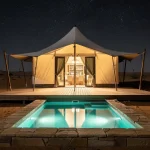
It is one booking that covers multiple sleeping areas, plus shared space that belongs only to your group.
That definition sits oddly inside a class where everything else is graded by comfort. A family unit can be built to modest standards or to suite standards. Both carry the same label, so the name alone tells you very little about what you are buying.
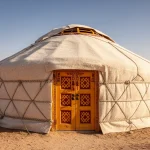
It still sits inside the tented camp class, and inside the broader group of mobile and temporary structures. Only the configuration changes.
The Two Layouts Behave Very Differently
Operators build this Unit in one of two ways, and the difference matters more than any brochure suggests.
The first is one large tent partitioned internally into sleeping sections. Everything shares a single envelope, so it also shares one climate system, one air volume and one soundscape.
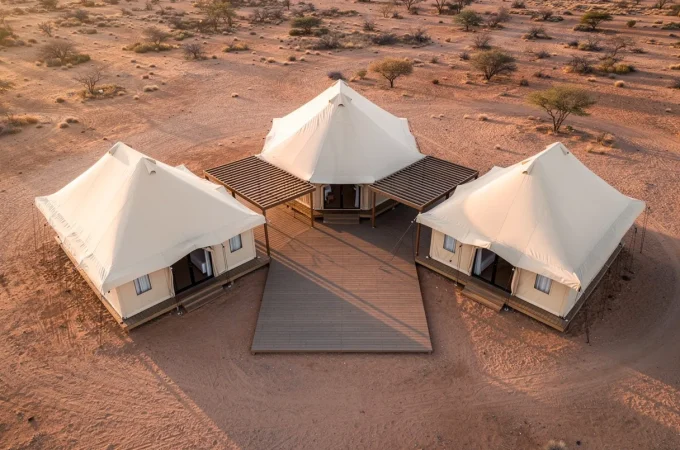
The second is a cluster of separate tents joined by a covered walkway or a shared deck. Each tent keeps its own walls, its own cooling and real acoustic separation. In exchange, someone crosses open ground to reach the others at two in the morning.
Neither layout is better. They suit different families, and most listings never say which one you are getting.
The Shared Space Is the Reason to Book It

Strip away everything else and one feature justifies the whole category.
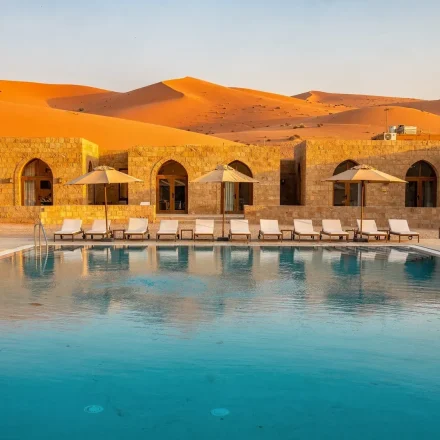
Three separate tents give a group three bedrooms and nowhere to be together. A family unit adds a lounge, a deck or a majlis that belongs to your booking alone. That is where the trip actually happens between activities.
So when you compare listings, count the shared square metres rather than the beds. A unit with generous common space and modest bedrooms usually beats the reverse.
A Fabric Wall Blocks Sight, Not Sound

This is the point most families discover on the first night, and it is worth knowing beforehand.
Builders measure how well a wall blocks noise using a Sound Transmission Class rating. Speech stays fairly understandable through an STC 30 wall, and every ten-point rise roughly halves the sound energy getting through. Even a plain uninsulated drywall wall sits around STC 33, which the acoustics industry already calls almost no soundproofing.
A hanging sheet of canvas has almost no mass at all, so it lands far below that. Treat an internal partition as a curtain that reaches the ceiling. It buys darkness and privacy from view. It does not buy quiet.
Families with a light-sleeping baby, or teenagers keeping different hours, should choose the connected-cluster layout instead.
Bathrooms Are Where the Maths Goes Wrong

Sleeping capacity gets advertised loudly. Bathroom capacity rarely gets mentioned at all.
Plenty of units sleep six behind a single bathroom built for a couple. That works for a family used to sharing. It fails badly for two adult couples travelling together, and nobody discovers it until the morning of the sunrise drive.
Ask two questions before booking. How many basins, and how many showers. A properly configured family unit answers with more than one of each.
What “Sleeps Six” Actually Means
Read that number carefully, because operators calculate it generously.
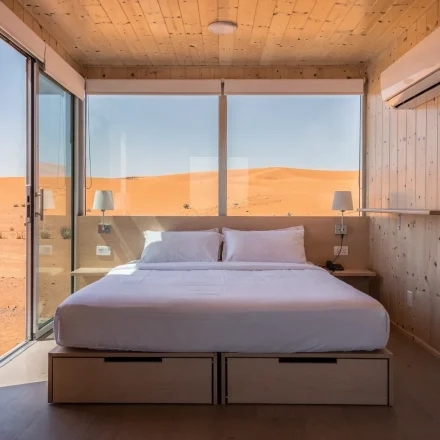
Six often means four adults in real beds plus two children on rollaway beds or a sofa bed in the shared lounge. That is a workable arrangement for a family with young kids. It is a poor one for six adults, and the rate rarely reflects the difference.
So ask for the bed configuration rather than the headcount. The answer separates a genuine multi-bedroom unit from a standard tent with extra mattresses added.
Which Comfort Tier Are You Getting?
Because this Unit sits outside the comfort scale, the same label covers very different stays.
At the lower end it matches a classic safari tent: real beds, shared or simple bathrooms, no climate control. At the upper end it matches a suite, with cooling, plumbed bathrooms and full service.
The price gap between those two versions is enormous. Ask the operator directly which standard applies, since the listing name will not tell you.
Is It Cheaper Than Separate Tents?
Often, though not always, and the reason is worth understanding.
Shared common space and consolidated service reduce a property’s cost per guest, so per-person rates frequently come in below the same group booking several individual tents. Camps with very few family units sometimes price them at a premium instead, precisely because demand outstrips supply.
Compare both ways before deciding. The answer flips depending on the property.
Booking Notes
Inventory is the real constraint here. Most camps run one or two family units against a dozen standard tents, so they disappear first during school holidays.
Book earlier than you would for a couple’s stay, especially around peak months from October to April. In the UAE, short transfers from the city make single-night family stays practical, which concentrates demand on weekends.
FAQ
What comfort level does a family desert glamping tent offer?
It varies widely, because this Unit is defined by layout rather than comfort. Ask whether it is built to classic, luxury or suite standards, since the same name covers all three.
Is this the same as booking two separate tents?
No. A genuine family unit adds shared common space that belongs to your booking, whether through one partitioned tent or a connected cluster. Two separate tents give you bedrooms and nothing between them.
Will we hear each other through the internal partition?
Almost certainly, yes. A fabric partition provides visual privacy without meaningful sound insulation, so choose a connected-cluster layout if acoustic separation matters to your group.
How many guests does a family tent actually sleep?
Commonly four to eight, though the headline number often includes children on rollaway beds. Ask for the exact bed configuration rather than the maximum occupancy.
How many bathrooms should I expect?
Fewer than you might assume. Many six-sleeper units carry a single bathroom, so confirm the number of basins and showers before booking for more than one couple.
Is it more affordable than booking several single tents?
Frequently, on a per-person basis, since shared space lowers the property’s cost per guest. Camps with very limited family inventory sometimes reverse that, so it pays to price both options.