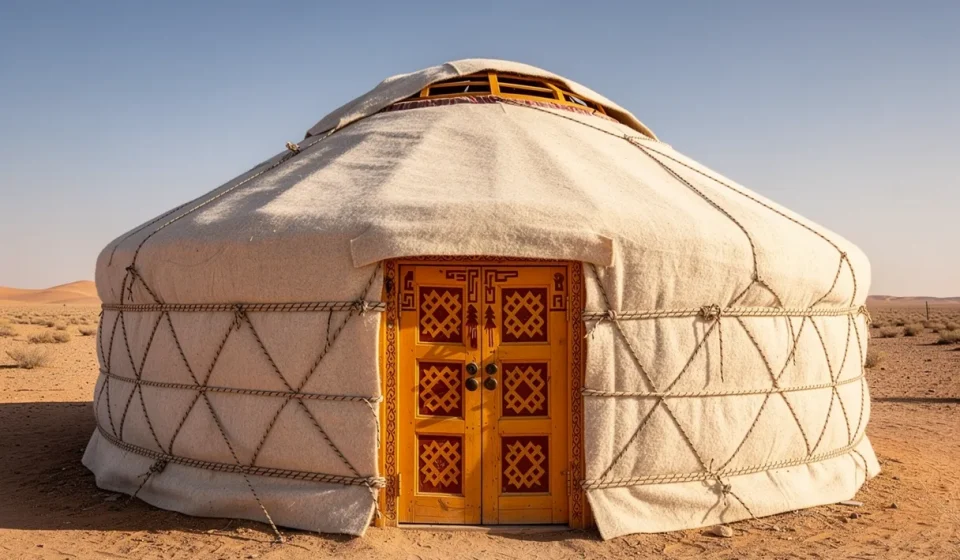

A desert yurt stay promises something no canvas tent can offer: a round room built from wood and wool. That difference is structural rather than decorative, and as a result it changes how the space feels the moment you step inside.
Table Of Content
- What a Yurt Actually Is
- The Toono, and Why the Roof Has a Hole in It
- Wool Felt Is the Real Technology
- The Frame Goes Up Fast, and Comes Down Faster
- Yurt or Ger? The Naming Question
- How to Tell a Real Yurt From a Round Tent
- Why the Craft Itself Matters
- Can You Actually Book a Desert Yurt Stay?
- How the Yurt Compares to a Canvas Tent
- FAQ
- Is a yurt warmer than a standard tent?
- What is the difference between a yurt and a ger?
- How long does a yurt take to put up?
- How do I know a yurt is genuine?
- Can I book a desert yurt stay right now?
- Is a yurt a good choice for a first desert night?
What a Yurt Actually Is
Britannica describes the yurt as a tent-like Central Asian nomad’s dwelling, erected on wooden poles and covered with skin, felt or handwoven textiles. Nomads carried it from place to place on horseback or a small wagon, since the whole structure was built to travel.
In fact, UNESCO puts the construction more precisely. Its listing for yurt-making calls it a collapsible wooden circular frame covered with felt and braided with ropes, assembled and dismantled within a short period of time.
Note what is missing from both descriptions. No canvas, and no rigid dome shell. Therefore the yurt sits firmly inside the soft-wall tent class, though it looks nothing like a safari tent.
The Toono, and Why the Roof Has a Hole in It

Look up and you find the toono, the wooden crown ring every roof pole sockets into.
The ring does two practical jobs at once. First, it lets daylight into a windowless room. It also vents smoke from a central stove, so in a hot climate that same aperture releases rising warm air.
Anyone who has stood under one understands why it dominates the interior. Every structural line in the building points at it, after all.
Wool Felt Is the Real Technology

Most people assume felt is a cold-weather material. However, it works in both directions, and the reason is simple.
Insulation slows heat moving in any direction. Because dense compressed wool has real thickness and traps air, it resists the afternoon sun coming in just as it resists warmth escaping at night. By contrast, a single layer of canvas does neither.
That is why the yurt suits a desert better than its origins suggest. Deserts swing hard between day and night, and felt flattens both ends of that swing.
The Frame Goes Up Fast, and Comes Down Faster

The khana, the expanding lattice wall, is the clever part.
It concertinas closed for transport, then opens into a rigid circle on site. Roof poles slot between that wall and the crown ring next, and finally the felt goes over the top. Nothing needs cutting, and nothing gets left behind.
UNESCO’s description stops at a short period of time without quoting an hour count, and honest operators do the same. Crew experience, yurt size and wind all change the answer. Therefore treat any precise figure you read elsewhere with caution.
Yurt or Ger? The Naming Question
Both words describe the same structure. In other words, the choice signals region rather than design.
Ger is the Mongolian term and simply means home. Yurt, meanwhile, comes from Turkic languages and travelled into English as the general word. Britannica lists ger as the Mongolian name for the same dwelling.
So a property calling its accommodation a ger is usually pointing at Mongolian tradition. One saying yurt, on the other hand, often points further west toward Kyrgyz or Kazakh practice.
How to Tell a Real Yurt From a Round Tent
Plenty of glamping operators sell a canvas tent on a circular metal frame as a yurt. That is a perfectly good room. Still, it is not the same object.
Ask two questions before booking. What is the wall frame made of, and what is the cover made of? A genuine answer names wood lattice and wool felt. Otherwise you are usually looking at powder-coated steel and canvas.
Neither product is dishonest by itself. The problem appears only when a traveller books for the craft tradition and receives the silhouette instead.
Why the Craft Itself Matters
UNESCO inscribed yurt-making on its Representative List of the Intangible Cultural Heritage of Humanity, and the reasoning explains a lot.
Men build the wooden frames by hand, along with the leather, bone and metal fittings. Women, meanwhile, make the exterior coverings and interior decoration, usually working in community groups under experienced artisans. Families also hold weddings, births and funerals inside these structures, and pass individual yurts down through generations.
That context is the actual product a cultural stay sells. A round tent cannot carry it, however well built.
Can You Actually Book a Desert Yurt Stay?
Here is the honest answer, and it is not the one most articles give.
The yurt’s home is the Central Asian steppe rather than the Arabian or African desert. Across the destinations covered in this Hub, therefore, genuine felt-and-lattice yurts stay rare. A handful of glamping operators worldwide have adopted the form as a design choice, and those stays can be excellent even though they are not culturally native to where they stand.
So treat a desert yurt as a design experience unless the operator can point to real Central Asian craft behind it. For a nomadic tradition genuinely rooted in these deserts, a woven goat-hair Bedouin tent is the closer match.
How the Yurt Compares to a Canvas Tent
Against a classic safari tent, the yurt wins on insulation and loses on ventilation when sealed.
The round plan also changes how a room works. Since there are no corners to push furniture into, everything arranges around the centre. Some guests find that calming. Others, however, find it impractical for luggage.
Both structures sit inside the same family of mobile and temporary desert accommodation, because both are built to come apart and move.
FAQ
Is a yurt warmer than a standard tent?
Yes, and cooler too. Because thick wool felt insulates in both directions, it slows heat entering during the day as well as heat escaping at night.
What is the difference between a yurt and a ger?
Nothing structural. Ger is the Mongolian word for the same dwelling, while yurt comes from Turkic languages and became the general English term. Usually the naming signals which regional tradition a property follows.
How long does a yurt take to put up?
UNESCO says only that it assembles and dismantles within a short period. Since size, crew experience and wind all affect it, any precise hour figure quoted elsewhere deserves scepticism.
How do I know a yurt is genuine?
Ask what the wall frame and the cover are made from. A real one uses a wooden lattice and wool felt. Otherwise, a round canvas tent on a steel frame is a different product, whatever the listing calls it.
Can I book a desert yurt stay right now?
Rarely, and almost never as a culturally native option. Because genuine yurts belong to the Central Asian steppe, a desert version is usually a design adaptation by an individual operator rather than a local tradition.
Is a yurt a good choice for a first desert night?
It can be, provided you book it for the room rather than the heritage. The insulation is genuinely good, and in addition the interior is unlike anything else in this class.