


A camel ride is the simplest way into the desert. You need no training, no special gear, and no fitness test. Most sessions last 15 minutes to two hours. So camel riding sits right at the start of the desert experience ladder, and every longer camel trek builds on the same basic skill.
Table Of Content
- What Is Camel Riding?
- The Mount Is the Part Nobody Warns You About
- How a Camel Ride Actually Works
- Do You Need Any Skill or Fitness?
- Camel Riding Safety Tips
- How to Spot an Operator That Treats Camels Well
- What to Wear and What Is Provided
- How Long Does a Camel Ride Last?
- Camel Riding or a Camel Trek?
- Best Places for a Camel Ride in the Desert
- Best Season and Time of Day
- Who Is Camel Riding For?
- Frequently Asked Questions
- Is camel riding uncomfortable?
- How do I know an operator treats its camels well?
- Can I ride a camel by myself?
- Do camels spit or bite?
- What if I have never been on an animal before?
- How high off the ground am I?
- Can children go on a camel ride?
- Related Experiences
This guide covers the mount, the gait, the safety points, and the welfare signs that separate a good operator from a poor one.
What Is Camel Riding?
Camel riding means sitting on a dromedary, the one humped camel, while a handler leads it on foot or from a lead camel. You do not steer. In fact, nobody hands you reins. The handler holds the rope for the whole ride, and your camel simply follows the animal in front of it.
Saddles change from country to country. Some operators use a soft padded blanket saddle. Others use a wooden frame with a raised horn at the front. That horn matters more than it looks. It gives you one solid thing to hold, and it changes how steady the ride feels for a first timer.
Both styles are safe with a handler present. Neither one asks for any prior skill.

The Mount Is the Part Nobody Warns You About
The camel kneels so you can climb on. So far, so calm. Then it stands up in two stages, and this is where first timers get caught out.
The back legs come up first, so your body tips forward. A second later the front legs follow, and you tip back. The whole move takes about two seconds.

Hold the horn firmly through both stages. Lean back slightly as the rear rises, then lean forward as the front comes up. That is the entire technique, and it works every time.
Getting down repeats the same lurch in reverse. Because you know what is coming by then, it usually feels much easier.
How a Camel Ride Actually Works
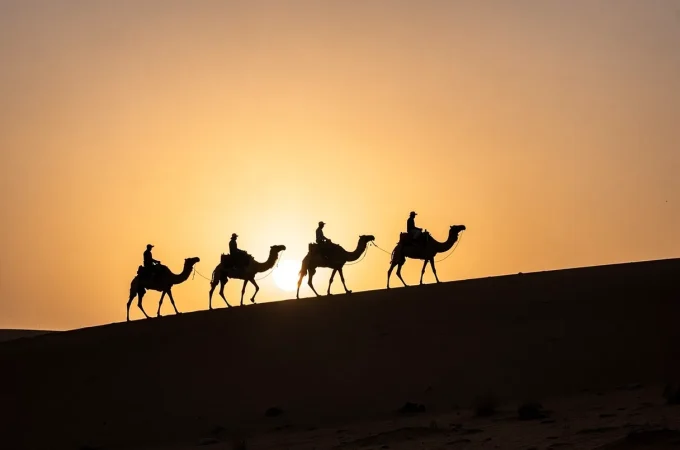
Camels travel in a line, tied nose to tail behind a lead handler. This is not a limit on your freedom. Rather, it is simply how camel handling works, since a camel naturally follows the animal ahead of it.

The gait surprises people more than the height does. A horse bounces up and down. A camel rolls side to side instead, a bit like a slow boat. Some guests love it straight away. Others need a few minutes before their body settles into the rhythm.
Group sizes vary a lot. A quiet morning slot might hold five or six riders. A peak sunset slot can run a dozen camels or more, with one handler at the front and a second at the back.
The ride is quieter than most people expect. There is no clatter of hooves, because a camel walks on broad soft pads. So you mostly hear wind, the creak of the saddle, and the handler talking to the animals.
Most routes include a photo stop at a dune crest. The handler picks the moment, so you do not need to ask for it.
Do You Need Any Skill or Fitness?
No. That is the short answer, and it is why camel riding works as the default first step into the desert.
Still, one physical point is worth knowing. Your lower back and core do quiet work throughout the ride. A saddle sore feeling afterwards is normal, even after 20 minutes. It says nothing about your fitness or your technique.
Pregnant travellers should talk to the operator before booking. The same goes for anyone with recent back or joint surgery. Ask about the mounting lurch in particular, rather than the ride itself.
Camel Riding Safety Tips
Two moments carry real risk, and both of them last seconds. The first is the mount. The second is getting down.
Grip the horn, lean back as the camel rises, and lean forward as it drops. After that, the ride itself feels remarkably stable.
Beyond those two moments, your safety does not rest on your own skill. Instead, it rests on the handler holding the rope. A calm, attentive handler is the single most useful thing to look for.

A few practical camel riding safety tips help as well:
- Keep your feet relaxed rather than gripping the animal.
- Wear sunglasses, because you sit high with no shade at all.
- Tell the handler at once if the saddle slips.
- Wait for the handler before you climb down.
How to Spot an Operator That Treats Camels Well
Animal welfare is not a side issue here. It is part of your safety, because a stressed or tired animal is a less predictable one.
The RSPCA lists concrete signs that you can check yourself. Look at the camel before you book. A well kept animal looks settled and well fed. Its eyes are clear. The skin under the saddle and harness stays smooth, with no worn patches. You can read the full list in the RSPCA guidance on camel tour rides.

Then look at how the operation runs. Good operators rest their animals between rides rather than working them back to back. They shorten or move sessions in peak heat. Above all, they answer questions about training and rest openly.
One more signal is easy to miss. Camels are built for dry air. So a camel working in humid, non desert conditions is a genuine warning sign.
What to Wear and What Is Provided
The camel, the saddle, and the handler come as standard. You bring the rest, and there is not much of it.
Wear loose trousers. Tight jeans pull awkwardly in the saddle position, and you will feel it within ten minutes. Bring a hat and sunglasses, because you sit higher and more exposed than any vehicle passenger.
A light scarf or shemagh helps on longer rides. It cuts both sun and blown sand, and it costs you nothing to pack.

Finally, wear closed shoes. The ride itself does not demand them. However, you often get down onto loose sand or gravel rather than a paved area.
One small camera tip. Use a wrist strap rather than a neck strap, since a neck strap swings with the gait and blocks your view at the worst moments.
How Long Does a Camel Ride Last?
Short sessions run 15 to 30 minutes. Operators sell these on their own, or they bundle them into a wider desert safari day.
Longer sessions stretch to roughly two hours. Beyond that you move into a different format, the half or full day camel trek, which is built around covering a set route.
Sunset slots book out first, everywhere. The low light and the camel silhouette make the most photographed moment in the whole category. So book a morning slot if you want a smaller group. You get the same ride with a fraction of the crowd.
Camel Riding or a Camel Trek?
People often mix these two up, so the difference is worth stating plainly.
A camel ride is about the feeling. There is no route goal and no distance target. You get on, you ride for a set time, and you get off near where you started.
A camel trek is about the journey. It follows a planned route, it lasts half a day or longer, and it usually includes food, rest stops, and sometimes a camp.
Start with the ride. If you enjoy the gait and the pace, the trek becomes the obvious next booking.
Best Places for a Camel Ride in the Desert
Camel riding is the most widely available experience in the Desert Booker network. The UAE, Morocco, Oman, and Australia all list it as a signature experience.

That makes it genuinely country independent. You can ride outside Dubai in January and near Merzouga in March, and the core experience holds.
Coastal operations are worth knowing about too. Some run along a beach as well as dunes. The backdrop looks quite different from the classic dune and sunset picture, so ask first if a particular photo matters to you.
Best Season and Time of Day
Morning and late afternoon both work well. Midday is the one to think twice about.
Heat is an animal welfare question as much as a comfort question. Good operators shorten midday sessions, move them, or drop them completely in summer.
From October through April, most desert climates handle a midday booking fine. In peak summer, though, plan around morning or sunset only.
Ask about a sunrise slot in summer if the operator runs one. The light is just as good as sunset, the sand has not built up heat yet, and the groups are far smaller.
Who Is Camel Riding For?
Almost everyone. It is the lowest barrier experience in the whole hub. Families, first time desert visitors, and anyone who wants one short iconic desert moment will get what they came for.
It suits you less well in two cases. First, if you have significant back or joint problems, the mount and the saddle position may simply be uncomfortable. Second, if you want to ride alone and control the animal yourself, this format will disappoint you. Handler led is not a compromise here. It is how the activity works.
Frequently Asked Questions
Is camel riding uncomfortable?
Mild soreness after a first ride is normal, and nothing went wrong. The saddle position and the rolling gait take a few minutes to get used to. A second ride almost always feels better than the first.
How do I know an operator treats its camels well?
Check the animals and the schedule. Camels should look alert and well fed rather than thin. Handlers should rest them between rides. Operators should cut ride times in peak heat. Those three signs are easy to check on the spot.
Can I ride a camel by myself?
No, not at a commercial operator. Handlers lead camels on a rope for guest safety. Besides, camels are trained to follow a lead animal rather than respond to an unfamiliar rider.
Do camels spit or bite?
Rarely, and almost never at a paying guest. Spitting is a warning between camels rather than a greeting for people. Trekking camels get handled every day, so they tolerate strangers well. Keep your hands away from the face, and let the handler do any touching.
What if I have never been on an animal before?
That is the normal case, not the exception. Camel riding asks for no experience at all. The handler does the work, and you hold the horn.
How high off the ground am I?
Roughly two and a half metres once the camel stands. It feels higher than it sounds, so give yourself the first minute to adjust before you reach for a camera.
Can children go on a camel ride?
Usually yes, though minimum ages vary by operator and by country. Many operators seat a young child with a parent instead of on a separate camel, so check the policy when you book.