

A hot air balloon desert flight is the slowest and quietest way to see a dune field. It is also the one most likely to get cancelled. Both facts come from the same source, which is the weather.
Table Of Content
- What Is a Hot Air Balloon Flight?
- You Control Height, Not Direction
- What Happens on the Morning Itself
- What the Flight Feels Like
- Why Hot Air Balloon Desert Flights Get Cancelled So Often
- How to Book Around the Weather
- Pilot Licensing and Safety Checks
- The Landing, and the Brace Position
- Fitness, Heights, and Who Should Think Twice
- How Long Does the Whole Thing Take?
- Shared Basket or Private Charter?
- Balloon, Helicopter, or Plane?
- Best Places for a Desert Balloon Ride
- Best Season and Time of Day
- Who Is This For?
- Frequently Asked Questions
- How often do hot air balloon desert flights get cancelled?
- Is a hot air balloon desert flight safe?
- What happens to my money if the flight is cancelled?
- Can you steer a hot air balloon?
- Is it cold up there?
- Do I need to book far in advance?
So this guide starts with the part most operators bury. Then it covers the morning itself, the flight, the landing, and the two credentials worth checking before you pay.
What Is a Hot Air Balloon Flight?
You stand in a wicker basket. Above you sits a large fabric envelope filled with hot air. Burners heat that air, and the balloon rises. That is the whole machine.
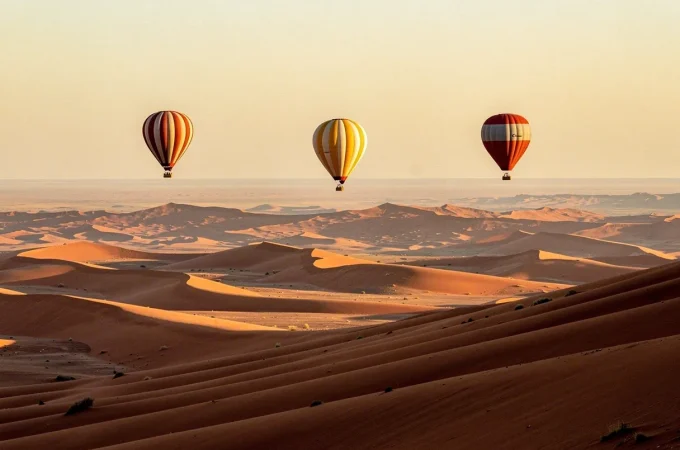
There is no engine and no propeller. Instead, the balloon drifts with whatever wind is blowing at whatever height it is flying. Over a desert dune field, a hot air balloon desert flight usually cruises between 300 and 1,000 metres. That is low enough to pick out single dune ridges, animal tracks, and the long shadows the sun throws at dawn.
You Control Height, Not Direction
This is the single mechanic that explains everything else about the experience.
On a hot air balloon desert flight, the pilot controls altitude with the burner. Fire the burner, the air heats, and the balloon climbs. Let it cool, and the balloon sinks. That part is precise, and a good pilot can hold a height within a few metres.

Direction works differently. Wind runs at different speeds and different angles at different heights. So a pilot steers by changing altitude until the balloon finds a wind going roughly the right way. It is closer to sailing than to driving.
Because of that, nobody can promise you a specific view in advance. The landing site is also unknown until the balloon is nearly down. That is why a chase vehicle follows you across the sand.
What Happens on the Morning Itself
A hot air balloon desert flight starts in the dark. Pickup usually happens between 4 and 5 in the morning. You reach the launch field while it is still black outside, and the balloon lies flat on a tarpaulin.
First, a fan pushes cold air into the envelope until it swells into a long tunnel. Then the pilot fires the burner into the mouth of that tunnel. The hot air lifts the envelope off the ground, and the whole thing stands upright over roughly 15 to 20 minutes.

Watch this part. Many first-time guests remember the inflation as clearly as the flight, and it happens while everyone is still half awake in the dark. The burner light through the fabric is the best photograph of the morning.
Then you climb in over the side of the basket. There is no door, so expect a short scramble.
What the Flight Feels Like
Quieter than you expect, and stiller.
The balloon moves with the wind, so you feel almost no wind at all. There is no engine noise either. Between burner blasts you get silence, and the burner itself is loud enough that the contrast is startling.
A typical flight runs 45 minutes to an hour. The sun comes up during it, which changes the desert underneath you from grey to orange in about ten minutes.
Because the basket floor is solid and the movement is slow, most people who dislike aeroplanes are fine here. The sensation is closer to standing on a balcony than to flying.
Why Hot Air Balloon Desert Flights Get Cancelled So Often
Now the honest part. Balloon flights get scrubbed far more often than helicopter tours or scenic plane flights, and the reason is structural rather than commercial.
A plane can fly through a headwind. A balloon cannot fight anything, because it has no way to push against the air. So conditions that a plane would simply absorb will ground a balloon completely.
The pilot makes a go or no go call on the morning itself. That call rests on wind speed at ground level, wind at flight height, visibility, and any forecast change during the flight window.

Here is the part that frustrates guests most. Conditions can look perfect from your hotel window and still be wrong at 600 metres. So a scrub called at the launch field, after everyone has already driven out in the dark, is normal. It is not a sign of a badly run operation. It is the opposite.
How to Book Around the Weather
Treat cancellation as likely rather than unlucky, and the whole problem shrinks.
Book your hot air balloon desert flight for the first or second morning of a multi day trip. Then a scrub still leaves you two or three mornings to rebook. Booking it for your last morning removes that option completely.
Ask about the rescheduling policy before you pay, and get the answer in writing. Good operators rebook you rather than refund you, because a refund helps nobody. Also ask how many mornings they will keep trying.
Finally, never put a balloon flight on the same day as a connecting flight. That combination fails often enough that experienced guides simply refuse to plan it.
Pilot Licensing and Safety Checks
Two things are worth verifying with an operator you do not know.
First, the pilot. Balloon flying needs its own commercial certificate, separate from any aeroplane or helicopter licence. Holding one means logged balloon hours and a written exam covering weather and regulations.
Second, the aircraft. Balloons carry a mandatory annual inspection by a certified repair station, in the same spirit as any other commercial aircraft.
Rules differ by country, though the direction of travel is consistent. In the United States, for example, the FAA closed a long standing loophole in November 2022. Commercial balloon pilots carrying paying passengers now need a second class medical certificate, the same class other commercial pilots hold. Congress ordered the change in the FAA Reauthorization Act of 2018, and the NTSB had recommended it as well. You can read the details in the FAA announcement on medical requirements for commercial balloon pilots.
Asking about certification and inspection currency is reasonable anywhere. A confident operator answers in one sentence.
The Landing, and the Brace Position
Landings vary more than the flight does, and your pilot will brief you before descent.
On a calm morning the basket simply settles onto the sand. On a breezier one it touches, tips, and drags a short way before it stops. Both count as normal landings.
The brace position handles the second case. You face the direction of travel, hold the rope handles inside the basket wall, bend your knees, and keep your feet planted. Above all, stay standing until the pilot says otherwise.

Then the ground crew arrives. They have been tracking you by vehicle across the sand for the whole flight, and they pack the envelope while you stand around in the sunrise. Most operators finish with a champagne toast, which is a real ballooning tradition rather than a marketing invention.

Fitness, Heights, and Who Should Think Twice
You need no fitness and no experience. You do, however, need to stand for about an hour.
Two groups should think carefully first. Anyone who cannot stand comfortably for an hour will find the flight long. And anyone with a serious fear of heights should be honest about it, because basket walls sit around chest height and the view straight down is completely open.
Interestingly, the fear of heights question splits people in an unusual way. The balloon never banks, drops, or accelerates. So some people who hate aeroplanes love this, while others find the open edge harder than any enclosed cabin.
Children are usually welcome above a minimum height, since they need to see over the basket wall. Operators set that limit themselves, so check when you book.
How Long Does the Whole Thing Take?
Airtime is 45 minutes to an hour. Plan for about three hours door to door.
That total covers a pre dawn pickup, the drive out, the inflation, the flight, the landing, the pack down, and the toast. Add travel time from your hotel on top.
So a hot air balloon desert flight consumes your whole morning. Plan a slow lunch after it rather than a museum booking.
Shared Basket or Private Charter?
Shared baskets carry anywhere from 4 to 16 passengers, depending on the size of the balloon. Crews sort guests by weight so the load sits evenly around the basket.
A private charter usually means you book the whole basket rather than a smaller aircraft. That is why the premium is steep instead of slight. You are paying for the empty seats.
For most travellers the shared basket is fine. Baskets are divided into compartments, so you are not standing in a crowd.
Balloon, Helicopter, or Plane?
Pick by pace and certainty, rather than by altitude.
A helicopter or a plane flies a planned route whatever the wind does. You know what you will see, and the schedule holds. Speed and noise come with it.
A balloon gives you silence, a low drift, and a route nobody can predict. That unpredictability is exactly the appeal for some travellers and a dealbreaker for others.
In short, book the balloon for the feeling and book the scenic helicopter tour for the itinerary.
Best Places for a Desert Balloon Ride
Namibia is the strongest documented hot air balloon desert market. Sunrise flights over the Sossusvlei dune fields put you above some of the tallest dunes on earth, and the low light on those red slopes is the reason most people book.

Dubai runs a dense operator network over its desert conservation reserves, which makes the UAE the easiest option to add to an existing trip. Namibia takes more planning and rewards it.
Outside the current network, Phoenix, Scottsdale, and Las Vegas all support year round desert ballooning with plenty of operators to compare.
Best Season and Time of Day
Dawn is not really a preference. It is close to the only option.
Early morning air is calm and stable, and that stability is what makes a safe launch possible. As the sun heats the ground, thermals build and the air becomes rough. Almost every hot air balloon desert operator therefore flies sunrise slots only.
Season matters less than time of day, though winter mornings are generally calmer. In peak summer, operators push departures even earlier to stay ahead of the heat.
Who Is This For?
A hot air balloon desert flight suits travellers who want the quietest aerial view available, and who can absorb a cancelled morning without the trip falling apart.
It fits badly in two cases. First, a tight schedule with no rebooking room turns a normal scrub into a ruined plan. Second, anyone chasing speed or adrenaline will find a balloon slow by design. Tandem skydiving answers that brief far better.
Frequently Asked Questions
How often do hot air balloon desert flights get cancelled?
Often enough to plan around. Rates vary by season and by site, so ask your operator directly what their recent record looks like. Then book early in your trip, and treat any flight that does happen as a bonus.
Is a hot air balloon desert flight safe?
Yes, when a properly certified commercial balloon pilot flies an airworthy balloon. Checking both before you book with an unfamiliar operator is ordinary due diligence rather than excessive caution.
What happens to my money if the flight is cancelled?
Most reputable operators rebook you rather than charge you twice. Policies vary, though, so confirm the exact terms at booking. Cancellations are common enough that a clear written policy should already exist.
Can you steer a hot air balloon?
Only indirectly. The pilot changes altitude until the balloon finds a wind heading in a useful direction. So the general course is manageable, while the exact path stays unpredictable.
Is it cold up there?
Less than you expect. You climb slowly, and the burner throws real heat down into the basket. Still, the ground is cold before sunrise, so bring a layer you can take off.
Do I need to book far in advance?
Yes, especially in high season. Baskets are small, flights run once a day, and cancelled mornings push rebooked guests into later slots. That combination fills schedules quickly.