

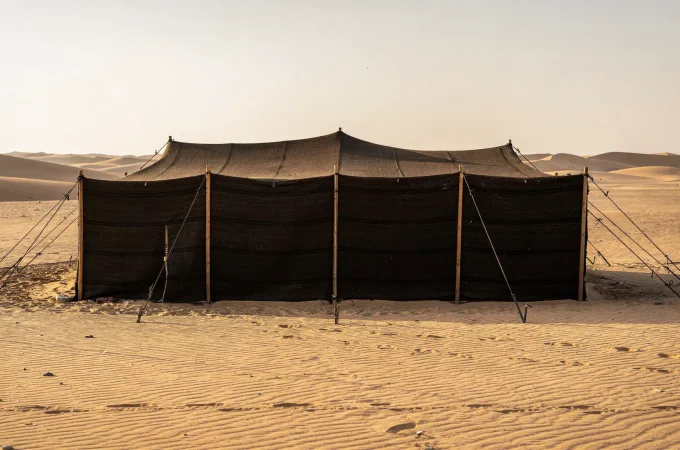
A goat hair tent, called the bayt al sha’r in Arabic, is the traditional Bedouin home. Weavers make it from black goat hair and pitch it by hand. A few camps in the UAE and Oman still offer a night in a real one. Above all, they build it the old way, so it is not a dyed canvas tent styled to look the part.
Table Of Content
- What is a bedouin tent made from
- Bedouin tent interior: the men’s and women’s sections
- How to tell a genuine goat hair tent from a dyed canvas copy
- What to expect from a night in a bedouin tent
- Where to stay in a goat hair tent
- FAQ
- What does bayt al sha’r mean?
- How long does it take to weave one goat hair tent?
- Why is the tent always black or dark brown?
- Does the men’s and women’s split still apply at a camp built for guests?
- Is a goat hair tent comfortable for sleeping, the way a glamping tent is?
What is a bedouin tent made from

Weavers make the bayt al sha’r from black goat hair. In addition, they often mix in camel hair and a little sheep wool, so the finished colour turns dark brown rather than pure black. Bedouin women traditionally spin the hair on a drop spindle. Then they weave it on a ground loom into long strips, around 60 to 90 centimetres wide. After that, they sew the strips edge to edge with hair thread to form one wall or roof panel. In fact, a family-sized tent can take two women several hours a day for eight to ten months.
The weave also works as climate control. Because dry heat shrinks the fibres, small gaps open between the threads, so air moves through the tent. However, damp or cold weather swells those same fibres shut. As a result, the panel that vents heat in August keeps out a cold wind in January. For that reason, this tent has lasted across the Arabian Peninsula.
Bedouin tent interior: the men’s and women’s sections

Inside, a woven curtain called the ma’nad splits the tent in two. The shiqq is the men’s side, where the family receives guests and serves coffee. Meanwhile, the maqad is the women’s side, which holds cooking and family life. Because the curtain belongs to the structure itself, a night in a genuine bayt al sha’r follows that layout instead of one open room.
The frame stays simple. A row of poles runs down the ridge, while guy ropes on both sides hold the roof taut. As a result, the tent looks long, low and dark, which is the shape most people picture. Therefore it looks nothing like the upright, framed Classic Safari Tent.
How to tell a genuine goat hair tent from a dyed canvas copy
Check the weave, not the colour. Weavers build a real bayt al sha’r from narrow strips sewn together, so you can see and feel the spun hair fibre. However, a canvas tent in dark brown shows one smooth sheet of machine-woven fabric with no strip seams. You can also simply ask the camp whether weavers made the tent from goat hair by hand. In short, a genuine Bedouin camp will answer that plainly.
What to expect from a night in a bedouin tent
Furnishing stays simple: floor cushions, low seating and rugs, with no raised bed or private bathroom. Therefore it sits closer to the more basic tent types in the wider Tents class than to a glamping stay. Camps usually offer it as a single night with coffee and a short talk on the weave, because the craft is the draw. For that reason, many guests book it between two more comfortable nights.
Where to stay in a goat hair tent

Both the UAE and Oman keep Bedouin camp traditions alive, as the Bedouin entry on Wikipedia describes in general terms. However, the tent usually appears as a named stop inside a wider desert camp program, not as a resort category of its own. Since availability stays thinner than for a standard safari tent, first confirm with the camp that weavers made the tent in the traditional method.
FAQ
What does bayt al sha’r mean?
It means house of hair in Arabic. Bedouin communities use it for the black goat hair tent, because the name points to the material rather than to a shape or a brand.
How long does it take to weave one goat hair tent?
Traditionally eight to ten months, while two women weave several hours a day to produce enough strips for one family-sized tent.
Why is the tent always black or dark brown?
Weavers use black goat hair. In addition, they often mix in camel hair and a little sheep wool, so the finished colour lightens to dark brown.
Does the men’s and women’s split still apply at a camp built for guests?
A genuinely built bayt al sha’r keeps the shiqq, the maqad and the ma’nad curtain between them. However, how a camp uses the two sides for guests varies by operator.
Is a goat hair tent comfortable for sleeping, the way a glamping tent is?
No, and it is not built to be. You get cushions and rugs instead of a bed or private bathroom. Therefore most camps sell it as one distinctive night rather than a full comfort stay.