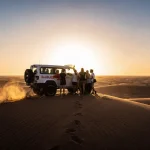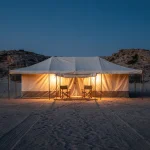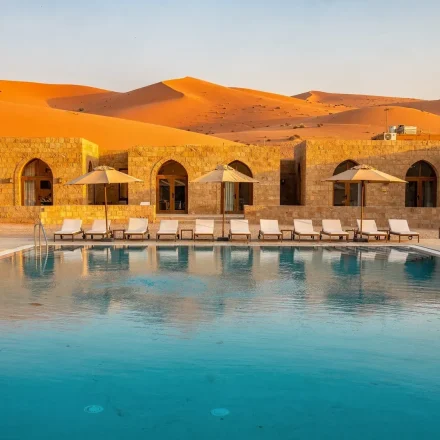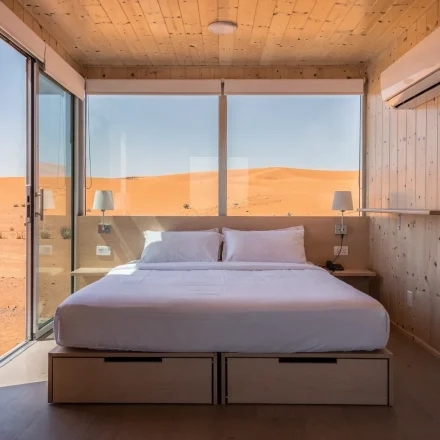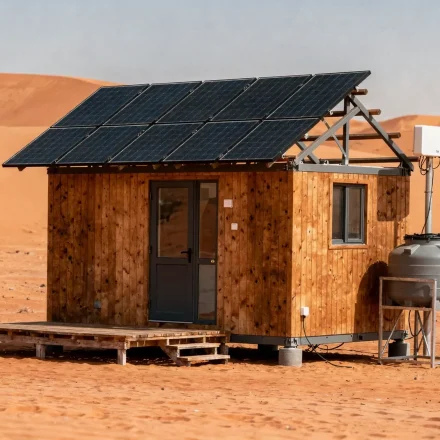

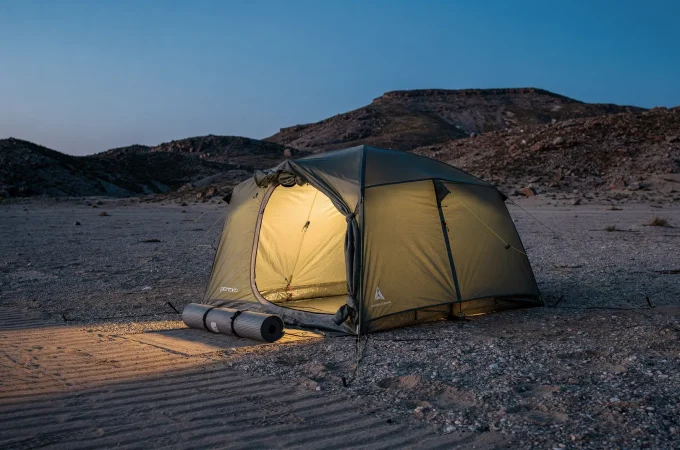
Soft-wall fabric or felt over a frame that does not form a rigid curved shell. That is the entire structural boundary of the Tented Camp System. It separates every tent, yurt and ger in this class from the domes and hard-wall pods beside it.
Table Of Content
- What Defines the Tented Camp System
- The Structural Boundary Against Domes and Pods
- The Eight Desert Tent Types Inside This Class
- Graded by Service Level
- Defined by Building Tradition
- Comfort and Price Range Across This Class
- Fabric, Frame and Desert Performance
- What Separates a Well-Run Camp
- Where Tented Camps Operate
- Who This Class Suits
- FAQ
- What is the real structural difference between a tent and a dome?
- Are desert tents hot at night?
- Can a tented camp have a private bathroom?
- Which unit type is the most widely available in this class?
- Is a yurt classed as a tent?
The eight desert tent types in this class span the widest comfort range in desert hospitality. At one end sits a two-person shelter carried on a trek. At the other, a serviced suite with a private bathroom and climate control. Comfort is not the classifier. Construction method is.
What Defines the Tented Camp System

A unit belongs here when flexible material forms the enclosure, held in tension over a supporting frame, and when that frame creates no self-supporting curved shell. In practice this covers structures that rely on fabric, poles, beams or lattice walls rather than rigid panels or load-bearing domes.
The material range is broad: cotton canvas, polycotton, technical synthetics, wool felt, and goat or camel hair. What matters structurally is simpler than the list suggests. The enclosure works in tension while poles, ridge beams or a lattice frame carry compression.
Once the shell turns rigid, curved and self-supporting through its own geometry, the unit leaves this class.
The Structural Boundary Against Domes and Pods
The line against the Dome / Inflatable System is geometric rather than material. A dome spreads stress across a curved lattice and stands as a complete structure on the ground. That is why a Geodesic Dome Unit holds its shape without guy lines while a ridge tent does not. Fabric-covered domes exist, and they still count as domes, because the shell does the structural work.
The line against the Modular Relocatable Unit is simpler: hard walls. A prefabricated Eco Pod or Capsule arrives as a finished box. A tent arrives as fabric, poles and rope.
That difference sets almost everything a guest notices, from how much outside sound enters the room to how fast the interior heats after sunrise.
The Eight Desert Tent Types Inside This Class

The eight desert tent types split two ways. Five follow a service ladder. Three follow a building tradition instead.
Graded by Service Level
- Expedition Tent
Low profile, fast to pitch, little or no standing height. Lightweight aluminium or composite poles carry a synthetic skin. Built for wind resistance and portability rather than comfort. - Classic Safari Tent
A rectangular canvas envelope over a rigid timber or steel frame. Vertical walls give standing height. The tent anchors to a ground-level platform, with no built-in plumbing. - Luxury Safari or Glamping Tent
A semi-permanent tensile structure with a heavy fabric membrane and a double roof layer for insulation. A raised platform hides the plumbing and wiring for an en-suite bathroom. - Ultra-Luxury Suite Tent
Heavy steel or laminated timber framing under a high-grade architectural membrane. Adds rigid glass panels, separate interior zones, climate control, and decking wide enough for a plunge pool. - Family or Multi-Unit Tent
Several rooms under one outer flysheet, usually built around a central hub with radiating poles. Fabric partitions or short corridors separate sleeping space from living space.
Defined by Building Tradition
- Bedouin Goat-Hair Tent (Bayt al-Sha’r)
Handwoven from goat hair and sheep wool, tensioned across carved wooden poles and heavy guy ropes. The fibers swell when wet and close the weave. Dry, the same weave opens and lets air pass through. - Yurt or Ger
A circular, self-supporting frame made of an expanding wooden trellis wall (khana), roof poles (uni) and a central compression ring (toono). Felted wool layers insulate it. External tension bands hold it together without guy lines or ground anchors. - Other Traditional Portable Dwelling
Documented regional forms using a flexible skin over a portable frame. Examples include the North American tipi, built on a conical pole frame under canvas or hide, and the Tuareg leather tent, built on a simple arched wooden frame under dyed skin panels.
Comfort and Price Range Across This Class
The spread inside this single class is wider than the spread between most other classes in the Hub. That is the one thing worth understanding before booking on the label alone.
An expedition tent and an ultra-luxury suite tent share a parent class and share almost nothing else. Nightly rates routinely differ by a factor of ten for the same desert in the same season.
Commercial context explains why the upper tiers keep expanding. Grand View Research values the global glamping market at USD 3.8 billion in 2025, rising to a projected USD 7.9 billion by 2033. It also reports that demand for tent accommodation is forecast to grow at 10.6 percent annually, faster than the cabins and pods segment that currently holds the largest share. Investment is moving toward serviced tents, not away from them.
Fabric, Frame and Desert Performance

Fabric choice drives most of what a guest experiences overnight. Heavy cotton canvas breathes, which cuts condensation and moderates afternoon heat. It also absorbs water and takes far longer to dry.
Coated synthetics shed sand and rain and dry quickly. However, they trap interior moisture unless someone vents them deliberately. Wool felt on a yurt behaves differently again, holding warmth through the sharp drop after sunset in a way thin canvas cannot.
Frame and tension matter as much as fabric. A slack guy line lets a wall panel drum against its pole all night in wind. That is the most common complaint in this class, and it has nothing to do with price tier.
Sand ingress comes second. A tent with a sewn-in floor and a sealed door track stays clean through a blowing afternoon. A loose ground sheet does not. Both are checkable in photographs before you book.
What Separates a Well-Run Camp
Two details do most of the work, and neither appears on a rate card. The first is platform construction. A tent on a raised timber or steel deck sits level, drains, and keeps the sleeping area clear of ground heat and insects. A tent pitched straight onto sand shifts underfoot and collects whatever the wind carries.
The second is the service corridor. Serviced camps route staff, water delivery and waste removal behind the tent line rather than through it. A camp that skipped that planning puts vehicle noise and generator hum on the guest side for most of the working day.
Where Tented Camps Operate
The class is documented across UAE, Morocco, Namibia and Oman. It is the only class present in strength in all four.
The regional pattern is consistent. The UAE and Oman concentrate the serviced and luxury tiers, helped by short transfers and graded access. Morocco carries the densest cluster of mid-tier camps, mostly around the large ergs, alongside genuine Bedouin-style and Amazigh tent traditions.
Namibia leans toward smaller camps over longer driving distances, where a camp is often the only accommodation for a considerable radius. Season stays the constant: October to April in the northern destinations, May to October in Namibia.
Fabric age is the third checkable factor and the least discussed. Desert sun degrades canvas on a measurable curve, since ultraviolet exposure breaks down both fiber and coating. A tent in its fifth season leaks light, sound and fine sand in ways a tent in its first does not.
Operators who rotate their canvas on a schedule usually say so, because it is a real cost. Where a property stays vague and its photographs look old, assume the fabric is nearer the end of its cycle than the start.
Who This Class Suits

This class suits travelers who want the desert immediately outside the fabric rather than behind glass, and who will pick a tier deliberately instead of assuming one.
Cultural interest is served better here than anywhere else in the Hub, since this is the only class holding structures with a documented building lineage. Protected sites work well too, because a camp can hold a permit where a lodge cannot.
Travelers who want to move between locations during one trip also do well. A mobile fly camp can come down at one site and go up at the next while guests walk or drive between them. So an itinerary can follow a route instead of returning to one base each night.
Two groups do poorly here. Anyone who needs reliable acoustic separation, from neighbors or from wind, is better served by the modular class or by Permanent Built Structures. Anyone whose priority is a panoramic glazed view from bed should compare the Bubble / Transparent Dome Unit, which was designed for exactly that and which a tent cannot reproduce.
FAQ
What is the real structural difference between a tent and a dome?
Flat or gently curved soft walls on a frame that is not self-supporting, against a rigid or inflatable curved shell that carries load through its own geometry. A fabric-covered dome is still a dome.
Are desert tents hot at night?
The opposite surprises people more often. Desert nights drop sharply, and a single-skin tent holds very little heat after sunset. Breathable canvas and felt handle that swing better than thin synthetics. Serviced camps in the upper tiers usually add heating, not just cooling.
Can a tented camp have a private bathroom?
Yes, from the Luxury Safari or Glamping Tent tier upward. Below that, expect a shared washblock or a screened bucket arrangement set apart from the sleeping tent.
Which unit type is the most widely available in this class?
The Classic Safari Tent and the Luxury Safari or Glamping Tent between them hold most bookable inventory across the four destinations. Traditional forms are rarer and more seasonal.
Is a yurt classed as a tent?
Within this Hub, yes. Its lattice wall and roof poles form no self-supporting curved shell, and its enclosure is felt or textile in tension. That places it inside the Tented Camp System rather than the dome class.