

Some of the driest places on Earth are also among the foggiest. That sounds impossible until you look at what is happening offshore. Coastal fog deserts run on a mechanism that delivers water to the air almost every day and almost never lets it fall.
Table Of Content
- The Mechanism
- Why the Inversion Layer Is the Real Reason
- Fog Is Not Rain, and the Difference Matters
- Worked Example: The Atacama
- Turning Fog Into Drinking Water
- Worked Example: The Namib
- How Life Collects Fog
- Other Coastal Fog Deserts Worth Knowing
- What to Expect on the Ground
- Related Topics
- FAQ
- How can a desert be foggy almost every day and still be one of the driest on Earth?
- Why is the Atacama desert so dry?
- Are the Atacama and Namib formed by exactly the same mechanism?
- Does fog harvesting actually work at a useful scale?
- What does camanchaca mean?
- Why doesn’t a cold current cool the whole nearby landmass evenly?
- Could fog harvesting help with water scarcity worldwide?
- What time of day should I go out to see the fog?
The Mechanism

A cold ocean current runs along the coastline. It chills the air sitting directly above it.
Cold air holds less water vapour than warm air. So the air moving inland from that current carries very little moisture in absolute terms, even when it is completely saturated.
Saturated air with little moisture in it produces fog, not rain. Dense fog rolls ashore night after night. Measurable rainfall almost never follows.
That is the paradox in one line. These coasts are soaked in fog and dry by every rain gauge standing on them.
Why the Inversion Layer Is the Real Reason
The cold current explains the fog. It does not fully explain the missing rain.
For rain to form, air has to rise, cool further, and let its droplets grow heavy enough to fall. On these coasts, the air cannot rise.
A layer of warm, sinking air sits on top of the cold marine layer and caps it like a lid. Meteorologists call this a temperature inversion. Air normally gets cooler with height. Here it gets warmer, which shuts down vertical movement completely.
So the fog forms, drifts inland, and burns off by mid-morning. It never gets the upward push it would need to become a rain cloud.
The warm lid usually comes from the same descending air that drives Subtropical High-Pressure Deserts. Two mechanisms working on one strip of coast.
Fog Is Not Rain, and the Difference Matters
Standard rain gauges do not catch fog. A gauge sits open to the sky and collects whatever falls into it. Fog droplets stay suspended and drift straight past.
So a coastal fog desert can record close to zero annual precipitation while delivering real, usable water to anything with a surface to catch it.
That gap matters for classification. The Aridity Index explained in Desert Definition and Classification runs on measured precipitation, so these places score as extremely arid on paper.
It matters ecologically too. On the ground the water is there. It simply arrives horizontally instead of vertically, and only things shaped to intercept it get any.
Worked Example: The Atacama
Chile’s Atacama is widely cited as the driest non-polar desert on Earth. It runs roughly 1,000 km down the northern Chilean coast.
Three mechanisms stack here, which is why it holds that title.
The cold Humboldt Current runs offshore, producing the fog and suppressing rain. The Andes sit to the east, casting the rain shadow that blocks moisture arriving from the other direction. A subtropical high-pressure cell sits over the ocean, supplying the warm lid.
Remove any one of the three and the Atacama would still be dry. With all three, some weather stations have never recorded a single rainfall event.
The local fog carries its own name. Chileans call it the camanchaca, a word usually traced to Aymara and taken to mean darkness. It is made of droplets between roughly 1 and 40 microns across, small enough to hang in the air indefinitely.
Turning Fog Into Drinking Water

The camanchaca is not just scenery. Chilean communities have built infrastructure to harvest it.
The design is simple. A large vertical mesh panel stands on a ridgeline where the fog runs thickest. Wind pushes fog through the mesh. Droplets snag on the fibres, merge, grow heavy, and run down into a gutter and a storage tank.
A 40 m² panel can yield roughly 100 litres on an average fog day, and several times that at peak season. No pumps, no power, no moving parts.
One of the earliest large projects sat near Chungungo, a fishing village in Chile’s Coquimbo region with no reliable freshwater source of its own. Nets on the ridge above the village supplied it for years.
The method only works where fog is dense, frequent and predictable. That is a short list of places. On that list, it works well.
Worked Example: The Namib
Namibia’s Namib sits beside the cold Benguela Current and runs the same way.
It is also among the oldest deserts on Earth. Arid, fog-dependent conditions have held here for tens of millions of years. That is long enough for evolution to build entire lineages around fog rather than rain.
Deserts of Africa covers the wider region.
How Life Collects Fog

Where rain is unreliable, the survivors are whatever learned to drink fog instead.
Namib darkling beetles climb dune crests before dawn, tilt their bodies head-down into the incoming fog, and let droplets condense on their backs and run to their mouths. The posture has a name in the literature: fog-basking.
Welwitschia, the Namib’s strangest plant, grows two leaves and keeps them for its entire life, which can run past a thousand years. Those leaves collect fog directly. Rare and Endemic Desert Plants covers it in detail.
In the Atacama, lichen and microbial communities do the same job at a much smaller scale. Researchers studying the Atacama’s microbiome have found life persisting in soil that receives essentially no rain, sustained by fog and by moisture pulled straight from the air.
How Desert Plants Survive and How Desert Animals Survive Without Water cover the wider set of strategies. Fog collection is the specialised version, and it only exists here.
Other Coastal Fog Deserts Worth Knowing
The Atacama and the Namib are the extreme cases. The mechanism turns up in milder form elsewhere.
Mexico’s Baja California peninsula gets a version of it along parts of its Pacific coast, driven by the cold California Current. Coastal Western Sahara gets comparable fog from the Canary Current.
Neither reaches Atacama-level aridity, because neither has the full three-mechanism stack. The physics underneath is identical though: cold water offshore, a warm lid above, and a coastline placed to catch the fog before it thins out inland.
What to Expect on the Ground
Plan for a different rhythm than any other desert type.
Mornings arrive grey and cool. The fog usually burns off between mid-morning and midday, and the afternoon turns clear and bright. Then it returns overnight.
Pack layers rather than heat gear. These are the coolest warm-climate deserts on the planet, and the coastal strip can stay under 20 °C all day.
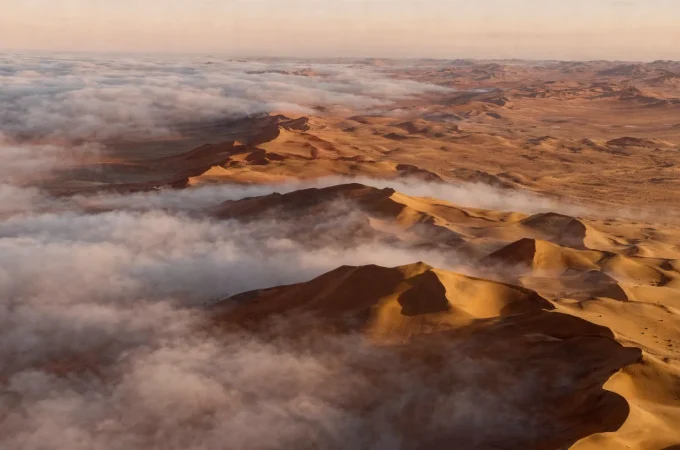
For photography, the burn-off window is the whole point. Fog moving across dunes at sunrise is the defining image of this desert type, and it runs on a schedule.
Check the season against Desert Climate and Weather before booking. Fog frequency shifts through the year, and a clear week here means you missed what you came for.
Related Topics
How Deserts Form · Continental Interior Deserts · Polar Deserts · Desert Definition and Classification · World Deserts Atlas
FAQ
How can a desert be foggy almost every day and still be one of the driest on Earth?
Fog and rain are different things. Cold air can saturate into fog without ever releasing that moisture as measurable rainfall. A rain gauge catches nothing, so the record shows extreme aridity.
Why is the Atacama desert so dry?
Three mechanisms stack there. The cold Humboldt Current suppresses rain, the Andes block moisture from the east, and a subtropical high-pressure cell caps the coast with warm sinking air. Any one alone would produce a desert. All three together produce the driest non-polar desert on Earth.
Are the Atacama and Namib formed by exactly the same mechanism?
The cold-current core is the same. The Atacama adds a rain shadow from the Andes and a stronger subtropical influence, which the Namib does not share to the same degree.
Does fog harvesting actually work at a useful scale?
Yes, within limits. Individual net arrays have supplied whole villages with drinking water. The method needs dense, frequent fog and suits small settlements rather than cities.
What does camanchaca mean?
The word is usually traced to Aymara, an Indigenous language of the Andean region, and taken to mean darkness. It describes how the fog blankets the coastal landscape.
Why doesn’t a cold current cool the whole nearby landmass evenly?
The effect is strongest right at the coast, where the temperature gap between cold water and warmer land drives fog formation. Further inland the gap closes and elevation and distance take over.
Could fog harvesting help with water scarcity worldwide?
Only in specific places. It needs the right combination of cold current, coastal terrain and reliable fog. That is a genuine tool for a handful of regions, not a universal fix.
What time of day should I go out to see the fog?
Before sunrise. Fog is thickest overnight and usually burns off between mid-morning and midday, so the window closes early.