

Desert animal adaptations fall into three groups: behaviour, body function and body structure. Most animals avoid the worst heat by sheltering in burrows or working only at night. Others save water inside the body, with very concentrated urine or fat that releases water when burned. A few carry physical tools, such as large ears that shed heat.
Table Of Content
- Desert Animal Adaptations: Three Ways to Survive
- Behavioural Desert Animal Adaptations: Burrows and Night Shifts
- How Desert Animals Save Water Inside the Body
- Structural Desert Animal Adaptations: Ears, Nostrils and Eyelashes
- How Different Animal Groups Cope
- Nocturnal Desert Animals and the Heat Problem
- FAQ
- Do all desert animals avoid daytime activity?
- Can desert animals survive without drinking?
Desert Animal Adaptations: Three Ways to Survive
A desert gives an animal two problems at once. It is hot, and water is scarce. Every one of these desert animal adaptations solves one or both. Mammals, reptiles, birds and insects use different tools, but they pull on the same three levers.
Behaviour is the cheapest lever, because it asks nothing of the body. Physiology changes how the body spends water. Structure changes the body’s shape. Most species combine all three, and the pages on desert plant adaptations show plants making the same trade.
Behavioural Desert Animal Adaptations: Burrows and Night Shifts

Hiding from the sun is the most common desert strategy. Wikipedia’s overview of desert ecology notes that most small desert mammals are nocturnal. They spend the day in underground burrows that keep a steadier temperature.
The desert kangaroo rat is a clear case. It sleeps by day in a den that is sealed off at extreme temperatures, and it forages for seeds after dark. The Open University adds that a burrow cuts water lost through breathing, as long as it is cooler than the body.
Birds cannot burrow, so they move. The same overview notes that mobile birds avoid dehydration by flying between water sources. It also records the male sandgrouse, whose belly feathers carry water to its chicks.
How Desert Animals Save Water Inside the Body
Body function is where the most surprising adaptations sit. Many are invisible, which is why myths survive about them.
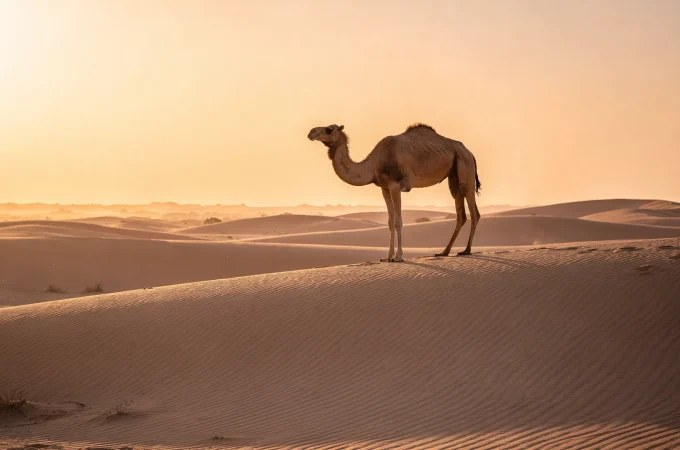
The camel hump is the famous example. EarthSky explains that the hump holds fat, not water, and that it shrinks when the camel goes hungry. The camel saves water in other ways. The dromedary lets its body temperature swing from 31 to 41.7 °C through the day, which reduces sweating. It can also tolerate a water loss of more than 30% of body weight, which is generally impossible for other mammals. When it finds water, it can drink up to 114 litres in one sitting.
The kangaroo rat takes the opposite route. The Open University describes it as dependent on metabolic water, because the seeds it eats contain little or no water. Its urine is extremely concentrated, averaging about 5,500 mOsmol per litre. Its narrow nasal passages work as a heat exchanger. At 30 °C and 25% humidity they recover around 54% of the water vapour it breathes out. Humans recover only about 16%.
Some of these tricks do not need the animal to drink at all. The fennec fox hydrates through its food, according to the Smithsonian’s National Zoo. The Namib darkling beetle even gets water from the air, as the beetle example below shows.
Structural Desert Animal Adaptations: Ears, Nostrils and Eyelashes

Shape can be a cooling system. The fennec fox is the standard example. Its ears reach 10 to 15 centimetres in length. The Smithsonian’s National Zoo says they dissipate heat and let the fox listen for prey under the sand. The fox also spends the day in a burrow with tunnels that can reach 10 metres.
Camels carry other tools. The dromedary can close its nostrils voluntarily, which helps water conservation, and its bushy eyebrows and double row of eyelashes keep out sand and glare.

Reptiles use their bodies differently, because they take their heat from outside. The desert iguana stays active after other lizards have retreated. It seeks shade in the low forties Celsius and goes into a burrow when its body temperature reaches the mid forties. Moving between sun, shade and burrow is how it sets its own temperature.
How Different Animal Groups Cope
Among desert animal adaptations, mammals lean on burrows, night activity and kidney efficiency. The Arabian oryx is a good example in the Gulf, and the Arabian oryx in the UAE is covered in its own guide. Large grazing mammals like the oryx and the camel can also tolerate a warm body, so they sweat less.
Reptiles depend on behaviour more than on physiology. They bask, shelter and move with the sun, as the iguana shows. Birds rely on flight between water points. Insects and arachnids are small enough to use microhabitats, such as shade under a stone.
The Namib is the extreme case. In fog-basking tests, only one of four darkling beetle species tried, Onymacris unguicularis, took a head standing posture facing into the wind. Fog droplets collected on its back and ran down to its mouth. The authors concluded that this behaviour mattered more than the structure of the wing cases. You can read how coastal fog creates such deserts in the guide to coastal fog deserts.

Nocturnal Desert Animals and the Heat Problem
Nocturnal desert animals do not choose the night for comfort alone. Night air is cooler, so an animal loses less water to keep its body in range. That one choice covers a large share of the problem.
It also changes how you meet them. Most of these animals are out at dusk, at dawn and after dark, not at midday, so those are the hours to look. A camel ride is a slow way to see how the one animal everyone knows copes with the heat.
For the wider picture, start with what a desert is, then see why so many desert myths are wrong. The plant side of the story is in the guide to xerophyte adaptations.
FAQ
Do all desert animals avoid daytime activity?
No. Many small mammals are nocturnal, but the desert iguana stays active in heat that sends other lizards into shelter. Timing differs by species.
Can desert animals survive without drinking?
Some can. The kangaroo rat relies on metabolic water from its seed diet, and the fennec fox hydrates through its food. Camels do drink, and heavily, when water is available.