



Europe has exactly one true desert. It’s famous mostly for having doubled as the American Wild West in dozens of films.
Table Of Content
- Tabernas: Europe’s Only True Desert
- Why Only One European Desert Exists
- A Related but Distinct Case: The Canary Islands
- Why This Single Fact Carries Outsized Curiosity Value
- How Tabernas Fits Into This Hub’s Broader Argument
- What a Visit to Tabernas Actually Looks Like
- Related Topics
- FAQ
- Is Tabernas really the only place in Europe that qualifies as a true desert?
- Are the Canary Islands’ arid landscapes technically the same as Tabernas’s desert classification?
- How large is Tabernas compared to some of the other named deserts in this atlas?
- Why has Tabernas been used in so many films?
- Can Tabernas realistically be visited as a day trip, unlike most other deserts in this atlas?
Tabernas: Europe’s Only True Desert
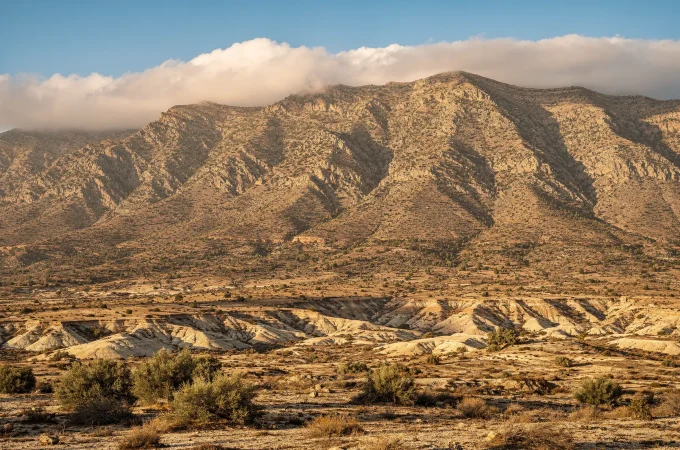
Spain’s Tabernas Desert, in Almería province, is Europe’s only true desert by the standard Köppen precipitation threshold. It covers roughly 280 square kilometers. Wind and water erosion carved its badlands terrain, covered in Badlands & Erosion Landscapes, out of ancient marine sediment. That sediment dates back roughly 8 million years, to when the Mediterranean submerged the area. Its dry, dramatic landscape made it a widely used filming location, too: more than 300 productions have shot there since the 1950s.
Why Only One European Desert Exists
Europe’s Atlantic exposure and prevailing westerly winds give the continent a generally temperate, moisture-receiving climate. As a result, most of the continent falls well outside the precipitation thresholds covered in What Is a Desert? Tabernas is a genuine exception, though. Surrounding mountain ranges shelter it from much of the moisture that reaches the rest of southern Spain. That creates a localized rain-shadow effect, similar in principle, though far smaller in scale, to the mechanism explained in Rain Shadow Deserts.
A Related but Distinct Case: The Canary Islands

Spain’s Canary Islands, particularly Lanzarote and Gran Canaria, feature striking volcanic arid landscapes: black lava fields, crater lakes, and coastal sand dunes. These support desert-adjacent tourism and ecosystems. Their classification and formation differ from Tabernas’s mainland badlands, however. Volcanic terrain and a drier subtropical position shape the Canaries, rather than sediment erosion.
Why This Single Fact Carries Outsized Curiosity Value
Of every entry in this atlas, Tabernas is arguably the one most likely to surprise a reader. Most people, including many Europeans, simply don’t expect the continent to host a true desert at all. That’s part of why this fact travels so well as standalone trivia, even outside any specific trip-planning context. This Hub, in fact, shares it more often than almost any other single fact.
How Tabernas Fits Into This Hub’s Broader Argument
This single small desert does a disproportionate amount of work for this Hub’s core message: desert classification comes down to measurable precipitation, not visual expectation or cultural assumption. A genuinely temperate, moisture-rich continent like Europe can still contain one qualifying desert. If that’s true, the same rigorous, precipitation-based standard applies everywhere else in this atlas, too, from the Sahara’s vast scale down to a single sheltered valley in southern Spain.
What a Visit to Tabernas Actually Looks Like

Entries like the Sahara or the Gobi demand a vast, multi-day journey. Tabernas doesn’t. It’s compact enough to explore as a single day trip from nearby coastal towns in Almería province, a genuinely different kind of desert visit than most other entries in this atlas require. Its film-set history adds another layer, too. Visitors can often combine the natural badlands scenery with preserved Western-movie set pieces that still stand in parts of the desert, a pairing of natural and cultural interest that most other entries in this atlas simply don’t offer.
Related Topics
Badlands & Erosion Landscapes · Desert Definition & Classification · World Deserts Atlas · How Deserts Form
FAQ
Is Tabernas really the only place in Europe that qualifies as a true desert?
Yes. Multiple independent sources confirm this, based on its precipitation totals meeting the standard aridity threshold. Nowhere else on the continent meets that same bar.
Are the Canary Islands’ arid landscapes technically the same as Tabernas’s desert classification?
They’re related in aridity but distinct in origin. Volcanic geology shapes the Canary Islands’ landscape significantly, while Tabernas is a sediment-erosion badlands desert on the Spanish mainland.
How large is Tabernas compared to some of the other named deserts in this atlas?
Considerably smaller. At roughly 280 square kilometers, it’s a fraction of the size of major entries like the Sahara or the Rub’ al Khali. Its status as Europe’s only true desert still gives it outsized reference value, regardless of scale.
Why has Tabernas been used in so many films?
Its dry, canyon-carved terrain closely resembles the American Southwest visually, while sitting far more accessibly for European film productions. That combination made it the default filming location for countless Westerns since the 1950s.
Can Tabernas realistically be visited as a day trip, unlike most other deserts in this atlas?
Yes. Its compact size and proximity to Almería’s coastal towns make it accessible as a single-day excursion, a genuinely different visiting experience than the expedition-scale trips most other entries in this atlas require.

Brilliantly written and impressively precise. The explanation of Tabernas as a rain-shadow desert, along with the distinction from the volcanic aridity of the Canary Islands, is especially clear. As someone from Portugal, I would only make one small linguistic-geographic caveat: calling Tabernas “Europe’s only true desert” works perfectly if Europe means the continental mainland, but the Canary Islands are politically European too, even if their landscapes follow a different climatic and geological story. Still, this is an excellent and genuinely surprising piece.