



The two largest deserts on Earth have never had a grain of sand blow across them. Is Antarctica a desert? Yes, and so is the Arctic, its close second. This page is where that fact finally gets its full geographic context.
Table Of Content
- Antarctica: The World’s Largest Desert
- The Arctic: The World’s Second-Largest Desert
- Why This Fact Belongs at the Center of This Atlas
- A Genuinely Open Question
- Why Only Part of Antarctica Technically Qualifies
- How This Page Closes the Loop on This Entire Atlas
- Why Neither Polar Region Sees Meaningful Tourism Framed as “Desert Travel”
- Related Topics
- FAQ
- Is it accurate to call Antarctica a desert, or is that just a technicality?
- Does the Arctic Desert refer to the same area as the Arctic Ocean’s sea ice?
- Is all of Antarctica equally classified as desert?
- How long can parts of Antarctica’s interior go without meaningful precipitation?
- Is polar desert travel marketed the same way as trips to the Sahara or Atacama?

Antarctica: The World’s Largest Desert
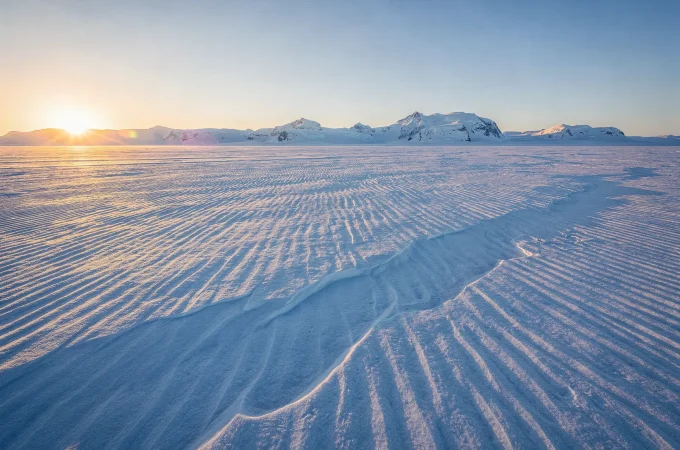
At roughly 14,000,000 square kilometers, the Antarctic Desert is the largest desert on Earth. That’s a wide margin over the Sahara’s 8,600,000 square kilometers. Polar Deserts explains the precipitation-based mechanism that confirms this classification. Britannica’s own explainer directly addresses this classification, too. It confirms the standard threshold: regions receiving less than 250 mm of annual precipitation qualify as desert. The interior polar plateau receives roughly 50 mm, liquid-water equivalent, per year, falling almost entirely as snow. Wetter coastal areas can receive several hundred millimeters and don’t meet the same threshold. Some interior locations have gone without significant precipitation for close to 2 million years.
The Arctic: The World’s Second-Largest Desert

The Arctic Desert, at roughly 13,900,000 square kilometers, follows the identical mechanism. It comes in just behind Antarctica. Together, the two polar regions form the largest desert terrain on the planet, by a considerable margin over every named hot or cold desert covered elsewhere in this atlas.
Why This Fact Belongs at the Center of This Atlas
Every other desert in this atlas carries popular recognition already: the Sahara, the Rub’ al Khali, the Atacama, the Gobi. Antarctica and the Arctic, though, register as almost anything else first in most people’s minds: ice, snow, polar wilderness. Placing them here, at their true scale relative to the more “expected” entries, makes a clear point. Desert classification really comes down to water balance, not appearance.

A Genuinely Open Question
Sources don’t fully agree on whether “polar desert” counts as a subtype of “cold desert” or as its own distinct category. This Hub keeps them separate. Two things set Antarctica apart, even from a snow-covered cold desert like the Gobi. Its sheer scale is one. The near-total absence of vegetation is the other.
Why Only Part of Antarctica Technically Qualifies
Not all of Antarctica meets the desert threshold uniformly. Its wetter coastal belt can receive several hundred millimeters of precipitation annually, considerably more than the dry interior plateau. As a result, the “desert” classification applies most strictly to the continent’s vast, extremely dry interior. It doesn’t apply evenly across every square kilometer of its coastline.
How This Page Closes the Loop on This Entire Atlas
Every other entry in this atlas builds toward the same underlying idea that How Deserts Form introduces. Desert status is a matter of water balance, not heat, sand, or visual appearance. Antarctica and the Arctic are the ultimate proof of that idea. Almost nobody would casually describe either region as “desert.” Yet both meet the exact same scientific definition as the Sahara.
Why Neither Polar Region Sees Meaningful Tourism Framed as “Desert Travel”
Unlike every other entry in this atlas, visitors don’t experience or market Antarctica and the Arctic as desert destinations at all. Polar tourism centers on wildlife, ice, and extreme-environment travel instead. As a result, this classification remains almost entirely a matter of scientific interest, rather than trip-planning relevance, for the foreseeable future. That said, the underlying science genuinely matters to anyone curious about climate. Researchers use the exact same precipitation-based measurement that classifies Antarctica as a desert. They also use it to track how its ice sheet’s mass balance may shift over time.
Related Topics
Polar Deserts · Desert Myths & Misconceptions, Debunked · How Deserts Form · World Deserts Atlas · Desert Definition & Classification
FAQ
Is it accurate to call Antarctica a desert, or is that just a technicality?
It’s a genuine, widely used scientific classification, not a loophole. Antarctica meets the same precipitation-and-evapotranspiration criteria used to classify every other desert in this atlas.
Does the Arctic Desert refer to the same area as the Arctic Ocean’s sea ice?
No. The classification refers to the broader polar region’s precipitation-based aridity. That’s distinct from sea ice extent, which fluctuates seasonally for different physical reasons.
Is all of Antarctica equally classified as desert?
Not uniformly. Its dry interior plateau is the most extreme example, while its wetter coastal belt receives considerably more precipitation and fits the desert threshold less strictly.
How long can parts of Antarctica’s interior go without meaningful precipitation?
Some documented locations are estimated to have gone without significant precipitation for close to 2 million years. That’s among the most extreme dry records of any location covered in this atlas.
Is polar desert travel marketed the same way as trips to the Sahara or Atacama?
No. Polar trips center on wildlife, ice, and extreme-environment experiences, rather than “desert travel” framing. The desert classification here remains a matter of scientific interest, not something that shapes how these destinations actually get marketed.

Waouh, je suis bluffé·e !
Je n’avais jamais réalisé que les déserts froids existaient aussi. L’Antarctique comme plus grand désert du monde, c’est vraiment contre-intuitif.