



Do not trust your rental car’s navigation past the edge of Liwa town. The paved surface ends quickly there, and some systems keep routing straight onto the sand. That single mistake accounts for most first-time self-drivers who end up stuck. So here is how to get to the UAE desert properly, with real drive times, the points where a guide becomes the better call, and six places worth building a route around.
Table Of Content
- Start With the Airport, Not the Map
- The Drive Times, Corrected
- Fly Into Abu Dhabi If Liwa Is the Plan
- Where the Pavement Ends
- Self-Drive or Guided
- Fuel and Water: Fill Up in Town
- Tyre Pressure Is the Detail Rentals Skip
- Season, Heat and Sandstorms
- Six Desert Spots Worth Routing Around
- Al Wathba Fossil Dunes, Abu Dhabi
- Al Wathba Salt Lake, Abu Dhabi
- Tal Moreeb, Liwa
- Jebel Jais, Ras Al Khaimah
- Jebel Hafeet Mountain Road, Al Ain
- Love Lake, Al Qudra, Dubai
- Filming and Drone Rules
- Three Itineraries That Actually Work
- Explore More
- FAQ
- How far is the desert from Dubai and Abu Dhabi?
- Do I need a 4×4?
- Can I self-drive into the dunes?
- Which airport should I fly into?
- Can I visit the desert in one day?
- Do I need to register a drone?
Start With the Airport, Not the Map
Two airports serve every destination in this guide: Dubai International and Abu Dhabi International. Both connect to the desert by fully paved highway.
Al Ain sits closest to either city, with gravel-plain desert and mountains rather than dunes. Liwa lies deeper southwest on the edge of the Rub’ al Khali, and it takes considerably longer to reach.
Which airport you choose therefore shapes the trip more than most people expect.
The Drive Times, Corrected
Plenty of guides understate these, so use the real numbers.
Abu Dhabi to Liwa runs roughly 220 to 230 kilometres and takes about two hours, on the E11 then the E65 past Madinat Zayed. Dubai to Liwa covers roughly 350 kilometres and takes closer to four hours, since that route passes Abu Dhabi on the way.
Al Ain is much quicker from either city, at around ninety minutes to two hours. All three routes stay paved the entire way.
Fly Into Abu Dhabi If Liwa Is the Plan
This is the most useful booking decision here, and no flight-comparison site will surface it.
Choosing Abu Dhabi over Dubai saves roughly two hours of driving each way to Liwa. Across a return trip that approaches four hours, which is most of a day.
So compare airports on total journey time rather than fare alone. A cheaper Dubai ticket often costs more once fuel, extra hire hours and a lost afternoon get counted.
Where the Pavement Ends

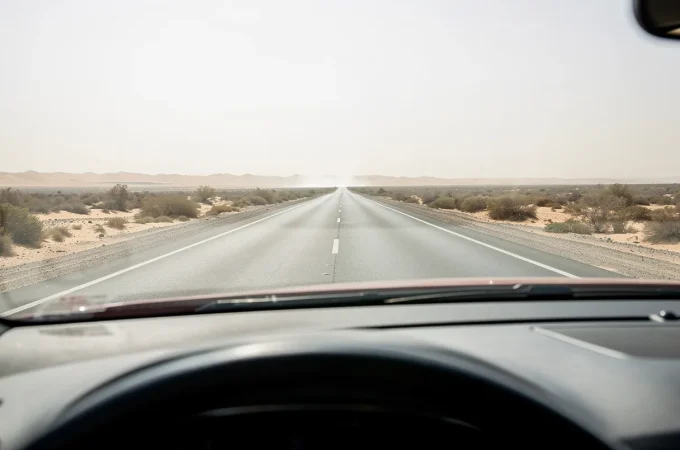
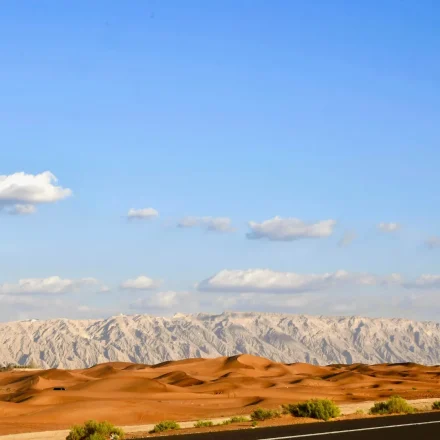
Highways here run as excellent asphalt right up to the desert edge. Then they simply stop.
The transition outside Liwa is abrupt, and the ground beyond it is soft. Meanwhile navigation systems often treat that sand as continuous road, because the tracks crossing it appear as routes in the map data.
Watch the surface rather than the screen. Once asphalt ends, a standard hire car has reached its limit.
Self-Drive or Guided
One question settles this. Does the trip finish at Liwa or Al Ain, or does it continue into open dunes?
For the first case, self-drive works perfectly. The route is paved, well maintained and easy, and a standard two-wheel-drive car handles it.
For the second, you need a proper four-wheel drive, recovery gear and someone who can read a dune face. Guided operators supply all three. Try dune bashing with a driver before ever attempting sand alone.
Fuel and Water: Fill Up in Town

Top up completely in Liwa or Al Ain before going further, because stations thin out sharply past the towns.
Carry more water than the trip appears to need. A breakdown in the shade of a stopped car turns uncomfortable fast, and mobile coverage weakens away from the main roads.
Both towns have hospitals and police stations, and guided operators carry satellite communication as standard.
Tyre Pressure Is the Detail Rentals Skip

Highway pressure works on asphalt and fails on sand.
Lowering it spreads the tyre’s footprint, so the vehicle floats rather than digs. Deflate to whatever your operator specifies before entering sand, then reinflate before returning to pavement. Driving at sand pressure on a highway damages tyres and handling alike.
Summer complicates matters further, since heat raises pressure while loose hot sand offers less grip. Both effects push the same way, which is one reason casual dune driving between June and September is a poor idea.
Season, Heat and Sandstorms
Conditions stay comfortable from October to April, and that is the window to plan around.
Summer brings serious heat affecting vehicles and people alike. Meanwhile shamal winds occasionally cut highway visibility, most often in spring, so check advisories before setting off.
Leave early regardless. Driving is cooler, traffic lighter and the light far better for photographs.
Six Desert Spots Worth Routing Around
These are the locations that actually earn the detour, and every one of them sits outside the cities. Each entry includes the shot that performs best, since a good location and a good clip are not the same thing.
Al Wathba Fossil Dunes, Abu Dhabi

Roughly 45 kilometres east of Abu Dhabi sits a reserve holding more than 1,700 wind-sculpted formations across about seven square kilometres. Calcium-carbonate sand hardened, then centuries of wind undercut the stems and left broad caps on top.
The result looks engineered rather than natural, which is why the site has appeared in film work including Star Wars. Go in the last half hour before sunset, when horizontal light shoots straight under the caps.
The shot that works: a slow orbit around one formation with the sun flaring through a gap in the rock, letting the shadow sweep across the sand as you circle.
Al Wathba Salt Lake, Abu Dhabi

Nearby, shallow brine pools sit in a bright white salt crust, and the colour contrast is genuinely extreme. Aquamarine water against a cracked white plain is not what anyone expects from a desert, which is precisely why the location spread.
Pair it with the fossil dunes on the same morning, since the two sit close together. Mid-morning light saturates the water colour hardest.
The shot that works: a low tracking move skimming just above the water line, turquoise filling the bottom half of the frame and white crust the top.
Tal Moreeb, Liwa

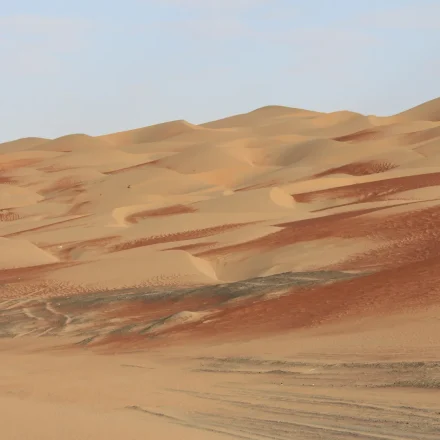
Moreeb rises more than 300 metres and carries one of the steepest faces anywhere, which is why hill-climb motorsport events use it. Locals call it the Hill of Horror.
Still photographs struggle to convey the gradient, so most people underestimate it until they stand at the base. It sits a short drive from Liwa on the edge of the Rub’ al Khali.
The shot that works: one unbroken clip climbing the face with the phone held low, the horizon dropping away behind you, and the turn at the crest as the payoff.
Jebel Jais, Ras Al Khaimah

At 1,934 metres, Jebel Jais is the highest point in the country, and a modern road climbs most of it. A public viewing deck sits at around 1,252 metres.
Temperatures up here run noticeably cooler than the coast, which makes it a genuine escape in the shoulder season. The landscape is bare grey limestone rather than sand, so it corrects the assumption that the UAE is flat.
The shot that works: a hyperlapse from a pull-off with the camera locked on a single switchback while cloud shadow moves across the range behind.
Jebel Hafeet Mountain Road, Al Ain

Outside Al Ain, a single road climbs 11.2 kilometres up an isolated limestone mountain through roughly 60 turns. Driving publications list it among the best roads in the world, and the surface quality supports that.
Hafeet is the highest peak in Abu Dhabi emirate and the second highest in the country. Because it stands alone on a flat plain, the climb reads dramatically from a distance.
The shot that works: a long exposure at blue hour from a lower pull-off, letting headlights trace the bends into continuous ribbons of light.
Love Lake, Al Qudra, Dubai

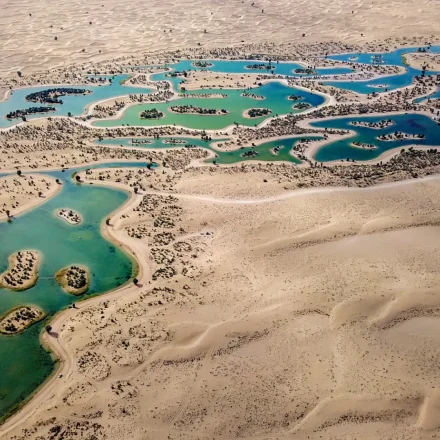
About 35 kilometres from central Dubai, two man-made lakes form interlocking hearts within the Al Qudra desert. From ground level the shape is invisible, so this location built its entire reputation on aerial footage.
Drone flying is permitted, though it needs registration and approval and comes with altitude limits. Sort that before driving out rather than after.
The shot that works: a slow vertical rise revealing the shape gradually, with the reveal moment carrying the whole clip.
Filming and Drone Rules
The shift from city to open desert along these highways remains one of the most filmed transitions in UAE travel content. Shoot it from a designated pull-off with the vehicle stopped, in the first or last two hours of daylight.
Drones need registration with the UAE General Civil Aviation Authority. Registration becomes mandatory once a drone reaches 250 grams, and it involves a knowledge test with an 80 percent pass mark.
Fees and validity periods change, and secondary sources contradict each other on current figures. Check the GCAA page directly rather than trusting a blog. Fly within visual line of sight, and never fly near camps or wildlife areas without permission.
Three Itineraries That Actually Work
A single day suits Al Ain from either city, with time for both Jebel Hafeet and the oryx programme.
A weekend suits Liwa. Drive down Friday morning, stay one night at a camp, return Saturday. From Dubai, though, budget the full four hours each way rather than treating it as a short hop.
Three days allows a proper circuit: Liwa with an evening dune excursion on day one, Tal Moreeb and a guided Empty Quarter run on day two, then a return through Al Ain on day three. That last leg turns a transit day into a second destination.
Explore More
UAE Country Hub · Rub’ al Khali · Liwa Oasis · UAE Desert Travel Guide
FAQ
How far is the desert from Dubai and Abu Dhabi?
Liwa sits about two hours from Abu Dhabi and about four hours from Dubai, since the Dubai route passes Abu Dhabi. Al Ain is roughly ninety minutes to two hours from either city.
Do I need a 4×4?
Only past the paved roads. Liwa town, Al Ain and every location listed above are reachable in a standard car, whereas open dunes require a proper four-wheel drive with recovery equipment.
Can I self-drive into the dunes?
Not on a first visit. Sand driving needs experience, correct tyre pressure and recovery gear, so book a guided excursion before attempting anything independently.
Which airport should I fly into?
Abu Dhabi, if Liwa is the destination. It saves roughly two hours of driving each way compared with Dubai, which usually outweighs any fare difference.
Can I visit the desert in one day?
Al Ain works comfortably as a day trip from either city. Liwa is possible in a day from Abu Dhabi but rushed, and it genuinely needs an overnight from Dubai.
Do I need to register a drone?
Yes, for anything weighing 250 grams or more. Registration runs through the GCAA and includes a knowledge test, so check their official page for current fees and validity.


This is one of the most thoughtful and genuinely useful desert-travel guides I’ve come across. What impressed me most is how far beyond the usual generic advice it goes from choosing Abu Dhabi over Dubai for a Liwa trip to explaining exactly where the pavement ends, when a guide is essential The detailed photo suggestions for each location make the article feel especially unique and experience-driven. A superbly written guide for anyone looking to explore the UAE desert with more confidence and curiosity.