

How do desert animals survive without water? They make it, save it and collect it. Their bodies produce water from food, their kidneys and gut return almost all of it, and their habits keep them out of the heat. A few species also drink fog or dew straight from their own bodies.
Table Of Content
- How Do Desert Animals Survive Without Water? Four Core Methods
- Metabolic Water: Making It From Food
- Dry Waste: Concentrated Urine and Dry Feces
- How Do Desert Animals Survive Without Water During the Day?
- How Do Desert Animals Survive Without Water in Coastal Fog Deserts?
- Which Animals Need No Drinking Water at All?
- FAQ
- Which desert animal is most famous for surviving without drinking water?
- Is fog harvesting a common desert animal adaptation?
How Do Desert Animals Survive Without Water? Four Core Methods
No single trick does the job. Every species combines several. The four that matter most are metabolic water, dry waste, night and burrow behaviour, and fog or dew harvesting.
Free standing water is rare in a desert, and it is often too far away to reach. An animal that cannot go without it must follow rain. To survive without water, the animals below solved the problem by needing less.
Metabolic Water: Making It From Food
Breaking down food for energy releases water as a byproduct. Wikipedia’s entry on metabolic water gives the yield per 100 grams. Fat produces 107 to 110 grams of water. Carbohydrate gives about 60 grams, and protein 41 to 42 grams. Fat is the richest source, which is one reason fat stores matter in a desert.
Dry food can still deliver water. The Arizona-Sonora Desert Museum says one gram of grass seed gives half a gram of oxidation water. It adds that seeds stored in a burrow can absorb moisture and gain up to 30% of their weight in water. So a kangaroo rat is independent of any free water, and even of moist food.
Birds have an extra edge. The same metabolic water entry says birds excrete uric acid, so they gain water from protein metabolism. Mammals gain almost none.
Dry Waste: Concentrated Urine and Dry Feces
Water leaves an animal in urine and droppings, so desert species squeeze both. The Desert Museum says a kangaroo rat’s urine is twice as salty as seawater. Its feces are five times drier than a lab rat’s.
The addax shows the same logic in a large antelope. Wikipedia’s addax entry says it can survive almost indefinitely without free water, because it gets moisture from its food and from dew on plants. It also produces highly concentrated urine, and the entry mentions a stomach lining that stores water in pouches.
How Do Desert Animals Survive Without Water During the Day?

The cheapest saving is to avoid the heat. A resting animal that stays cool does not pant or sweat. That is why so many desert animals are active at night or at dawn and dusk, and rest by day.
Burrows make this work. The Open University’s burrowers module reports burrows in the Negev holding a steady 26 °C at one metre deep. The air above ranged from 16 to 44 °C. In a Mojave burrow, the same source says, the air is cooler and more humid than above ground. The humidity comes from the animal’s own breath.
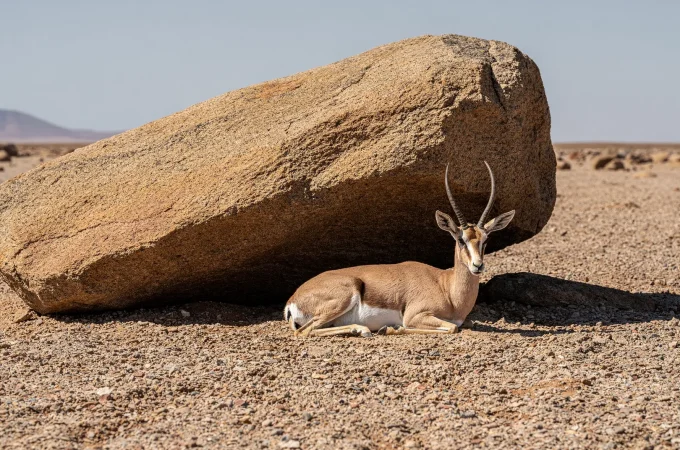
Large animals cannot dig, so they shade up. The addax entry notes that it huddles in shade by day and rests in sand hollows on cool nights. An antelope resting under a rock overhang follows the same rule.
How Do Desert Animals Survive Without Water in Coastal Fog Deserts?

Some coastal deserts get almost no rain but regular fog. Animals there can drink the air. The Namib dunes in southern Africa are the best known example. The guide to coastal fog deserts explains how such places form.
The Namib fog basking beetle, Onymacris unguicularis, climbs a dune and angles its body into the wind. Wikipedia’s entry on the beetle describes a headstand at about 23 degrees to the horizontal. Fog collects on its back and runs to its mouth. Some beetles have been recorded taking in 34% of their body weight in a single session.

The thorny devil of central Australia works differently. Wikipedia’s thorny devil entry explains that dew is channelled to its mouth by gravity and capillary action between its spines. Channels beneath its scales also move water across the skin. The entry adds that absorption through damp sand is its main source of water.
Fog harvesting is a specialist skill, not a general rule. Most desert animals rely on food water, dry waste and good timing.
Which Animals Need No Drinking Water at All?
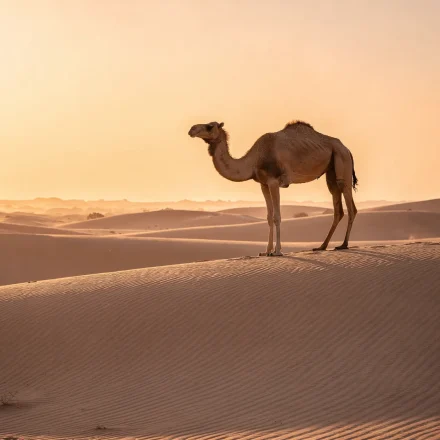
How do desert animals survive without water when they still must drink? Camels are the famous example, and they do drink. They rely on extreme efficiency and tolerance of dehydration. The kangaroo rat and the addax are closer to a true “no free water” life. For the full picture of body, behaviour and structure, see the guide to desert myths and the plant side in desert plant adaptations.
To meet a desert antelope in the wild, read the guide to the Arabian oryx in the UAE. Go at dawn or dusk, when animals are moving.
FAQ
Which desert animal is most famous for surviving without drinking water?
The camel is the best known, but it drinks heavily when it can. Its skill is using water very efficiently and tolerating dehydration. The kangaroo rat, which can live without free water, is a better example of true independence.
Is fog harvesting a common desert animal adaptation?
No. It is a specialist skill in a few coastal fog deserts, such as the Namib. Most desert animals rely on metabolic water, concentrated urine and dry feces, and careful timing.