
Modular unit features decide how a desert stay feels more than the shell itself. A modular unit is a factory-built room that a truck delivers to the site and sets on footings. Inside, the bed, bathroom, kitchen corner and storage are fitted before it leaves the factory. This guide explains each feature and what to check.
Table Of Content
- What Are Modular Unit Features?
- Beds and Sleeping Space
- Bathrooms: Pods, Showers and Toilets
- Do Modular Units Have Kitchens?
- Storage: Where Your Bags Go
- Cooling, Heating and Insulation
- Power, Lighting and Wi-Fi
- Modular Unit Features Compared
- What to Check Before You Book
- FAQ
- Do modular units have private bathrooms?
- Can I cook in a modular unit?
- Are modular units cool enough in summer?
- How much storage do modular units have?
- Is there Wi-Fi in a desert modular unit?
What Are Modular Unit Features?
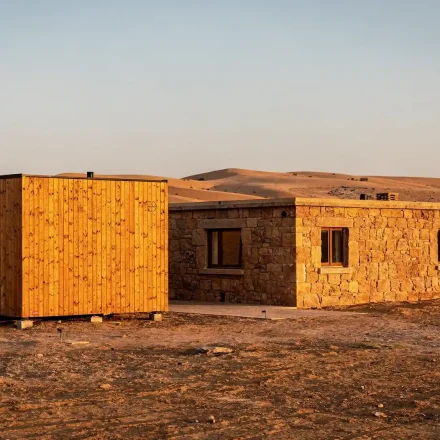
Modular unit features are the fixed fittings that come built into each module: the bed, the bathroom pod, any kitchen corner, storage, cooling and lighting. Because the factory installs them, they rarely change once the unit arrives. So the listing photos usually show exactly what you will get.
The type is still rare in desert travel. In fact, none of the 50 desert properties in Desert Booker’s camp database is a modular unit site. For the wider family of pods and cabins, read our guide to glamping pods in the desert.
Beds and Sleeping Space

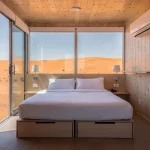
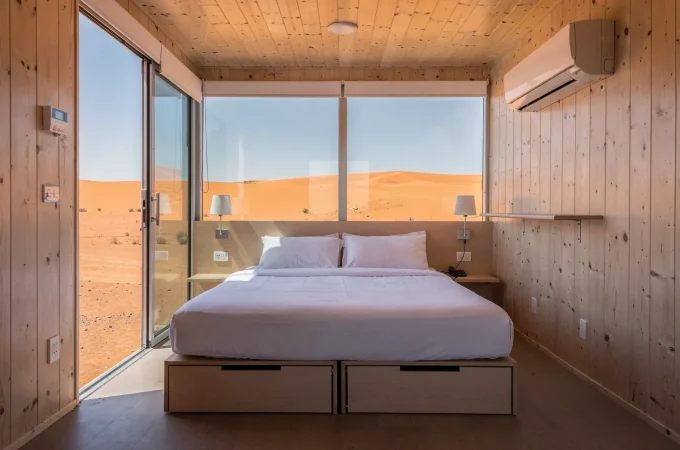
Factories build each modular building unit to a fixed plan. Most modular units fit one double or king bed, often on a raised platform with storage below. Some larger units add a second module with twin beds for families. Since the room is narrow, the bed usually faces the glass end, so you wake to the view.
A good unit also adds blackout blinds and a reading light on each side. Meanwhile, cheaper units may squeeze the bed against a wall. If you share the room, check that both sides of the bed have access.
Bathrooms: Pods, Showers and Toilets
Most modular units include a private bathroom pod built at the factory. It usually holds a shower, a flush toilet and a small basin, all sealed against sand. As a result, you do not need to walk to a shared block at night.
Water still comes from the camp’s own supply. Remote sites often run on a tank, so showers may be short. For comparison, see how glamping camp features handle bathrooms in tents.
Do Modular Units Have Kitchens?
Some do, but most desert modular units offer only a kitchenette rather than a full kitchen. A typical setup is a small fridge, a kettle and a sink. However, longer-stay units may add a two-plate hob and a microwave.
Cooking smells and heat build up fast in a small box. Therefore, many camps keep cooking in a shared dining area instead. If you plan to cook, ask whether the unit has an extractor fan and enough power for a hob.
Storage: Where Your Bags Go
Storage is the feature guests notice only when it is missing. Good units fit drawers under the bed, a hanging rail and a shelf by the door. In addition, some add hooks on the outside deck for sandy shoes.
Space for open suitcases is often the weak point. For that reason, pack a soft bag that fits under the bed. A luggage rack also keeps sand off your clothes.
Cooling, Heating and Insulation
A split air conditioner is standard in desert modular units. It cools the small room quickly, while insulated walls and double glazing hold the cool air in. In winter, most units use the same system as a heater.
Insulation quality varies between makers, so the same air conditioner can feel very different. Indeed, a well-sealed unit stays quiet and steady at night. For heat in other builds, compare the adobe desert stay, which relies on thick walls instead.
Power, Lighting and Wi-Fi

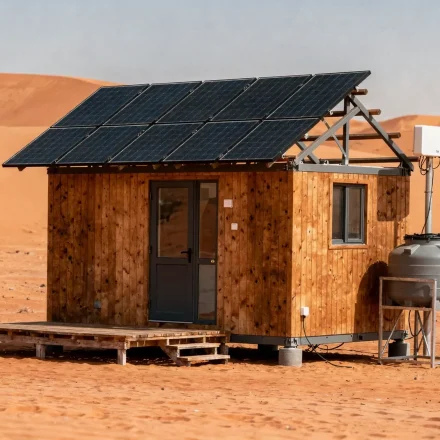
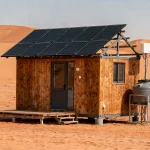
Each unit has its own sockets, lights and often USB points by the bed. Power may come from the grid, a generator or a solar power system with batteries. So the camp may limit heavy loads late at night.
Lighting usually mixes ceiling LEDs with warm bedside lamps. Wi-Fi, on the other hand, depends on the site. Near towns it comes from mobile data, while remote sites may use satellite internet.
Modular Unit Features Compared
| Feature | Basic unit | Mid-range unit | Larger suite unit |
|---|---|---|---|
| Bed | One double | King on storage base | King plus twin module |
| Bathroom | Shower and toilet pod | Larger pod, rain shower | Full bathroom, sometimes a tub |
| Kitchen | Kettle only | Fridge, kettle, sink | Kitchenette with hob |
| Storage | Hooks and a shelf | Drawers and a rail | Wardrobe and luggage space |
| Cooling | Split AC | Split AC, double glazing | Split AC, shaded deck |
| Outdoor space | Step and door | Small deck | Covered deck with seating |
What to Check Before You Book
Before you book, check five modular unit features in the photos and the listing. To begin with, confirm a private bathroom inside the unit. Secondly, look for real storage, not just hooks.
After that, ask what the kitchen corner includes. Then confirm air conditioning and how long it runs at night. Finally, ask how the site makes power, because that sets the limits on everything else. For a wider list across stay types, see desert accommodation features by property type.
FAQ
Do modular units have private bathrooms?
Most do. A factory-built pod with a shower, toilet and basin is standard.
Can I cook in a modular unit?
Usually only light cooking. Most units have a kettle and fridge, while some add a small hob.
Are modular units cool enough in summer?
Yes, when they have good insulation and split air conditioning. So ask how long cooling runs at night.
How much storage do modular units have?
Often drawers under the bed and a hanging rail. Large suitcases can be hard to open, so pack soft bags.
Is there Wi-Fi in a desert modular unit?
Often, through mobile data or satellite. However, remote sites may switch it off at night to save power.