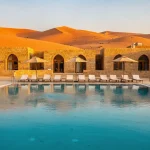
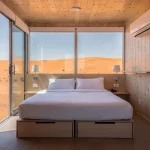
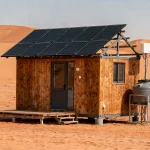

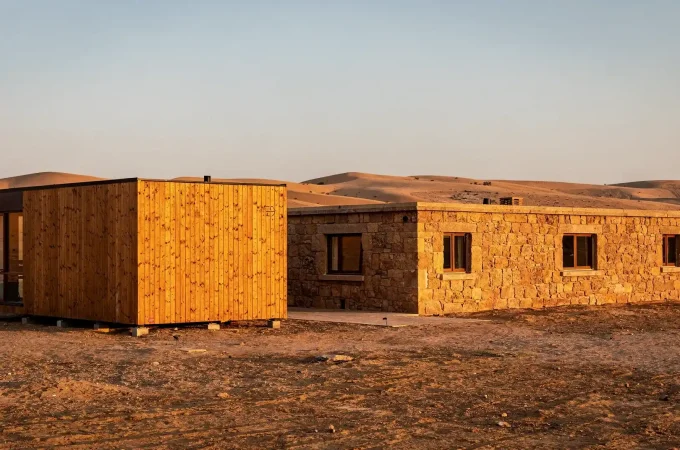
In relocatable vs permanent accommodation, the biggest night-time difference is how the walls hold heat. Permanent stays with thick stone or earth walls keep a steady temperature after dark. Relocatable units, from tents to modular cabins, change faster with the air outside. This guide compares comfort at night: warmth, cooling, sound, light and services.
Table Of Content
- Relocatable vs Permanent Accommodation: What Is the Difference?
- How Each Holds Heat Through the Night
- Relocatable vs Permanent Accommodation in Summer
- Sound and Wind at Night
- Light, Darkness and the Night Sky
- Bathrooms, Power and Water After Dark
- Relocatable vs Permanent Accommodation at Night
- Which One Suits Your Trip?
- FAQ
- Is a permanent building warmer than a tent at night?
- What is relocatable accommodation?
- Are modular cabins quiet at night?
- Which has a better view of the stars?
- Do relocatable camps have power all night?
Relocatable vs Permanent Accommodation: What Is the Difference?
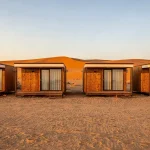
Relocatable accommodation is any guest unit a camp can move to a new site, such as a tent, a dome or a factory-built cabin. Permanent accommodation, by contrast, is built in place, such as a stone lodge or an adobe hotel. In short, one travels and the other stays.
In practice, most desert stays never move, even when the units could. Of the 50 desert properties in Desert Booker’s database, only 2 describe themselves as relocatable. About 9 more call themselves semi-fixed, seasonal or multi-site, while the rest stay on one site.
How Each Holds Heat Through the Night

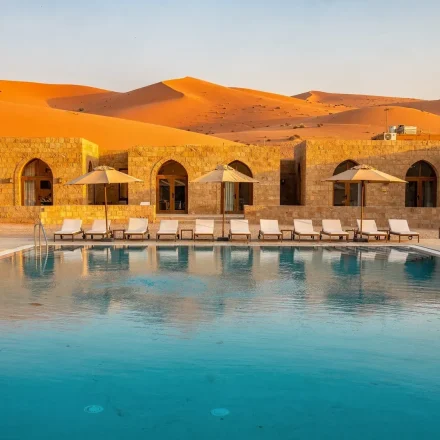
Permanent buildings hold heat better at night because of thermal mass. Thick stone or earth walls soak up warmth during the day. Then they release it slowly after dark, so the room cools gently.
Relocatable units, on the other hand, are light by design. Fabric and thin panels store little heat, so they follow the falling air temperature. Desert skies make this worse, because heat escapes fast through radiative cooling. As a result, light units need insulation, heaters and heavy bedding in winter.
Relocatable vs Permanent Accommodation in Summer
In summer, the picture flips during the evening. A thick wall that stored heat all day may keep a permanent room warm well into the night. Meanwhile, a well-insulated modular cabin with air conditioning can cool down quickly once the sun sets.
So the best summer night comes from good insulation and cooling, not from the build alone. Either way, ask whether air conditioning runs through the night. Our guide to the adobe desert stay explains how earth walls behave across the day.
Sound and Wind at Night

Permanent buildings are also usually quieter. Solid walls block wind, generators and neighbours far better than light walls. Therefore, a stone room feels calm even on a gusty night.
Relocatable units vary widely. A canvas tent carries every sound, while an insulated modular cabin can be nearly as quiet as a lodge room. Light sleepers should ask about the wall build and the distance to the generator.
Light, Darkness and the Night Sky
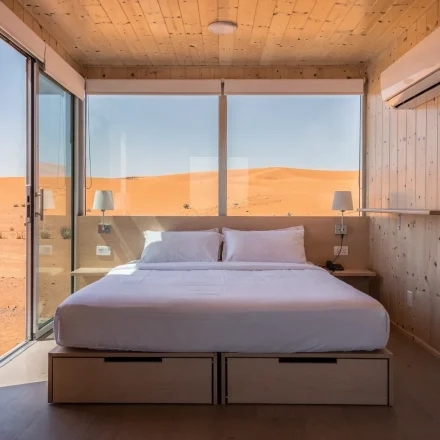
Relocatable units often sit closer to the open desert, which helps with the night sky. Camps can place them far from buildings and roads, where light pollution stays low. Many also face the dunes through large windows or open doors.
Permanent lodges, by contrast, often have smaller windows to keep heat out. In addition, their outdoor lighting can dim the stars nearby. Still, a short walk away from the building usually reveals a dark sky.
Bathrooms, Power and Water After Dark
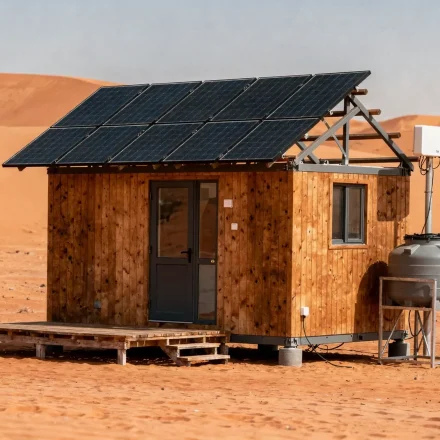
Permanent stays usually have private bathrooms, steady power and running water at any hour. Relocatable sites depend more on generators, solar batteries and water tanks. So camps may limit power late at night, and hot water can run out.
Good modular cabins now include a private bathroom in each unit. Simpler relocatable camps, however, still share a toilet block. Check this line in the listing before you book. For the permanent side, read what a desert lodge is.
Relocatable vs Permanent Accommodation at Night
| Night factor | Relocatable unit | Permanent building |
|---|---|---|
| Warmth in winter | Falls fast unless insulated and heated | Steady, thanks to thick walls |
| Cooling in summer | Quick with AC and insulation | Walls may release heat late |
| Sound | Tents loud, cabins quieter | Usually quiet |
| Night sky | Often darker, closer to dunes | Lights nearby can dim stars |
| Bathroom | Private in cabins, shared in simple camps | Usually private |
| Power at night | May be limited | Usually steady |
Which One Suits Your Trip?
Choose a permanent stay if you sleep lightly or feel the cold. Thick walls, steady power and a private bathroom make the night predictable. Choose a relocatable unit if you want to sleep close to the dunes and the stars.
A well-built modular cabin sits between the two. It offers solid walls and cooling, yet it keeps you near the open desert. For that middle ground, see our guide to glamping pods in the desert.
FAQ
Is a permanent building warmer than a tent at night?
Usually, yes. Thick walls store heat during the day and release it slowly after dark.
What is relocatable accommodation?
It is any guest unit a camp can move to a new site, such as a tent, a dome or a modular cabin.
Are modular cabins quiet at night?
Insulated ones are fairly quiet, while canvas tents carry much more sound.
Which has a better view of the stars?
Often the relocatable unit, because camps can place it far from buildings and lights.
Do relocatable camps have power all night?
Not always. Some limit generator or battery power late at night, so ask before you book.