

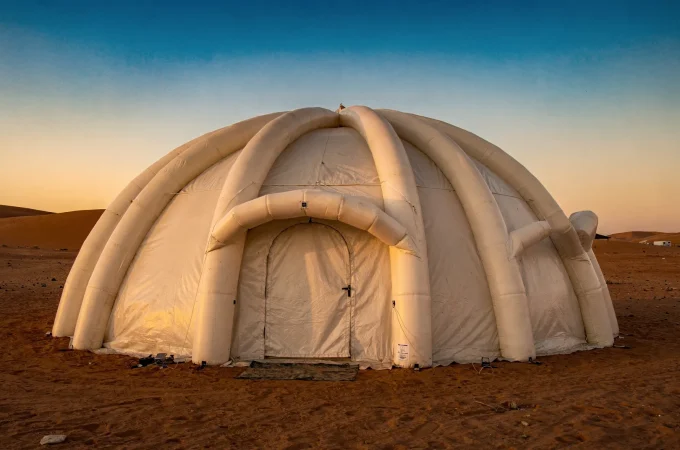
An inflatable dome tent is a tent whose frame is made of air-filled beams instead of poles. In the desert, the beams flex in wind and the round shape sheds gusts. Sand and heat still need careful anchoring and pressure checks. This guide explains how air-beam domes work and what to ask a camp.
Table Of Content
- What Is an Inflatable Dome Tent?
- How Air-Beam Structures Handle Wind
- What Holds an Inflatable Dome Tent in the Desert Sand?
- Heat, Pressure and Fabric: The Daytime Limits
- What to Ask a Camp About an Inflatable Dome Tent
- FAQ
- What is an inflatable dome tent?
- Are inflatable tents good in wind?
- Can an inflatable dome tent be used in sand?
- Is an inflatable dome tent the same as a bubble tent?
- Do air beams deflate in heat?
What Is an Inflatable Dome Tent?
An inflatable dome tent uses sealed tubes, called air beams, as its ribs. Crews pump the tubes up, and the beams lift a fabric skin into a dome. Because there are no poles, setup is quick and the frame has no metal parts to bend or snap.
Do not confuse it with other dome types. A geodesic dome has a rigid frame of struts, and a bubble tent has no frame at all. The table shows the difference.
| Structure | Frame | How it holds its shape |
|---|---|---|
| Inflatable dome tent (air beam) | Sealed air-filled tubes | Beams hold pressure, a fabric skin covers them |
| Geodesic dome | Rigid struts in triangles | Frame carries the load |
| Bubble tent | None | A blower keeps air pressure inside the shell |
For the frame type, read about the desert dome camp. Meanwhile, the guide to the bubble tent in the desert covers the frameless type. For heat, light and noise side by side, read dome vs inflatable tent compared.
How Air-Beam Structures Handle Wind

Wind is the main test in open desert. A dome has no flat wall, so air flows around it instead of pushing it over. In addition, air beams flex under a gust and then return to shape, whereas a rigid pole can snap or bend.
The flex has limits. A strong storm can still lift a tent that is poorly anchored. For this reason, a camp should secure every beam base and guy line, and it should take the tent down when a storm is forecast. For anchors, storm plans and what guests should do, read air beam tent safety in desert wind.
What Holds an Inflatable Dome Tent in the Desert Sand?

Sand is a poor anchor. A standard peg slides out of loose dunes, so camps use other methods. Common choices include long sand stakes, buried anchors and weighted sandbags on the skirt. A raised platform also keeps the floor level and stops sand drifting under the door.
Ground choice matters too. Firm, flat gravel holds anchors better than a soft dune crest. Therefore, a camp should pitch on stable ground and clear sand from the base after a windy day. This overview of the tent shows how pegs and guy lines normally work.
Heat, Pressure and Fabric: The Daytime Limits

Heat changes the air in the beams. Warm air expands, so pressure rises in the afternoon and falls at night. Crews check a gauge and adjust the pressure so the beams stay firm and safe. Sun also wears fabric over time, which is why a good camp uses a coated, UV-resistant skin.
The dome interior can feel warm, since the skin takes the sun on all sides. Shade cloth, an outer fly and a cooling unit help. Ask when the unit runs, as in the guide to air conditioning in glamping tents.
What to Ask a Camp About an Inflatable Dome Tent
Air-beam domes suit short stays and relocatable camps, because crews set them up fast. However, they are newer than canvas tents, so ask for details. A good camp answers these questions plainly:
- How is each beam anchored to the ground?
- What wind speed makes the camp take the tent down?
- Who checks the beam pressure, and how often?
- Does the dome have a cooling unit and vents?
- How does the camp repair a punctured beam?
Our guide to desert stay types shows where a dome camp fits among the other stay types.
FAQ
What is an inflatable dome tent?
It is a dome tent with air-filled beams instead of poles. The beams hold a fabric skin in a rounded shape.
Are inflatable tents good in wind?
They handle gusts well because the beams flex. Even so, they need strong anchoring, and a camp should take them down in a storm.
Can an inflatable dome tent be used in sand?
Yes, with sand stakes, buried anchors or sandbags. Standard pegs hold poorly in loose sand.
Is an inflatable dome tent the same as a bubble tent?
No. An air-beam dome has sealed tubes as a frame, and a bubble tent has no frame and uses a blower.
Do air beams deflate in heat?
Heat raises the pressure rather than lowering it. Crews adjust the pressure through the day to keep the beams safe.