
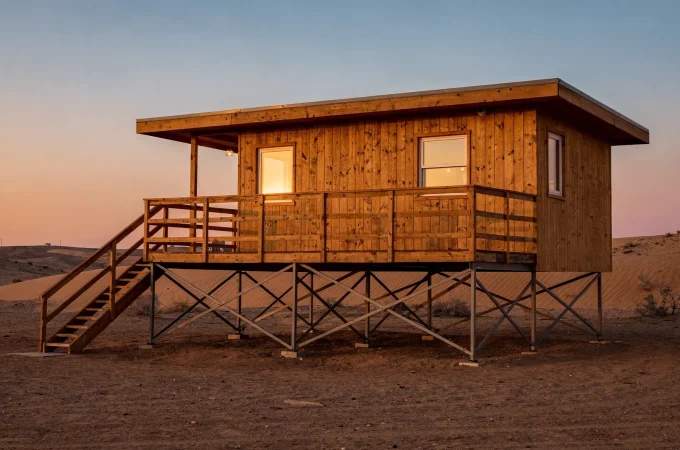
A desert treehouse or stilt cabin is a room raised off the ground on posts, piles or a platform. Raising it lets wind pass underneath and keeps sand, insects and floodwater away from the floor. This guide explains how elevated stays work in the desert.
Table Of Content
- What Is a Desert Treehouse or Stilt Cabin?
- Why Build Elevated Stays in the Desert?
- How Desert Treehouses and Stilt Cabins Stay Stable
- What to Check Before You Book
- Treehouse, Platform or Cabin? Comparing Elevated Styles
- Comfort, Power and Bathrooms in Elevated Stays
- FAQ
- Are there treehouses in the desert?
- Are stilt cabins cooler?
- Are desert stilt cabins safe in wind?
- Are stilt cabins good for children?
- Do elevated cabins have private bathrooms?
What Is a Desert Treehouse or Stilt Cabin?
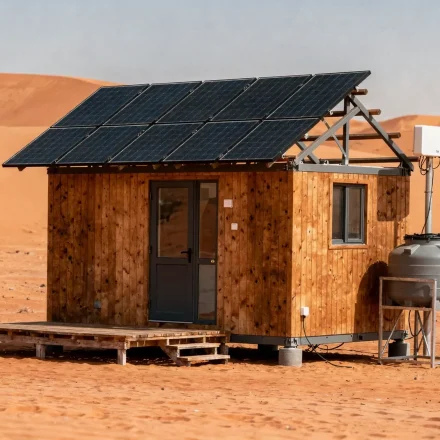
A stilt cabin stands on posts that lift the floor above the ground. A stilt house is a common form in wet regions and on coasts. In the desert, however, builders use the same idea for different reasons.
True treehouses are rare in dry land, since few trees can carry a room. Most so-called desert treehouses sit on steel posts or timber piles. Meanwhile, some use a rock outcrop as a base. In addition, a few oases have palms or acacias strong enough for a light platform.
Why Build Elevated Stays in the Desert?

First, height brings air. Wind moves faster above the ground, so a raised floor stays cooler than a floor on sand. The gap underneath also stops the hot ground from heating the room from below.
Elevation also protects the building, since flash floods can run across dry ground and a raised floor stays clear of the water. In addition, drifting sand cannot pile against the walls. Finally, the view improves, since a deck above the dune line sees farther.
How Desert Treehouses and Stilt Cabins Stay Stable

First, builders drive piles deep or set them in concrete footings. Then cross braces tie the posts together and stop sway in wind. Sand shifts, so the crew checks footings each season.
However, a tree is a weaker base than a post. Builders therefore use steel bolts and slip joints so the trunk can move. So ask the host how often an engineer inspects the structure. In short, a good elevated cabin looks light but rests on strong parts.
| Base type | How it works | What to ask |
|---|---|---|
| Steel piles | Driven or bolted to footings | When was the last inspection? |
| Timber posts | Set in concrete, braced | Is the wood treated against insects? |
| Rock outcrop | Platform fixed to stone | Is the rock stable? |
| Live tree | Light platform on slip joints | Does the tree carry the load? |
What to Check Before You Book

First, check access. Stairs or ladders can be steep, so ask about handrails and lighting. Check the deck railings and the gap between boards, especially with children.
Heat is the next question. A raised cabin still needs shade and cooling in summer, because the roof takes full sun. Also ask about wind noise. For other stay styles, read desert stay types or the guide to desert glamping.
Treehouse, Platform or Cabin? Comparing Elevated Styles
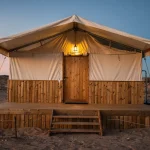
In general, elevated stays come in three common forms. First, a treehouse hangs from a tree or sits on a platform around one. Second, a platform tent puts a canvas tent on a raised deck. Third, a stilt cabin is a hard-walled room on posts.
Each form therefore suits a different guest. A platform tent feels the lightest and the airiest. The stilt cabin gives the most privacy and strength, while a treehouse gives the most novelty. In addition, a stilt cabin can hold a private bathroom more easily than a tree platform.
Comfort, Power and Bathrooms in Elevated Stays
Elevated stays carry the same services as other cabins, but they need planning. Pipes and cables run up the posts or along the deck. Because the cabin has no ground slab, builders insulate the floor to hold in heat at night.
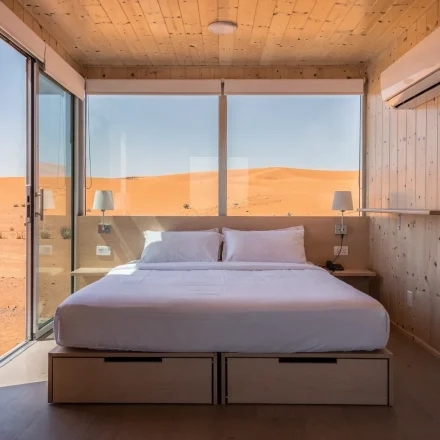
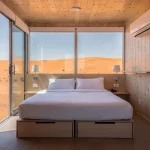
Most stilt cabins include a bed, lights and a cooling unit. Bathrooms may sit inside or on a lower level. Check whether the deck has a shaded corner, since the sun hits an exposed deck all day.
FAQ
Are there treehouses in the desert?
Few. Most elevated stays stand on steel or timber posts, and some use strong oasis trees.
Are stilt cabins cooler?
Often yes. Air flows beneath the floor, so the ground does not heat the room from below.
Are desert stilt cabins safe in wind?
Well-braced cabins handle strong wind. Ask how the footings and braces are inspected.
Are stilt cabins good for children?
They can be, with solid railings and guarded stairs. Check the deck gaps before booking.
Do elevated cabins have private bathrooms?
Many do. Some camps keep the bathroom at ground level, so confirm the layout.