
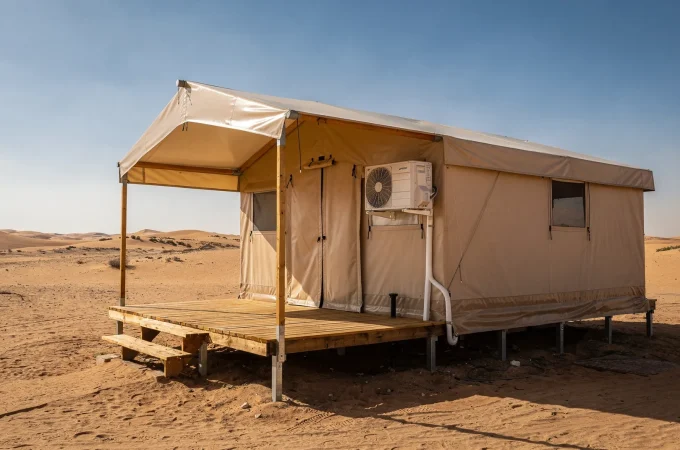
Do glamping tents have air conditioning? In most desert camps the answer is yes for the hot months, but it depends on the camp and the tent. Some camps fit an electric unit, while others rely on shade, airflow and thick fabric. This guide explains each option, what happens on cold nights, and what to ask before you book.
Table Of Content
- Do Glamping Tents Have Air Conditioning in the Desert?
- How Desert Camps Keep a Tent Cool in Summer
- How Camps Heat a Tent on Cold Desert Nights
- What to Ask a Desert Camp Before You Book
- Glamping in Summer and Winter: What Changes Inside the Tent
- FAQ
- Do glamping tents have electricity?
- Are glamping tents warm in winter?
- Are glamping tents waterproof?
- Can you go glamping in the desert in summer?
- Do glamping tents have a heater?
Do Glamping Tents Have Air Conditioning in the Desert?
Many desert glamping tents do have air conditioning, especially in the UAE and Oman, where summer days pass 40 °C. However, the feature is not universal. A camp that offers a simple canvas tent may provide only a fan. In contrast, a camp with hard-floored tents and a steady power link usually fits a split unit or a portable cooler. So the answer changes from camp to camp, and sometimes from tent to tent inside one camp.
Three setups cover most cases. First, a wall or split unit runs from a generator or the grid and cools the whole tent. Second, a fan or evaporative cooler moves air without a compressor. Third, the tent has no powered cooling and depends on shade and ventilation. Camps rarely say which applies unless you ask. For a wider view of the format, read what desert glamping is and how it differs from camping.
| Cooling setup | How it works | What to check |
|---|---|---|
| Split or wall unit | Cools the tent with a compressor | Hours of power and noise at night |
| Fan or evaporative cooler | Moves air and adds light cooling | Works best in dry air, weak in humid weather |
| No powered cooling | Shade, vents and thick fabric | Suits winter and the cooler shoulder months |
How Desert Camps Keep a Tent Cool in Summer

Powered cooling is only part of the story. Good camps also design the tent to keep heat out. Operators often use double-layer canvas, a raised wooden platform and a reflective outer fly. The sun then hits an air gap before it reaches the bed. In addition, they turn the door away from the afternoon sun and open vents at the ridge, so hot air rises out.
Air conditioning also depends on power. Camps with a solar array or a generator often run units on a schedule, for example from late afternoon until morning. As a result, a tent can feel warm at midday even when it has a unit. Guests who plan a noon rest should ask when the unit runs.
Summer is hard on any tent. Therefore some camps close or cut capacity between June and September.
How Camps Heat a Tent on Cold Desert Nights

Desert nights can turn cold even after a hot day. In winter, night temperatures in some deserts fall to single digits, so a tent needs heat as much as cooling. Camps solve this in several ways. Many fit a heater or a reverse-cycle air conditioner, while others supply extra blankets and hot-water bottles. A few tents carry a small stove, though a stove inside canvas needs strict safety rules. The camp should explain how it vents the fumes.
Insulation matters too. A tent with a lined roof and a sealed floor holds warmth longer than a single-skin tent. Fires outside the tent add warmth in the evening, but they do not heat the bed. In short, ask about heating even if you travel in the hot season, because the shoulder months can surprise you. A classic safari tent shows what a standard canvas layout offers on a cold night.
What to Ask a Desert Camp Before You Book

Short questions save a poor night. Ask the camp these before you pay:
- Does my tent have a powered cooling unit, or only a fan?
- During which hours does the unit run?
- Does the tent have heating for winter nights?
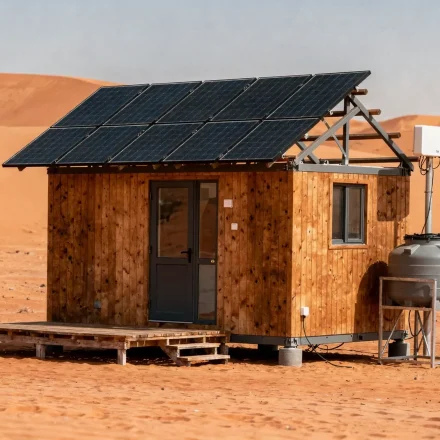
- Does the power come from the grid, solar panels or a generator?
- Does the tent have a lined roof and a raised floor?
- What happens if the unit fails overnight?
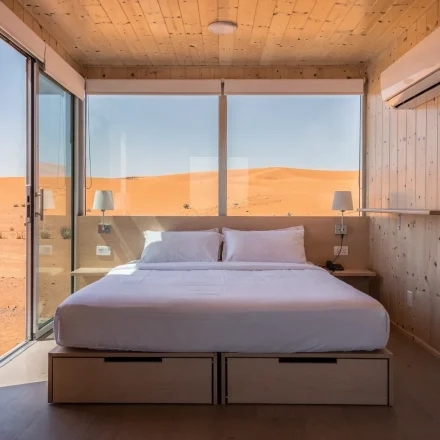
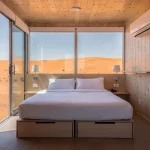
Study the photos as well. A visible split unit on the wall, a vent in the roof or a floor heater tells you more than a line in the description. Meanwhile, a listing that says only “climate comfort” leaves the question open. If the camp does not answer in plain words, treat the answer as no.
Glamping in Summer and Winter: What Changes Inside the Tent
The season sets what you need from the tent. In summer, cooling decides the night, and a tent with only a fan will feel warm. Winter flips this: heating decides the night, and a unit that cannot heat leaves the tent cold. March, April, October and November are milder, so a fan and a good blanket can be enough.
Waterproofing is a smaller worry. Operators use coated canvas, so most glamping tents shed rain well. Even so, a sudden desert storm can push water under a door, and a raised floor stops that. For a bubble-style stay with a clear roof, see how heat works in a bubble tent in the desert. This overview of air conditioning explains how a heat pump both cools and heats. For power and shade as well, read glamping camp features explained.
FAQ
Do glamping tents have electricity?
Most desert glamping tents have electricity for lights and charging. However, the supply can come from solar panels or a generator, so some camps limit it at night.
Are glamping tents warm in winter?
They can be, if the camp fits a heater or a reverse-cycle unit. Without one, a tent feels cold after dark, so ask before you book.
Are glamping tents waterproof?
Yes, most use coated canvas that sheds rain. Still, ask about the floor and the door seal, since storms in the desert are rare but sharp.
Can you go glamping in the desert in summer?
You can, but only where the tent has strong powered cooling and the camp stays open. Many travellers choose the cooler months instead.
Do glamping tents have a heater?
Some do. Camps in cold desert regions often provide a heater or a stove, while others offer blankets only, so check the listing.