
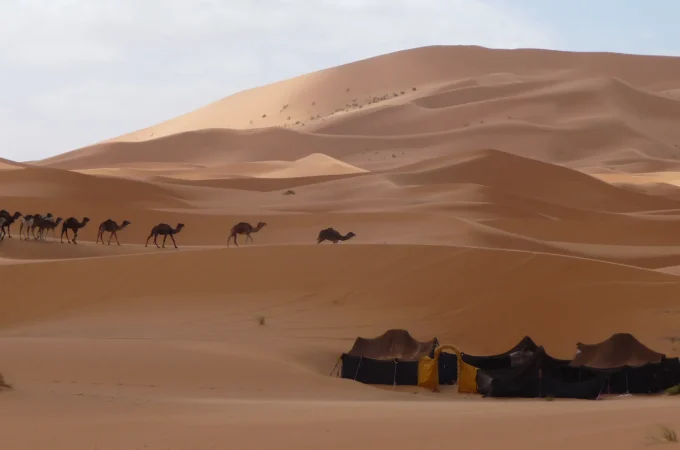
In the desert camp vs hotel question, neither side is always cheaper. A simple shared camp usually costs less than a mid-range hotel. However, a well-equipped glamping camp deep in the dunes often costs more, because water, power, food and staff must all travel to a remote site. This guide explains why.
Table Of Content
- Desert Camp vs Hotel: Which Costs More?
- What You Pay For at a Desert Camp
- What You Pay For at a Desert Hotel
- Why Remote Logistics Push Camp Rates Up
- Why Hotels Can Cost Less per Night
- Meals, Transfers and Activities: The Hidden Inclusions
- Season, Weekends and Fees
- Desert Camp vs Hotel Cost Drivers Compared
- Desert Camp vs Hotel: What Our Rate Sample Shows
- FAQ
- Is a desert camp cheaper than a hotel?
- Why are some desert camps so expensive?
- Do desert camp rates include meals?
- Do desert hotels include transfers to the dunes?
- When are desert camps cheapest?
Desert Camp vs Hotel: Which Costs More?
The answer depends on the tier, not the property type. At the simple end, a camp with shared bathrooms and set meals is often the lowest-cost way to sleep in the dunes. Higher up the scale, a small camp with private tents can cost more than a large resort.
The reason is simple. A hotel spreads its costs over many rooms on a road with mains power. By contrast, a camp spreads them over a few tents with none of that. So every guest carries a bigger share of the fixed cost.
What You Pay For at a Desert Camp
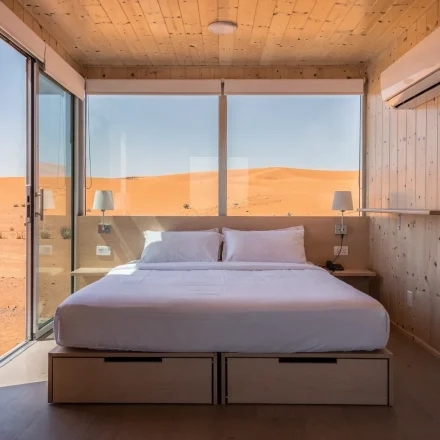
At a desert camp, the nightly rate usually buys more than a bed. Most camps include dinner and breakfast, and many include a transfer from the nearest road. In addition, some add a camel ride, a sandboarding session or a sunset walk.
That bundle is close to full board, even when the listing does not say so. As a result, a camp rate can look high next to a room-only hotel rate. Compare the two only after you add meals and transport to the hotel side. Our guide to what a desert camp is lists the usual inclusions.
What You Pay For at a Desert Hotel
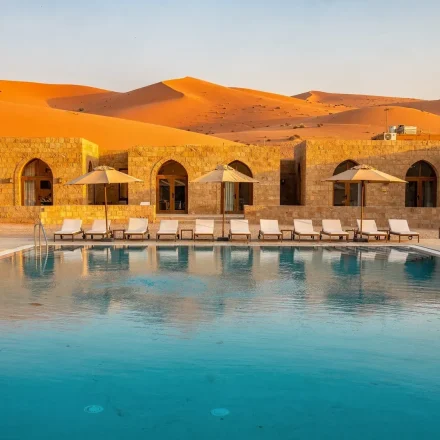
At a desert hotel or resort, the rate often covers the room and breakfast only. Meanwhile, dinner, drinks and activities come as extras. In return, you get solid walls, central cooling, a pool and round-the-clock staff.
Hotels also sell many room types under one roof. So the cheapest room can be far below the suite with a private pool. When you compare, match like with like: basic tent with basic room, top tent with top suite. The split between a lodge, a resort and a tented camp also shapes what each rate covers.
Why Remote Logistics Push Camp Rates Up

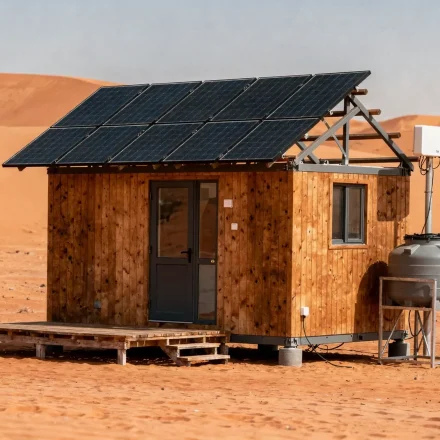
Remote logistics are the biggest reason a camp can cost more than a hotel. Most deep-desert camps have no mains water, so a truck refills their tanks. Similarly, they make their own power with a diesel generator, solar panels or both.
Every item also rides in by four-wheel drive, from food and gas to clean linen. On top of that, staff often live on site for weeks. Wind and sand wear out canvas, so owners replace it more often than hotel walls. All of this lands in the nightly rate.
Why Hotels Can Cost Less per Night
Hotels gain from scale. A large property buys in bulk, shares one kitchen across hundreds of guests and connects to the grid. Therefore, each extra room adds little cost.
Hotels also use revenue management to fill quiet nights with lower rates. A small camp has less room to discount, because its fixed costs stay the same with two tents full or ten.
Meals, Transfers and Activities: The Hidden Inclusions

Transfers are the inclusion travelers forget most often. Reaching a camp in deep dunes needs a four-wheel-drive vehicle and a trained driver. If the hotel sits on a paved road, you skip that cost. Book a desert jeep safari from a hotel, and you pay for that ride anyway.
Meals work the same way. In a camp, the kitchen is often the only option for many kilometres. So camps price dinner into the stay. Before you decide, list every meal and ride you would buy on each side.
Season, Weekends and Fees
Desert rates rise and fall with the tourist season. In the Arabian Peninsula and North Africa, the cool months from about October to April fill fastest. Meanwhile, many camps close in midsummer, while hotels stay open with lower rates.
Taxes and fees also differ by place and licence. In Dubai, for example, licensed hotel establishments collect the Tourism Dirham fee per room per night. On top of that, value-added tax applies in many desert countries. Ask whether the quoted rate includes both.
Desert Camp vs Hotel Cost Drivers Compared
| Cost driver | Desert camp | Desert hotel or resort |
|---|---|---|
| Water | Trucked in, stored in tanks | Mains or large on-site supply |
| Power | Generator, solar or both | Grid, with backup |
| Access | Four-wheel-drive transfer | Paved road |
| Meals | Usually included | Usually extra beyond breakfast |
| Number of units | Few, so high cost per unit | Many, so low cost per unit |
| Season | Often closes in summer | Open all year |
Desert Camp vs Hotel: What Our Rate Sample Shows
Our own rate sample supports the “tier, not type” rule. Desert Booker collected 67 public nightly rates across desert property types and countries. Among 17 glamping tent rates, the highest was more than 100 times the lowest.
The middle values tell a different story. Here, the median desert lodge rate was about seven times the median glamping tent rate. Likewise, the median resort rate was about three times higher. The sample is small and mixes dates, so treat it as a direction, not a price list.
FAQ
Is a desert camp cheaper than a hotel?
Often, but not always. A simple shared camp usually costs less, while a top-tier glamping camp can cost more than a resort.
Why are some desert camps so expensive?
Remote logistics. Water, power, food, staff and guests all travel by four-wheel drive to a site with few units.
Do desert camp rates include meals?
Most do. They usually cover dinner and breakfast, and many camps add a transfer and one activity.
Do desert hotels include transfers to the dunes?
Rarely. Hotels on paved roads usually sell dune trips and safaris as separate extras.
When are desert camps cheapest?
Shoulder months at the edge of the cool season usually cost less. Many camps close in midsummer.
Photo credits: Featured image: Camel train arrives at Berber camp. – Flickr – gailhampshire by gailhampshire, CC BY 2.0; Wahiba Sands (19) by Andries Oudshoorn, CC BY-SA 2.0, cropped from the original. All via Wikimedia Commons.