

Is sandboarding hard? Not if you start lying down: a sit-down or lie-down run needs no balance at all. Standing on the board is a real skill, closer to learning to snowboard. What wears most people out is the climb. Dunes have no lifts, so every run ends at the bottom of a slope you have to walk back up.
Table Of Content
- Is Sandboarding Hard? The Short Answer
- How Sandboarding Works: What a Session Looks Like
- Is Sandboarding Hard on Your Body? Fitness and the Climb
- Sandboarding Safety: How Hard Is a Fall?
- Sandboard Wax, Boards and What’s Provided
- Duration and Format Options
- Best Locations for Sandboarding in the UAE, Morocco, Namibia and Oman
- Best Season and Time of Day
- Is Sandboarding Hard for Kids and Older Riders?
- FAQ
- Is sandboarding hard for a complete beginner?
- Is sandboarding harder than snowboarding?
- Is sandboarding dangerous?
- Do I need to wax a sandboard?
- How many runs can I fit into an hour?
Is Sandboarding Hard? The Short Answer
It depends on which of three things you mean.
Sliding down on your belly or your seat is easy. You point the board downhill and hold on. Sandboarding guides suggest sand sledding, the sitting version, as the way to get comfortable before you stand up.
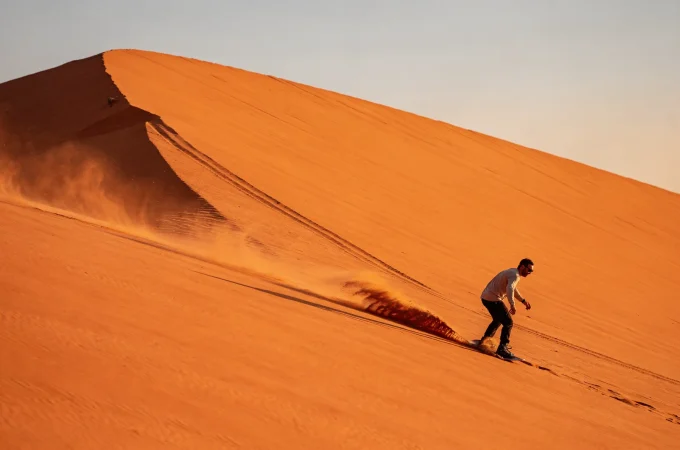
Standing is the skill. You ride with both feet strapped to the board and one foot forward, and you steer by shifting your weight from toes to heels, the same movement as on a snowboard. Keep your weight toward the back of the board, because a nose that digs into soft sand pitches you forward. Expect to fall on your first attempts, and spend a few runs on a small dune before you try a big one.
The climb is the part nobody warns you about. One Dubai guide puts a descent at about 30 seconds and the walk back up at 5 to 10 minutes. Other guides call the climb the most tiring part of the sport.
How Sandboarding Works: What a Session Looks Like

Most sessions follow one loop: climb, slide, repeat. You walk up a dune face carrying the board, sit, lie or stand on it at the top, and slide down. Then you walk up again. Nobody times it, and you do as many loops as your legs allow.
Two kinds of board turn up. Stand-up boards look like short snowboards with bindings. Sit-down sleds are for beginners and young children, because you need no balance to ride one. In the UAE, sandboarding is usually a stop inside a desert safari rather than a trip of its own. One Dubai guide says it happens in the breaks between the dune bashing drives, which is why it often sits next to a desert jeep safari or a dune bashing outing.
Do the math on the two numbers above. A 30 second run against a 5 to 10 minute climb gives about six to ten runs in an hour at a steady pace, and fewer on a tall dune or in soft sand.
Is Sandboarding Hard on Your Body? Fitness and the Climb

The legs and lungs do the work. Soft sand gives way under every step, so a walk up a dune is slower and harder than a walk up a path of the same length. You carry the board too. Sandboards are short, about a meter long, and light enough to carry up the slope.
The guides we read set no fitness test, yet they all mention the climb. Plan for it. Climb in the cooler hours, drink before you are thirsty, and rest at the top, not at the bottom. One Dubai guide suggests 1 to 2 liters of water for a session.
If your stamina is limited, a sit-down sled keeps the effort to the climb alone. Standing runs add the strain of balancing on tired legs.
Sandboarding Safety: How Hard Is a Fall?

Sand is harder to land on than snow or water, and it does not forgive speed. Two choices do most of the work: the dune and your clothes.
Pick a dune with a smooth, steep face, no plants or rocks on it, and a long, flat run-out at the bottom. The run-out is where you slow down, so it needs to be empty. Start on a short slope, and move up once you can stop on purpose.
Wear closed shoes. Operators ask for them, and in lie-down boarding your shoes double as brakes, according to Visit Namibia. High-top shoes keep sand out better than low-tops. Long sleeves and trousers cut scrapes if you fall. Some guides also recommend eye protection and knee and elbow pads for standing runs.
Speed climbs fast on tall dunes. One Namibian listing says experienced boarders can reach up to 80 km/h on its fastest dune. First-timers should treat that as a number for other people.
Sandboard Wax, Boards and What’s Provided
A sandboard is not a snowboard. It is shorter, about a meter long, and has no metal edges. The base is much harder than a snowboard’s, built mostly from formica or laminex, according to Wikipedia’s overview of sandboarding. That hard base only slides well when it is waxed. Riders apply a paraffin-based sandboard wax before a run, and one sandboarding guide says to repeat it before every descent, because without wax the sand sticks and the board drags.
If your first run feels slow and sticky, check the wax before you blame your technique.
On a tour, the operator normally supplies the boards, and desert safaris that include sandboarding list them in the package. Ask whether wax comes with them and whether the boards are stand-up, sit-down or both. Bring sunscreen, sunglasses, a hat and closed shoes of your own.
Duration and Format Options
In the UAE the usual format is a stop inside a half-day or full-day safari. The time you get is whatever the itinerary leaves, so ask how long the stop lasts. One Dubai guide says a morning safari can give more time on the dunes because it skips the camp activities.
Dedicated sandboarding sessions are easier to find in Namibia, where operators in Swakopmund and Walvis Bay run boarding trips with instructors on the dune.
Match the format to your legs. One short stop is enough to try sitting and standing once. A longer session gives you the time to improve.
Best Locations for Sandboarding in the UAE, Morocco, Namibia and Oman
Around Dubai, guides name the Lahbab desert, Al Badayer (known as Big Red) and the dunes near Mleiha in Sharjah, all under an hour’s drive from the city.
In Morocco, sandboarding is offered around Merzouga in the Sahara. One traveler’s account of Merzouga in March describes basic rental boards, runs of about 50 meters and a hot climb after each one, so ask what gear comes with the booking.
In Namibia, Swakopmund and Walvis Bay offer stand-up and lie-down boarding on the Namib dunes, with instructors on the slope.
In Oman, one guide rates Sharqiya Sands, also called Wahiba Sands, as the best sandboarding in the country, about three hours’ drive from Muscat, and says to go with a guided desert tour. The Bousher Dunes inside Muscat are closer, smaller and busy on weekends.
For the wider picture of these deserts, see our UAE desert travel guide, Deserts of Africa for the Sahara and the Namib, and Deserts of the Middle East for Oman.
Best Season and Time of Day
In Dubai, guides recommend October to April, with sessions between 8 and 11 in the morning or between 4 and 7 in the evening. Heat is the issue. Sand gets uncomfortable underfoot and on bare skin, and the climb is where it bites. Dunes have no snow season, so the sport runs all year where the dunes are open, but plan around the heat.
Is Sandboarding Hard for Kids and Older Riders?
Sit-down sleds suit young children, because they need no balance. Older riders and anyone with limited stamina should treat the climb as the test, not the descent. Standing sandboarding suits riders with snowboard or skateboard experience who want a real skill to work on.
If standing feels like too much, dune sledding is the sit-down version of the same idea. Sand skiing is the two-ski cousin.
FAQ
Is sandboarding hard for a complete beginner?
Not if you sit or lie down. You need no balance, and most first-timers start that way. Standing takes practice, so begin on a small dune and expect a few falls.
Is sandboarding harder than snowboarding?
It is easier to start and harder on the legs. The weight shift from toes to heels is the same, but a dune has no lift, so every run is earned on foot, and sand is a harder landing than snow.
Is sandboarding dangerous?
It is as safe or as risky as you make it. Choose a small dune with an empty run-out, wear closed shoes, and keep your speed in check until you can stop on purpose.
Do I need to wax a sandboard?
Yes. Wax before each run keeps the base from dragging. A board that sticks is usually an unwaxed board.
How many runs can I fit into an hour?
About six to ten at a steady pace, based on a 30 second run and a 5 to 10 minute climb. Tall dunes and soft sand cut that number.