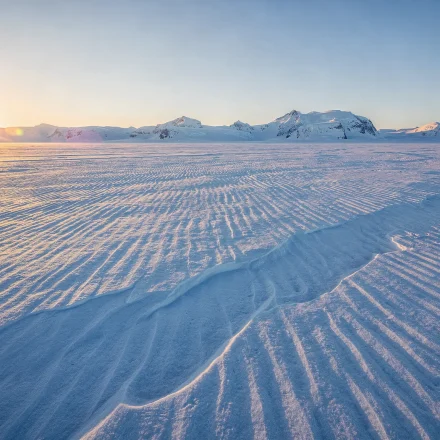


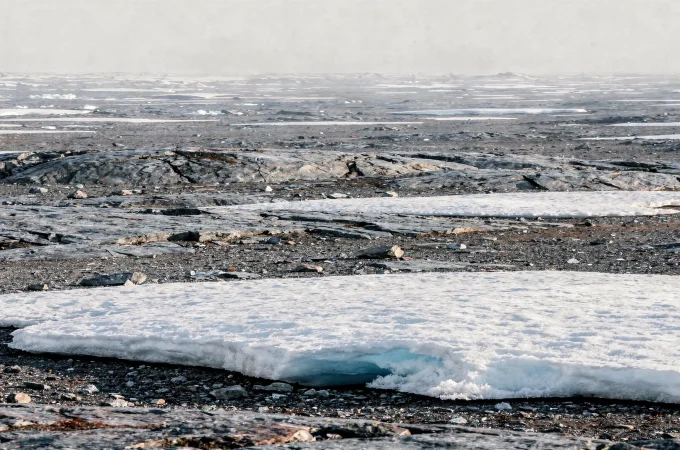
The two largest deserts on Earth are both covered in ice. Polar deserts work on a mechanism that most people never think of as drying anything: cold itself.
Table Of Content
- The Mechanism
- Cold air carries almost no water
- The Polar Highs push air downward
- The inversion layer locks it in place
- Why the Ice Is Misleading
- Antarctica: The World’s Largest Desert
- The Arctic: The Second Largest
- An Extreme Case: The McMurdo Dry Valleys
- How Old Is That Dryness?
- What Actually Falls Here
- Life at the Limit
- Why This Fact Surprises Almost Everyone
- Related Topics
- FAQ
- Is Antarctica the largest desert on Earth?
- Why doesn’t more snow fall in Antarctica if it is so cold?
- Is the Arctic desert the same thing as Arctic sea ice?
- What makes the McMurdo Dry Valleys drier than the rest of Antarctica?
- Why do the two dates for the Dry Valleys disagree?
- Why do researchers compare the Dry Valleys to Mars?
- Does anything live in the McMurdo Dry Valleys?
- Will polar deserts stop being deserts as ice melts?
The Mechanism

Three separate effects stack at the poles. Each one suppresses precipitation on its own.
Cold air carries almost no water
Cold air holds less water vapor than warm air, reducing absolute humidity and leading to minimal precipitation. Temperatures stay far below freezing for most or all of the year here, so the air arrives with very little to give in the first place.
The Polar Highs push air downward
Semi-permanent high-pressure systems sit over both poles. Air sinks under them rather than rising. Sinking air suppresses cloud formation, which is the same principle behind Subtropical High-Pressure Deserts, running at the opposite end of the planet.
The inversion layer locks it in place
A stable layer of cold, dense air sits trapped beneath warmer air above. Air normally cools with height. Here it warms, which blocks the upward motion needed to lift moisture and turn it into snow.
Put the three together and you get a place where snow falls rarely, accumulates slowly, and almost never melts. The total water arriving each year is tiny.
Why the Ice Is Misleading
The obvious objection is the ice. How can a continent buried under kilometers of frozen water count as arid?
Because aridity measures flow, not stock.
The Antarctic ice sheet is an accumulation, built up over millions of years at a rate of a few centimeters of water equivalent a year. Almost none of it melts, so almost none of it leaves. The pile grows even though the delivery rate stays minimal.
Frozen water is also unavailable water. It does not cycle through soil, feed plants, or evaporate back into the air the way liquid moisture does. That distinction is exactly what the Aridity Index in What Is a Desert? is built to capture.
Antarctica: The World’s Largest Desert
At roughly 14,200,000 km², Antarctica exceeds the Sahara’s 9,200,000 km² by a wide margin. It is the largest desert on the planet, and nothing else is close.
Antarctica also holds the coldest air temperature ever reliably measured at the surface. Vostok Station, deep in the continental interior, recorded −89.2 °C in July 1983.
That number is not a curiosity. It is a direct statement about how little water the air can hold. At −89 °C the atmosphere is, in absolute terms, close to empty.
The Arctic: The Second Largest
The Arctic follows the identical mechanism and comes in just behind, at roughly 13,900,000 km². Extreme cold suppresses moisture capacity there in exactly the same way.
One clarification worth making. The Arctic desert classification describes the region’s precipitation balance. It is not the same thing as sea-ice extent, which grows and shrinks seasonally for separate reasons.
An Extreme Case: The McMurdo Dry Valleys

Inside Antarctica sits something drier still. The McMurdo Dry Valleys are the largest ice-free region on the continent, and two extra mechanisms keep them that way.
The Transantarctic Mountains stand between the valleys and the Southern Ocean, blocking moist coastal air from ever arriving. This is a rain shadow operating in a place with almost no rain to shadow.
Then there are the katabatic winds. Dense, extremely cold air pours downhill off the polar plateau and accelerates as it goes. Those winds actively strip moisture from the ground, which is why the valley floors stay bare rock while the rest of the continent lies under ice.
How Old Is That Dryness?
Two dating methods give two different numbers for the Dry Valleys, and both are correct.
Cosmogenic beryllium-10 dating of the Sirius Group tills puts the onset of permanent frozen, hyperarid conditions at roughly 6 to 9 million years ago, in the late Miocene.
Argon-argon dating of volcanic ash in the Labyrinth channel system, published by Lewis and colleagues in Geology in 2006, places the last major subglacial meltwater flood through the valleys at roughly 12.4 to 14.4 million years ago.
These are not competing figures. One dates when the landscape stopped changing. The other dates the last big event before it did. Sources that cite only one number without saying which event it describes are the reason this looks like a contradiction.
What Actually Falls Here
Precipitation in polar deserts gets measured as water equivalent, meaning how much liquid water the snow would produce if it melted.
That distinction matters more here than anywhere. Snow is mostly air. A layer of it collapses to a fraction of its depth once melted.
The Dry Valleys receive some snow each year, on the order of a few centimeters of depth. The water equivalent is a small fraction of that, which is why the region ranks among the driest measured places on Earth.
Almost none of it stays anyway. The katabatic winds scour fresh snow off the valley floors nearly as fast as it lands.
Life at the Limit
Visible life is essentially absent from the Dry Valleys. No plants, no animals, no lichen crust across most of the ground.
Microbial life persists anyway. Some communities live inside porous rock rather than on it, occupying the few millimeters below the surface where a little light penetrates and the wind cannot reach. Others survive in lakes that stay liquid all year beneath a permanent ice cap, supporting colonies of bacteria and phytoplankton.
These are among the most studied extreme habitats on the planet, precisely because they mark where terrestrial life gives out. How Desert Animals Survive Without Water covers the strategies that work in warmer deserts. Almost none of them apply here.
Why This Fact Surprises Almost Everyone

Popular imagination ties the word desert to heat and sand so tightly that an ice-covered desert reads as a contradiction.
It is not one. The classification has always tracked water balance rather than temperature, as Desert Myths and Misconceptions, Debunked sets out in full.
The Dry Valleys push the point further than anywhere. Researchers use their terrain as one of the closest Earth analogs to the Martian surface, testing equipment and studying how life behaves at the edge of what is survivable. A landscape that most people would not recognize as desert turns out to be the best stand-in we have for another planet.
Related Topics
How Deserts Form · Coastal Fog Deserts · Continental Interior Deserts · The 5 Types of Deserts · World Deserts Atlas
FAQ
Is Antarctica the largest desert on Earth?
Yes. At roughly 14,200,000 km² it is larger than the Sahara by a wide margin, and it meets the precipitation-based definition of a desert despite being covered in ice.
Why doesn’t more snow fall in Antarctica if it is so cold?
Cold air holds very little water vapor to begin with. The same low temperature that keeps Antarctica frozen is what keeps its actual precipitation total so small.
Is the Arctic desert the same thing as Arctic sea ice?
No. The desert classification describes the region’s precipitation balance over land and ice. Sea-ice extent shifts seasonally for separate oceanographic reasons.
What makes the McMurdo Dry Valleys drier than the rest of Antarctica?
Two extra factors. The Transantarctic Mountains block moist coastal air, and katabatic winds pouring off the polar plateau strip away whatever moisture reaches the ground.
Why do the two dates for the Dry Valleys disagree?
They do not. Beryllium-10 dating of the Sirius Group tills dates the onset of permanent hyperaridity at 6 to 9 million years ago. Argon-argon dating of the Labyrinth tephra dates the last major meltwater flood at 12.4 to 14.4 million years ago. Different events, different answers.
Why do researchers compare the Dry Valleys to Mars?
Prolonged extreme cold, near-total dryness and largely barren ground make them the closest available match on Earth. Teams use them to test equipment and study the limits of microbial survival.
Does anything live in the McMurdo Dry Valleys?
Yes, but almost nothing visible. Microbial communities survive inside porous rock, in permanently ice-covered lakes, and in brief films of summer soil moisture.
Will polar deserts stop being deserts as ice melts?
Ice melt alone does not change a precipitation-based classification. Shifting precipitation patterns could gradually alter these regions over time, which Climate Change’s Impact on Deserts covers.