

Grasses rarely get the visual attention cacti and palms do. They often do more work holding a desert ecosystem together than either.
Table Of Content
- Why Grasses Matter Structurally
- Worked Example: Esparto (Alfa) Grass
- How Desert Grasses Handle Water Scarcity
- Why Groundcover Matters Beyond the Individual Plant
- Grasses as an Overlooked Travel Detail
- Grasses as an Early Warning Sign
- Related Topics
- FAQ
- Why are desert grasses ecologically important if they’re not very visually dramatic?
- Has esparto grass had any historical human use beyond its ecological role?
- Can rolling or folding its leaves really help a grass survive drought?
- What happens to desert soil if its grass cover is lost?
- Can grass cover really act as an early warning sign for land managers?
Why Grasses Matter Structurally

Desert grasses typically rely on extensive, fibrous root networks rather than one deep taproot. That strategy spreads their water-gathering surface widely just below ground.
It also physically binds loose soil in place, reducing wind erosion across the areas they colonize. A single grass tussock’s root network can extend laterally well beyond the visible clump above ground, binding a surprisingly wide area of soil for its size.
Worked Example: Esparto (Alfa) Grass

Esparto grass (Stipa tenacissima) is a tough, fibrous perennial native to the Mediterranean basin. Researchers document it as one of the most representative species of dry Mediterranean ecosystems.
Its root system, though fibrous rather than deep, still reaches down about 50 centimeters. Regional government documentation from the province of Málaga, Spain credits esparto specifically with helping the soil of Almería, home to the Tabernas badlands covered in Badlands and Erosion Landscapes, resist erosion and desertification.
Esparto’s toughness has a human history too. People have used it for centuries in rope, basketry, and paper production, a practical use that grew directly out of the same fibrous strength that lets the plant survive extreme dryness.
How Desert Grasses Handle Water Scarcity
Many desert grasses roll or fold their leaves during the driest periods. This reduces the surface area exposed to sun and wind and cuts some water loss.
Leaf rolling is a secondary mechanism, not the main one. Research on drought response consistently shows that closing stomata accounts for the large majority of transpiration reduction in grasses, while leaf rolling contributes only a small additional share. Its real advantage is speed: because the change is mechanical rather than structural, a grass can reverse it within a short window once moisture returns.
Why Groundcover Matters Beyond the Individual Plant
Grass and low groundcover species stabilize soil against wind erosion at a landscape scale. Their presence or loss can measurably affect how quickly surrounding terrain erodes, directly relevant to the broader desertification concerns covered in What Is Desertification and Why Is It Spreading.
Where established grass cover disappears, whether from drought, grazing pressure, or land-use change, the exposed soil beneath it typically erodes considerably faster than it would with the root network intact.
Grasses as an Overlooked Travel Detail
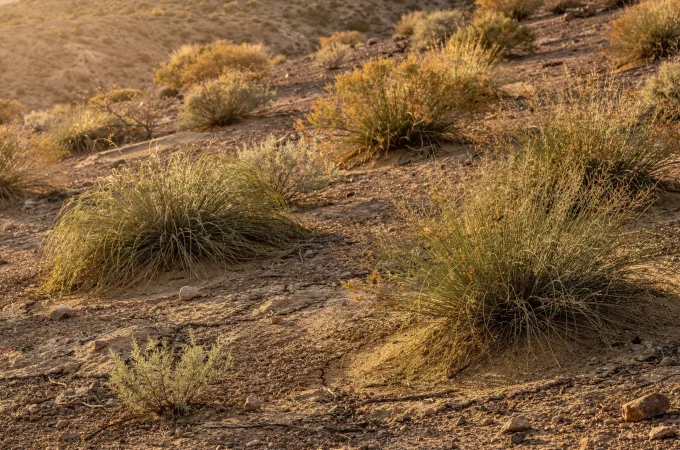
Desert grasses lack the visual drama of a dune field or a flowering cactus, so travelers tend to walk past them without a second look. Recognizing a tussock-forming grass anchoring a slope or a dune’s base is still a small, genuinely useful way to read how stable a given piece of desert terrain actually is.
Grasses as an Early Warning Sign
Desert grasses respond visibly and relatively quickly to changing conditions. They thin under sustained drought or grazing pressure, then recover after a good rainy season.
Land managers sometimes use that responsiveness formally, and travelers can read it informally, as an early indicator of broader ecosystem stress, well before more dramatic signs of desertification show up elsewhere in the landscape.
Related Topics
How Desert Plants Survive: Xerophyte Adaptations · What Is Desertification and Why Is It Spreading · Badlands and Erosion Landscapes · Rock Deserts and Desert Pavement · World Deserts Atlas
FAQ
Why are desert grasses ecologically important if they’re not very visually dramatic?
Their fibrous root systems stabilize soil against erosion at a scale individual cacti or trees don’t match, making them foundational to overall desert ecosystem stability even without visual prominence.
Has esparto grass had any historical human use beyond its ecological role?
Yes. It has a documented history of use in rope, basketry, and paper-making, a practical application that grew directly out of the same fibrous toughness that helps it survive arid conditions.
Can rolling or folding its leaves really help a grass survive drought?
Yes, but as a secondary mechanism. Closing stomata does most of the work of reducing water loss; leaf rolling adds a smaller, faster-reversing layer on top of that.
What happens to desert soil if its grass cover is lost?
It typically erodes considerably faster, since the fibrous root network that was physically binding the soil in place is no longer there, a key mechanism behind desertification in grass-anchored terrain.
Can grass cover really act as an early warning sign for land managers?
Yes. Grasses respond visibly and relatively quickly to drought or grazing pressure compared to slower-changing terrain, so their condition often works as an informal early indicator of broader ecosystem stress.