


A desert tree solves the water problem differently than a cactus. Instead of storing water above ground, it goes looking for it, sometimes tens of meters down.
Table Of Content
- The Deep-Root Strategy
- Worked Example: Acacia
- Worked Example: Tamarisk
- Worked Example: Date Palm
- Why These Species Anchor Larger Desert Ecosystems
- What This Means for Trip Planning
- A Note on Introduced vs. Native Ranges
- Related Topics
- FAQ
- How deep can a desert tree’s roots actually go?
- Why is the date palm specifically tied to oases rather than open desert?
- Why is tamarisk sometimes considered a problem species rather than just a survival success story?
- Can spotting large trees in the distance actually help while traveling in open desert?
- Is tamarisk native everywhere it’s now found?
The Deep-Root Strategy
Many desert trees and larger shrubs invest heavily in deep taproots. Unlike shallow-rooted cacti, they push down toward groundwater far below the surface.
That strategy trades a slower start for long-term payoff. A young desert tree often puts far more energy into root growth than into anything visible above ground, securing its water supply before it prioritizes height.
The record for this belongs to Boscia albitrunca, the shepherd’s tree of the Kalahari. Canadell et al. (1996), published in Oecologia, documented its roots at 68 meters, the deepest confirmed rooting depth of any plant species on record.
Worked Example: Acacia
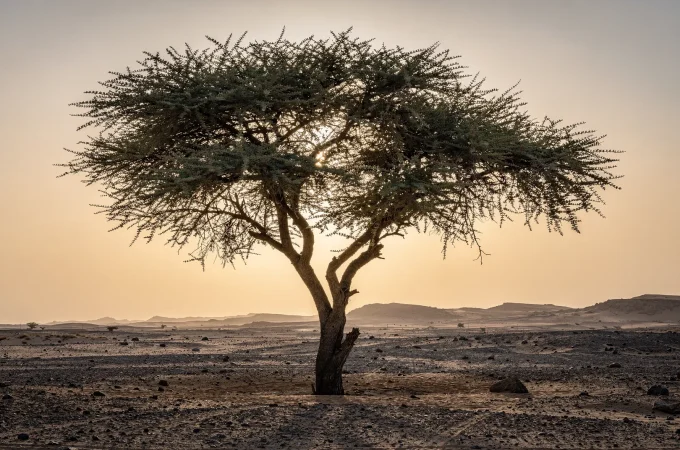
Acacia species are widespread across African and Middle Eastern deserts and count among the classic deep-root desert trees. Most carry small, water-conserving leaflets, and many species grow thorns as defense against browsing animals competing for their foliage.
Several acacia species also shed leaflets during periods of extreme summer heat or drought, cutting water loss further before re-foliating once conditions improve.
Worked Example: Tamarisk

Tamarisk, also called salt cedar, tolerates soil salt concentrations that would harm most other plants. It absorbs dissolved salts through its roots and excretes the excess through specialized glands on the undersides of its leaves.
Utah State University Extension’s tree guide confirms this excretion mechanism directly. The excreted salt accumulates as a visible crust on the soil surface beneath the plant, which can make the immediate area less hospitable to less salt-tolerant species nearby.
Worked Example: Date Palm

The date palm ties closely to oasis ecosystems specifically. It needs consistent access to groundwater or surface water that only an oasis setting reliably provides.
Its presence often marks accessible water in an otherwise arid landscape. That is part of why date palms cluster so reliably around Desert Oases: How They Form sites rather than appearing scattered through open desert.
Why These Species Anchor Larger Desert Ecosystems

Trees and large shrubs that reach reliable water sources often become focal points for surrounding wildlife. They provide shade, food, and structural habitat in landscapes where those resources stay scarce otherwise.
A single mature acacia or date palm can measurably concentrate more animal activity nearby than the surrounding open terrain does.
What This Means for Trip Planning

These larger plants tend to cluster around actual water access. That makes their presence on the horizon a genuinely useful practical signal while traveling through open desert.
A stand of date palms or a mature acacia grove reliably indicates an oasis or a shallow aquifer nearby, long before any built infrastructure comes into view. Local guides in many desert regions read vegetation this way as a practical navigation aid, since a distant tree line is visible from much further away than a small settlement or water source itself would be.
A Note on Introduced vs. Native Ranges
Tamarisk is a useful reminder that a plant’s remarkable adaptations do not automatically make it a good ecological fit everywhere. It originates from parts of Eurasia and Africa.
Land managers introduced tamarisk to the American Southwest in the early 1800s to control riverbank erosion. Smithsonian Magazine documents how it went on to dominate over a million acres of riparian habitat along the Colorado River system, spreading well beyond its intended range. Its salt tolerance and deep-root strategy let it outcompete native vegetation less suited to disturbed or saline soil.
Related Topics
How Desert Plants Survive: Xerophyte Adaptations · Desert Oases: How They Form · Desert Grasses and Groundcover · World Deserts Atlas · What Is Desertification and Why Is It Spreading?
FAQ
How deep can a desert tree’s roots actually go?
The documented record belongs to Boscia albitrunca in the Kalahari, at 68 meters. Most desert trees root far shallower than that, and exact depth varies significantly by species and local water-table conditions.
Why is the date palm specifically tied to oases rather than open desert?
It needs more consistent water access than a typical deep-rooted desert tree. An oasis’s reliable, aquifer-fed water supply meets that requirement in a way open desert soil generally cannot.
Why is tamarisk sometimes considered a problem species rather than just a survival success story?
Its aggressive spread and salt-excretion habit make surrounding soil less hospitable to native vegetation. Land managers in several regions actively monitor and, in some cases, control its spread as a result.
Can spotting large trees in the distance actually help while traveling in open desert?
Yes, as a general signal. Deep-rooted trees and oasis species cluster reliably around accessible water, so their presence on the horizon works as a genuinely useful, low-tech indicator of water nearby.
Is tamarisk native everywhere it’s now found?
No. It originates from parts of Eurasia and Africa and has spread considerably beyond that range in places like the American Southwest, where its salt tolerance and aggressive growth let it outcompete native desert vegetation.