


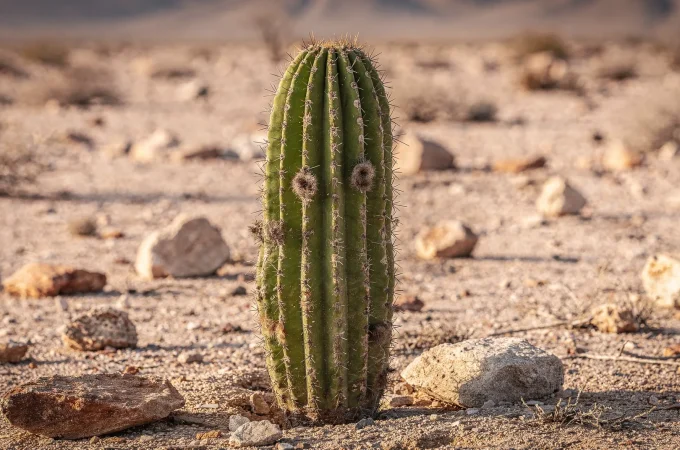
Cactus spines are not decoration. They are highly modified leaves that have lost most or all of their photosynthetic function. Defense and water conservation shaped them instead.
Table Of Content
- What Makes a Cactus a Cactus
- How Cacti Store and Use Water
- Ribbed Expansion
- Cactus vs. Succulent: The Actual Difference
- Root Strategy
- Why Cacti Are Considered Such an Efficient Design
- Where Cacti Are Actually Native
- Why Cactus Flowers Are Often Short-Lived
- Related Topics
- FAQ
- Are all spiny desert plants cacti?
- How long can a large cactus survive without rain?
- Why do cacti grow so slowly compared to other plants?
- What’s the single feature that confirms a plant is a true cactus?
- Can succulents that aren’t cacti survive just as long without water?
- Are cacti found naturally outside the Americas?
What Makes a Cactus a Cactus

Cacti are a specific plant family, Cactaceae, distinguished by areoles. These are small, cushion-like structures from which spines, flowers, and new growth all emerge. This feature is unique to cacti among succulent plants generally.
Britannica’s entry on the areole describes it as a modified axillary bud or short shoot. Botanists have not found one in any other plant family, which makes it the single structural feature that unambiguously identifies a true cactus.
Cactus spines are modified leaves, reduced to minimize surface area and water loss. They also double as physical defense against animals seeking the plant’s stored water.
How Cacti Store and Use Water
The thick, fleshy stem does the photosynthetic work leaves normally handle in other plants. It also serves as the primary water-storage tissue. Some large cacti can hold substantial water reserves collected during rare rainfall.
The plant draws down that reserve gradually across long dry periods. Stem tissue that prioritizes storage over rapid growth is part of the reason. Drought and limited nutrients add to it, and together these factors often produce the notably slow growth rates seen across the cactus family.
Ribbed Expansion
Many cactus stems are ribbed or pleated. That structure lets the plant expand like an accordion as it absorbs water after rain. It then contracts as the plant draws down that reserve, without cracking the outer tissue.
The ribs do a second job too. Each ridge casts a small shadow onto the neighboring furrow through most of the day, which shields part of the stem’s surface from direct sun. In some ribbed cacti, the sun-facing ridges also carry fewer and smaller stomata than the shaded furrows. That difference cuts evaporation exactly where sun exposure runs highest.
Cactus vs. Succulent: The Actual Difference

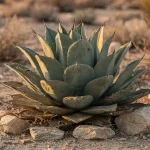
All cacti are succulents, but not all succulents are cacti. Succulent is a broad functional term for any plant that stores water in thickened tissue. Many non-cactus families qualify, including Aloe and Agave. Cactus refers specifically to the Cactaceae family and its areole feature.
This distinction matters on the ground. Many desert travelers assume any spiny, fleshy plant they see is a cactus. It may in fact be an unrelated succulent that evolved a similar appearance independently.
Root Strategy
Many cacti rely primarily on shallow, wide-spreading root systems. That design captures as much surface moisture as possible immediately after a rare rain event, rather than reaching deep for groundwater. Root depth and structure still vary substantially among species and habitats.
Some cacti extend these lateral roots considerably further than the plant’s own visible height above ground.
Why Cacti Are Considered Such an Efficient Design
Cacti combine succulence, CAM photosynthesis, spine-reduced leaves, and a rapid-response shallow root system in one plant. That combination is part of why cacti rank among the most specialized desert-survival body plans in the plant kingdom. Nearly every major water-conservation strategy that How Desert Plants Survive: Xerophyte Adaptations covers shows up in a single cactus at once.
That layering also lets cacti occupy desert niches other plants can’t reach. A location too dry and too exposed for a deep-rooted tree or a broad-leafed shrub can still support a cactus. The cactus draws on several water-saving mechanisms simultaneously to make that possible. This is part of why cacti dominate the visual identity of so many arid landscapes, despite representing a comparatively small fraction of total desert plant diversity.
Where Cacti Are Actually Native
Nearly all cacti are native specifically to the Americas. The main exception is Rhipsalis baccifera. This cactus species’ natural range extends beyond the Americas into parts of tropical Africa, Madagascar, and Sri Lanka.
The many other cactus-like plants seen in the world’s deserts, particularly in parts of Africa and Madagascar, are typically unrelated succulents. Certain Euphorbia species are the clearest example. They evolved a similar spiny, water-storing form independently through convergent evolution, not through any true botanical relation to cacti.
Why Cactus Flowers Are Often Short-Lived
Many cactus flowers open for only a single day or night before wilting. This short flowering window often lines up with the activity of specific pollinators, especially nocturnal moths and, in some species, bats. Flowering duration varies considerably among species.
The plant still needs that pollinator active during the narrow open window to succeed, whether a bat, moth, or bee depending on the species.
Related Topics
How Desert Plants Survive: Xerophyte Adaptations · Desert Grasses and Groundcover · Desert Trees and Shrubs · World Deserts Atlas · Rare and Endemic Desert Plants
FAQ
Are all spiny desert plants cacti?
No. Many non-cactus succulents, including some Agave and Euphorbia species, also have spines through convergent evolution. Only plants with areoles are true cacti.
How long can a large cactus survive without rain?
Some large, established cacti with substantial stored water reserves can survive many months without substantial rainfall. The actual duration varies greatly with species, size, temperature, soil conditions, and how much water the plant had stored beforehand.
Why do cacti grow so slowly compared to other plants?
Their stem tissue prioritizes water storage capacity over rapid growth, and CAM photosynthesis favors water-use efficiency over maximum carbon uptake. Combined with drought and limited nutrients, these trade-offs often produce slow growth in desert cacti.
What’s the single feature that confirms a plant is a true cactus?
The areole is the small, cushion-like structure from which spines, flowers, and new growth emerge. It is unique to the Cactaceae family, and botanists treat it as the definitive identifying feature.
Can succulents that aren’t cacti survive just as long without water?
Many can. Succulence itself, water storage in thickened tissue, is the primary mechanism at work in both groups. The areole distinction is about family classification, not drought tolerance.
Are cacti found naturally outside the Americas?
With one well-documented exception, Rhipsalis baccifera, no. Cactus-like plants seen in African or Madagascar deserts are typically unrelated succulents. They evolved a similar appearance independently, and are not true members of the Cactaceae family.