

Africa alone hosts the largest hot desert on Earth. It’s also home to one of the oldest deserts anywhere, arid for tens of millions of years, plus a fog-harvesting beetle that might be this Hub’s single strangest fact.
Table Of Content
- The Sahara
- The Namib
- The Kalahari
- How These Three Deserts Compare
- Why Africa’s Deserts Get Special Attention in This Hub
- A Closer Look at the Sahara’s Internal Variety
- Related Topics
- FAQ
- Is the Sahara mostly sand dunes?
- What’s the difference between the Namib and the Kalahari?
- Does the Sahara’s size actually change over time?
- Why is the Namib considered one of the oldest deserts on Earth?
- Why does Africa get particularly detailed coverage in this atlas?
The Sahara
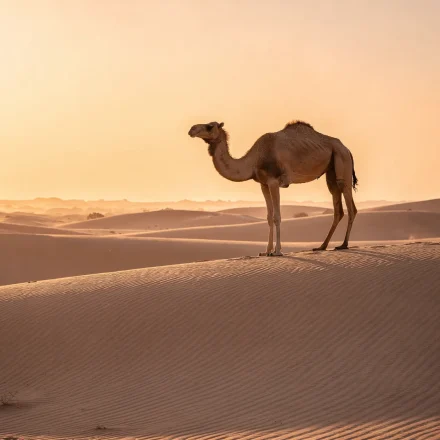
Britannica’s own entry on the Sahara puts its area at roughly 3,320,000 square miles, about 8,600,000 square kilometers. It spans North Africa across Morocco, Algeria, Tunisia, Libya, Egypt, Mauritania, Mali, Niger, Chad, and Sudan, making it by far the largest hot desert on Earth. The subtropical high-pressure mechanism shaped the Sahara, and the result is a landscape genuinely dominated by rock and gravel terrain, known as hamada and reg, rather than the endless dunes of popular imagination. Significant sand seas do exist within it, however. Britannica’s profile also notes the Sahara’s boundaries aren’t fixed. The desert measurably expands and contracts over time, depending on longer-term rainfall trends along its margins. Morocco’s Country Hub will cover the Sahara’s Erg Chebbi region in full trip-planning depth once that page goes live.

The Namib
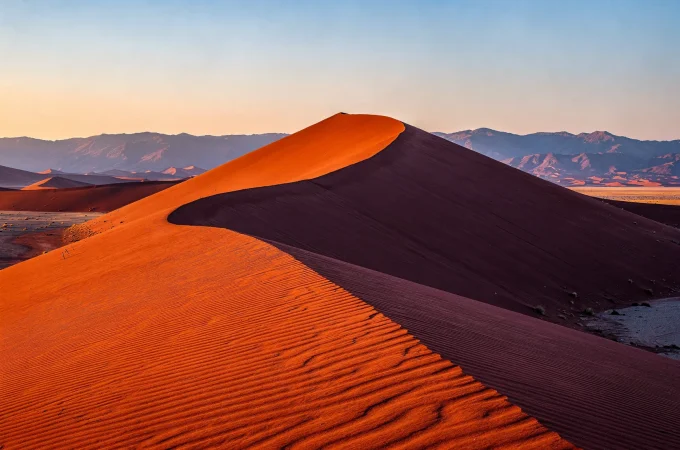
The cold Benguela Current mechanism, covered in Coastal Fog Deserts, shaped Namibia’s Namib Desert. It’s famous both for Sossusvlei’s towering red dunes and for its fog-harvesting beetles. Researchers frequently cite it among the oldest deserts on Earth, too. According to National Geographic, the Namib has persisted in some arid form for an estimated 55 to 80 million years. That’s a long enough timescale that its current specialized wildlife has had considerably more time to evolve fog-dependent adaptations than species in most younger desert ecosystems. Namibia’s Country Hub will cover this region in full trip-planning depth once that page goes live.

The Kalahari
The Kalahari spans parts of South Africa and Botswana. It’s a semi-arid to arid region, and it supports notably more vegetation and wildlife than a true hot desert like the Sahara. That makes it a useful worked example of the semi-arid classification covered in Desert vs. Semi-Arid vs. Steppe. Despite its “desert” name, much of the Kalahari receives enough seasonal rainfall to support grassland and scattered tree cover. That rainfall also sustains far more large wildlife than the Sahara’s harsher interior.

How These Three Deserts Compare
The Sahara, Namib, and Kalahari illustrate three genuinely different points on the aridity spectrum within a single continent. The Sahara is a true hot desert, dominated by rock and gravel. The Namib, by contrast, is a coastal fog desert sustained by an ocean current rather than rainfall. The Kalahari, meanwhile, is a semi-arid region that only partly meets the strict desert threshold. Seeing all three side by side is a useful reminder that “African desert” doesn’t describe one uniform landscape.
Why Africa’s Deserts Get Special Attention in This Hub
Two of Desert Booker’s five launch countries, Morocco and Namibia, sit directly within the deserts profiled on this page. That gives Africa’s desert geography particular relevance to this Hub’s existing trip-planning content, beyond its considerable general interest.
A Closer Look at the Sahara’s Internal Variety
Even within the Sahara itself, conditions vary enormously by region. The areas bordering the Atlas Mountains differ considerably from the deep interior, for instance. And the sand seas most travelers picture make up only a portion of the desert. Its full extent also includes mountain ranges, dry riverbeds, and vast gravel plains.
Related Topics
Coastal Fog Deserts · Subtropical High-Pressure Deserts · World Deserts Atlas
FAQ
Is the Sahara mostly sand dunes?
No. Rock and gravel terrain covers most of its area. Its sand seas, like Erg Chebbi in Morocco, are genuinely spectacular, though, which is why they’re disproportionately represented in popular imagery.
What’s the difference between the Namib and the Kalahari?
Formation mechanism and classification set them apart. The Namib is a true coastal fog desert. The Kalahari, on the other hand, is generally classified as semi-arid to arid, and it supports meaningfully more vegetation.
Does the Sahara’s size actually change over time?
Yes. Its boundaries fluctuate measurably based on longer-term rainfall trends along its margins. That means cited area figures represent a snapshot, not a permanently fixed measurement.
Why is the Namib considered one of the oldest deserts on Earth?
It has persisted in some arid form for an estimated 55 to 80 million years. That’s a long enough timescale for its wildlife to evolve highly specialized fog-dependent adaptations, which are rarely seen in younger desert ecosystems.
Why does Africa get particularly detailed coverage in this atlas?
Two of Desert Booker’s five current launch countries, Morocco and Namibia, sit directly within the deserts profiled here. That gives this continent’s desert geography direct relevance to existing trip-planning content.