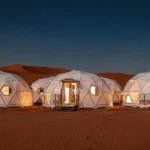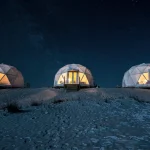

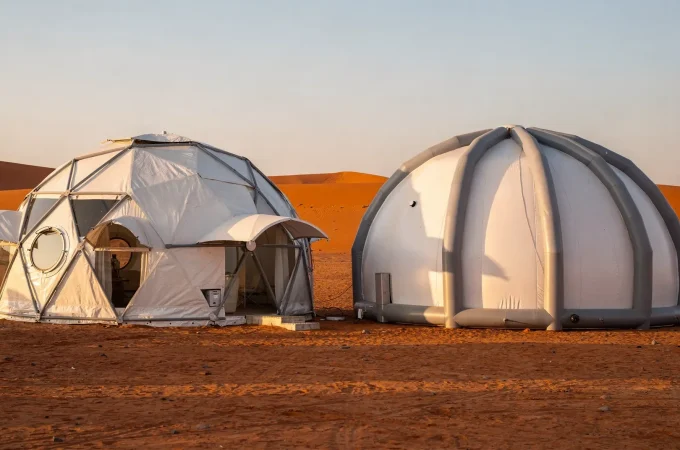
In the dome vs inflatable tent choice, the frame decides most of the stay. A geodesic dome stands on a rigid frame of triangular struts, while an inflatable tent stands on pressurised air beams. As a result, they differ in heat, light and sound. This guide compares the two for a desert night.
Table Of Content
- Dome vs Inflatable Tent: What Is the Difference?
- How Each Structure Is Built
- Heat: Which Stays Cooler by Day?
- Cold Nights: Dome vs Inflatable Tent
- Light: Clear Windows or Glowing Fabric
- Sound: Wind, Generators and Neighbours
- Dome vs Inflatable Tent Compared
- Which One Should You Book?
- FAQ
- Is a dome tent the same as an inflatable tent?
- Which is cooler in the desert, a dome or an inflatable tent?
- Which is quieter at night?
- Do inflatable tents lose air at night?
- Can I see the stars from both?
Dome vs Inflatable Tent: What Is the Difference?
A geodesic dome tent is a round shelter held up by a lattice of short, straight struts that form triangles. An inflatable tent, by contrast, has no rigid frame at all. Instead, thick fabric tubes filled with air hold the shape. So one is a building on a frame, and the other is a pressurised structure.
Both look round from the outside, which is why listings mix the names. However, the build changes how the room feels. For the wider picture, read our guide to the desert dome camp.
How Each Structure Is Built
A geodesic dome spreads load across many small triangles, so the frame stays stiff with little material. Camps cover the frame with canvas, PVC fabric or insulated panels. Many add a solid door and one large round window.
An inflatable tent works like an inflatable building on a small scale. Its beams usually have a tough outer sleeve over an inner bladder of PVC or thermoplastic polyurethane. The fabric between the beams then forms the walls. Our guide to the inflatable dome tent explains the beams in detail.
Heat: Which Stays Cooler by Day?

A covered geodesic dome usually stays cooler by day, because camps can fit thick insulated covers to a rigid frame. An inflatable tent has thinner single-layer walls, so sunlight warms the inside faster. In both cases, large clear windows add heat like a greenhouse.
Shade changes the picture more than the structure does. For example, a dome under a shade sail or beside a dune can stay far cooler than one in open sun. So most desert camps run air conditioning in both types. In fact, all 3 dome camps in Desert Booker’s database of 50 desert properties describe air conditioning.
Cold Nights: Dome vs Inflatable Tent
On cold nights, an insulated geodesic dome holds warmth better than a single-skin inflatable tent. Desert air can drop sharply after sunset, a pattern called diurnal temperature variation. Thin fabric loses that heat quickly.
Meanwhile, cool air also lowers the pressure inside air beams. Careful camps therefore check and top up the beams each evening. In winter, look for a heater and heavy bedding in either type.
Light: Clear Windows or Glowing Fabric
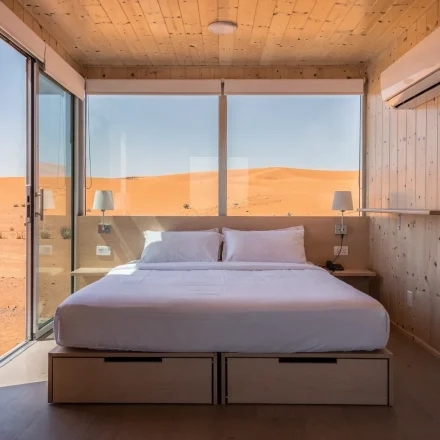
Light is where the two feel most different. A geodesic dome usually gives you one large clear window and a darker room around it. So you get a framed view of the dunes or the stars from bed.
An inflatable tent, on the other hand, lets daylight glow evenly through translucent fabric. The room feels bright and soft, yet the view outside is limited. If you want a full sky view, a clear bubble tent is a third option.
Sound: Wind, Generators and Neighbours

A padded geodesic dome with a solid door is usually quieter. Its rigid frame and thick cover damp the flap of fabric in wind. By contrast, the taut skin of an inflatable tent can drum in gusts.
Both types also carry outside noise, since neither has masonry walls. Therefore, ask where the generator sits and how far apart the units stand. A unit at the edge of the camp is often the quietest choice.
Dome vs Inflatable Tent Compared
| Factor | Geodesic dome | Inflatable tent |
|---|---|---|
| Frame | Rigid triangular struts | Pressurised air beams |
| Daytime heat | Lower with an insulated cover | Higher with thin walls |
| Night warmth | Holds heat better | Loses heat faster |
| Light | One clear window, darker room | Bright, diffuse glow |
| Sound in wind | Quieter, padded cover | Fabric can drum |
| Door | Often a solid hinged door | Usually a zip door |
| Daily checks | Few | Beam pressure and anchors |
Which One Should You Book?
Book a geodesic dome if you want a quiet room, a solid door and a framed view of the sky. Choose an inflatable tent if you like a bright, airy space and a short stay. Light sleepers should also ask about wind and generator noise in either case.
Above all, check the photos of the exact unit, because both names appear on very different builds. Then confirm air conditioning, heating and the bathroom before you pay.
FAQ
Is a dome tent the same as an inflatable tent?
No. A geodesic dome stands on rigid struts, while an inflatable tent stands on air beams.
Which is cooler in the desert, a dome or an inflatable tent?
Usually the insulated dome, because its thick cover slows the sun’s heat. Shade and air conditioning matter in both.
Which is quieter at night?
A padded geodesic dome with a solid door is usually quieter, since a taut inflatable skin can drum in wind.
Do inflatable tents lose air at night?
The pressure drops a little as the air cools, so careful camps check the beams each evening.
Can I see the stars from both?
Yes, through a clear window in a dome. However, an inflatable tent with opaque fabric shows far less sky.