
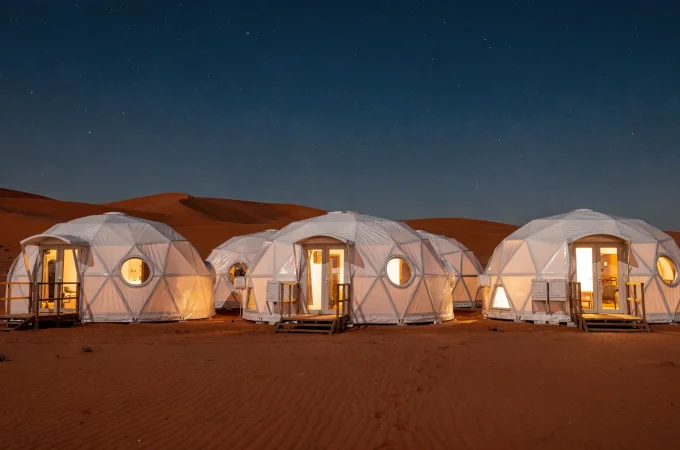
Dome camp prices change with the dome type, its size, its cooling, the sky view, the location, the season and the inclusions. In general, clear bubble domes and large geodesic domes with private bathrooms sit at the top. So this guide explains what moves the nightly rate and how domes compare with glamping tents.
Table Of Content
- What Changes Dome Camp Prices?
- Dome Type: Geodesic, Bubble or Air-Beam
- Size, Levels and Private Bathrooms
- Cooling: Why Domes Cost More to Run
- The Night Sky Factor
- Location and Season
- Inclusions: Meals, Transfers and Activities
- Dome Camp Prices vs Glamping Tents
- Dome Camp Prices: Drivers at a Glance
- FAQ
- Why do dome camps cost more than tents?
- Are bubble domes more expensive than geodesic domes?
- When are dome camps cheapest?
- Do dome camp rates include meals?
- Do desert dome camps have air conditioning?
What Changes Dome Camp Prices?
Dome camp prices depend mostly on how costly each dome is to build, cool and fill. For example, a dome needs a frame or air beams, a tough cover and often a large clear window. In addition, it traps heat like a greenhouse, so it needs more cooling than a canvas tent.
Most dome camps are also small. So a few units carry the camp’s fixed costs, from water trucks to generators to staff. Location, season and inclusions then push the rate up or down from there.
Dome Type: Geodesic, Bubble or Air-Beam
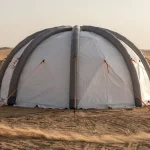
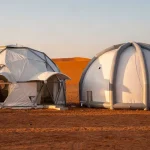
The dome type is the first price driver. A geodesic dome uses a frame of triangular struts under a fabric cover. By contrast, a bubble dome is a clear, frameless shell held up by air. An air-beam dome uses inflated tubes as its frame.
Clear bubbles often cost more per night, because they sell the full night sky. They also need careful cooling and privacy screens. Our guides to the desert dome camp and the bubble tent explain how each one is built.
Size, Levels and Private Bathrooms

Larger domes cost more, because they need a bigger frame, more cover and more cooling. Some camps even build two-level domes with a loft bed. As a result, these usually sit at the top of the rate card.
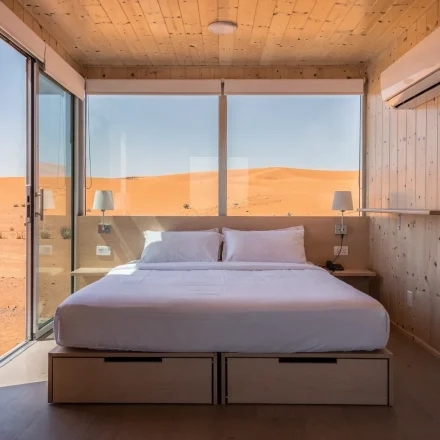
Bathrooms matter too. Also, most dome camps now attach a private bathroom pod to each dome. In Desert Booker’s database, all 3 dome camps describe private bathrooms and air conditioning. So a dome with a shared bathroom block should cost noticeably less.
Cooling: Why Domes Cost More to Run
A dome with a large clear panel lets in strong sunlight, and the heat builds up inside. Therefore, most desert dome camps run air conditioning, often around the clock in warm months. Remote camps make that power with generators or solar systems, which adds to the nightly rate.
However, some camps cut costs with reflective outer covers or shade on the sunny side. Others close in midsummer instead. Either way, cooling is a larger share of a dome’s running cost than a tent’s.
The Night Sky Factor

Many guests book a dome to see the stars from bed, and camps price that in. A dark site far from towns gives a clearer view, because light pollution stays low. Some camps describe their sky with the Bortle scale, where lower numbers mean darker skies.
The moon matters as well. In fact, nights near a new moon show far more stars than nights near a full moon. So stargazing packages often cluster around dark-moon dates, and those dates can fill first.
Location and Season
Location shapes both demand and running costs. Famous sites such as Wadi Rum in Jordan hold many dome camps, so prices there vary widely. Meanwhile, a remote dome in deep dunes pays more for water, power and transfers.
Season follows the same pattern as other desert stays. The cool months, from about October to April in the Arabian Peninsula and North Africa, carry the highest rates. Weekends and public holidays fill first, while midweek shoulder nights usually cost less.
Inclusions: Meals, Transfers and Activities
Like tented camps, most dome camps bundle dinner and breakfast into the rate. Many add a transfer from the nearest road, since domes often sit off the paved network. Some include a guided stargazing session or a sunset drive.
Before you compare two dome camps, list what each rate covers. A lower rate without dinner or the transfer can end up costing more in total.
Dome Camp Prices vs Glamping Tents
Domes usually cost a little more than glamping tents at the middle of the market. Desert Booker collected 11 public dome rates in 4 countries. In addition, the median dome rate was about 1.3 times the median glamping tent rate in the same sample.
The spread is narrower for domes, though. Here, the highest dome rate was about 14 times the lowest, while glamping tents spread more than 100 times. The sample is small and mixes dates, so use it as a direction only. For the tent side, see our guide to desert glamping.
Dome Camp Prices: Drivers at a Glance
| Driver | Pushes the rate up | Pulls the rate down |
|---|---|---|
| Dome type | Clear bubble, large geodesic | Small covered dome |
| Size and levels | Two levels, loft bed | Single small room |
| Bathroom | Private attached pod | Shared block |
| Cooling | Air conditioning all day | Shaded cover, fans |
| Sky and moon | Dark site, new moon dates | Near town, full moon dates |
| Season | Cool months, holidays | Shoulder months, midweek |
| Inclusions | Full board, transfer, stargazing | Room only, own transport |
FAQ
Why do dome camps cost more than tents?
Domes cost more to build and cool, and clear domes sell the night sky. Most camps also have only a few units.
Are bubble domes more expensive than geodesic domes?
Often, yes. Clear bubbles need more cooling and privacy screening, and they offer a full sky view.
When are dome camps cheapest?
Midweek nights in the shoulder months, and often nights near a full moon.
Do dome camp rates include meals?
Most include dinner and breakfast. Many also include a transfer and a stargazing session.
Do desert dome camps have air conditioning?
Most do, since all 3 dome camps in Desert Booker’s database describe air conditioning.
Photo credits: Night sky in the Sahara – Morocco by Mustang Joe, CC0 1.0, cropped from the original. All via Wikimedia Commons.