

Air beam tent safety in desert wind depends less on the tent and more on how the camp anchors and runs it. An air-beam dome flexes in gusts and springs back, so the frame itself rarely fails. The weak points are anchors in loose sand, beam pressure and the camp’s plan for storms. This guide explains each one.
Table Of Content
- Are Air-Beam Dome Tents Safe in Desert Wind?
- How an Air-Beam Dome Resists Wind
- Where Air Beam Tent Safety Fails: Anchors in Sand
- Heat, Cold and Beam Pressure
- Sandstorms and Haboobs: The Real Test
- What a Safe Camp Does Before the Wind Arrives
- What Guests Should Do in Strong Wind
- Wind Strength and Air Beam Tent Safety
- Questions to Ask a Camp About Air Beam Tent Safety
- FAQ
- Can an air-beam tent pop in strong wind?
- Are inflatable tents safer than pole tents in wind?
- Do air beams lose pressure at night?
- What happens to a dome camp in a sandstorm?
- Should I touch the valves on my dome tent?
Are Air-Beam Dome Tents Safe in Desert Wind?
Yes, a well-anchored air-beam dome tent handles normal desert wind well. Its inflated tubes bend under a gust instead of snapping like a metal pole. Then they push the fabric back into shape once the gust passes.
However, no tent is safe in every storm. Strong gusts can pull stakes out of dry sand, and a dust storm can arrive within minutes. So safety comes from three things working together: the structure, the anchors and the people running the camp.
How an Air-Beam Dome Resists Wind
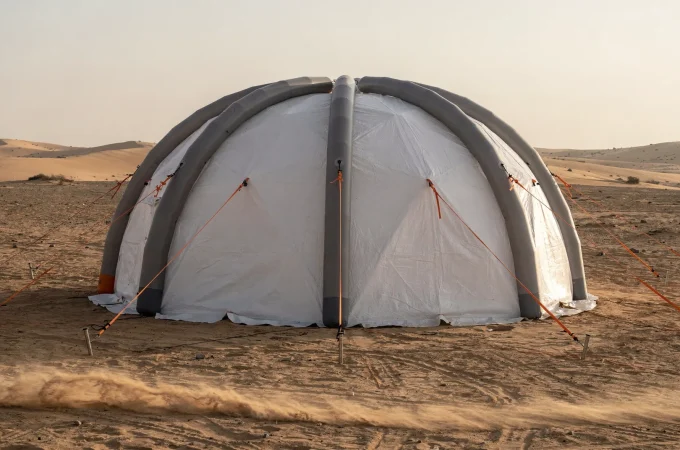
An air-beam dome uses inflated tubes, called air beams, as its frame. The tubes hold their shape because of pressure inside, much like an inflatable building. Most use a tough outer sleeve over an inner bladder of PVC or thermoplastic polyurethane.
The rounded shape helps too, because wind slides over a dome rather than hitting a flat wall. In addition, guy lines spread the load to the ground on every side. Our guide to the inflatable dome tent explains the structure in more detail.
Where Air Beam Tent Safety Fails: Anchors in Sand
Anchoring is the main weak point in air beam tent safety. Dry sand has almost no cohesion, so a short tent stake can slide out under a steady pull. The Danish national annex to the European tent standard EN 13782 makes the same point. It warns that the standard’s anchor calculations may not be conservative in sand, especially sand with very little clay.
For that reason, good desert camps use longer stakes, sand anchors, buried plates or heavy ballast. They also run more guy lines than a city campsite would. Look at the anchors when you arrive. Long, deep stakes and taut lines are a good sign.
Heat, Cold and Beam Pressure
Desert temperatures change beam pressure. As the air inside heats up by day, the pressure rises. Then it falls again as the night cools, so a firm beam at noon can feel softer at dawn.
A soft beam lets the dome flex more in wind. Therefore, careful camps check pressure with a gauge at least daily, often morning and evening. They top up or release air as needed. If a beam feels soft to the touch, tell the staff rather than adjusting a valve yourself.
Sandstorms and Haboobs: The Real Test

A sandstorm is the real test of any desert tent. The strongest kind, a haboob, is a wall of dust pushed ahead of a storm front. It can bring sudden strong gusts and very low visibility.
Fine sand also gets into zips, valves and seams. In practice, a camp may close the domes and move guests into a solid building or vehicle until the storm passes. National weather services, such as the UAE’s National Center of Meteorology, issue warnings for dust and strong wind.
What a Safe Camp Does Before the Wind Arrives

A safe camp has a written wind plan and someone who watches the forecast. Better still, it measures wind on site with an anemometer or at least a windsock. It also sets a clear limit for when guests leave the domes.
Before a storm, staff check every anchor and tighten every guy line. They close doors and windows and stow loose furniture. Meanwhile, they prepare a shelter, such as the dining building or the camp vehicles. Finally, they tell guests where to go and when.
What Guests Should Do in Strong Wind
Follow the staff first, because they know the site and the forecast. Keep the dome’s zips closed so wind cannot get under the fabric. Also keep shoes and bags off the guy lines, since a loose line weakens the whole tent.
Never adjust valves or stakes on your own. If you hear a loud flapping sound or see a beam bending more than usual, leave and tell the staff. At night, keep a torch and your shoes by the bed.
Wind Strength and Air Beam Tent Safety
The Beaufort scale describes wind strength in steps. Below, the table links each step to what a careful camp usually does. Exact limits vary by tent model, so always ask the camp for its own.
| Beaufort force | Wind speed | On site | Typical camp response |
|---|---|---|---|
| 4, moderate breeze | 20 to 28 km/h | Sand starts to drift | Normal use, routine checks |
| 5 to 6, fresh to strong breeze | 29 to 49 km/h | Blowing sand, flapping fabric | Extra checks on anchors and lines |
| 7, near gale | 50 to 61 km/h | Hard to walk against the wind | Prepare shelter, close all openings |
| 8 and above, gale | 62 km/h and more | Dust storm conditions | Guests move to solid shelter |
Questions to Ask a Camp About Air Beam Tent Safety
Ask five questions before you book a dome stay. First, what wind speed makes you move guests out? Second, how do you anchor the domes in sand? Third, how often do you check beam pressure?
Fourth, where do guests shelter in a storm? Fifth, do you have a backup way to inflate the beams if power fails? Domes remain rare, since only 3 of the 50 properties in Desert Booker’s database are dome camps. So compare carefully, and read our guide to the desert dome camp for the wider picture.
FAQ
Can an air-beam tent pop in strong wind?
Rarely, since the beams flex and recover. The bigger risk is anchors pulling out of loose sand.
Are inflatable tents safer than pole tents in wind?
They often cope better with gusts, because the beams bend instead of breaking. Anchoring still decides safety in sand.
Do air beams lose pressure at night?
Yes, a little. Cooler air lowers the pressure, so careful camps check and top up the beams daily.
What happens to a dome camp in a sandstorm?
A well-run camp closes the domes and moves guests to a solid building or vehicle until the storm passes.
Should I touch the valves on my dome tent?
No. Tell the staff if a beam feels soft, and let them adjust the pressure.
Photo credits: United States Airport Windsock at 66G Airport, Frankenmuth, MI by Mrmanssss, CC0 1.0, cropped from the original. All via Wikimedia Commons.