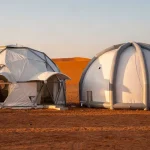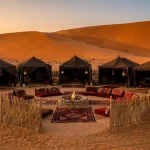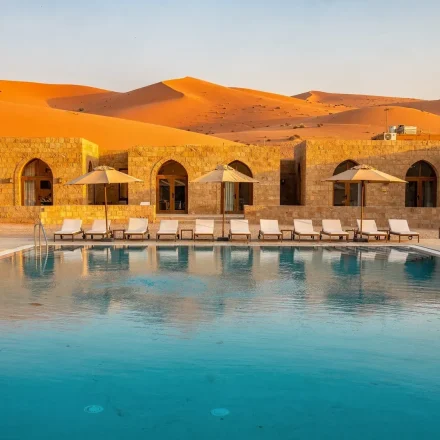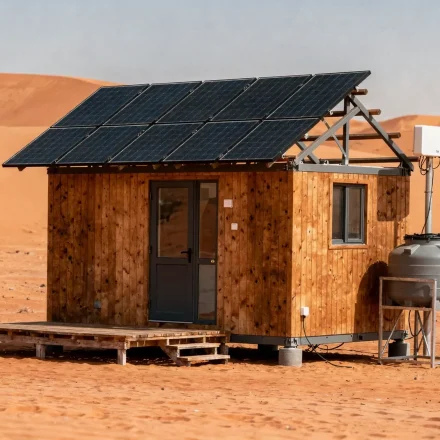

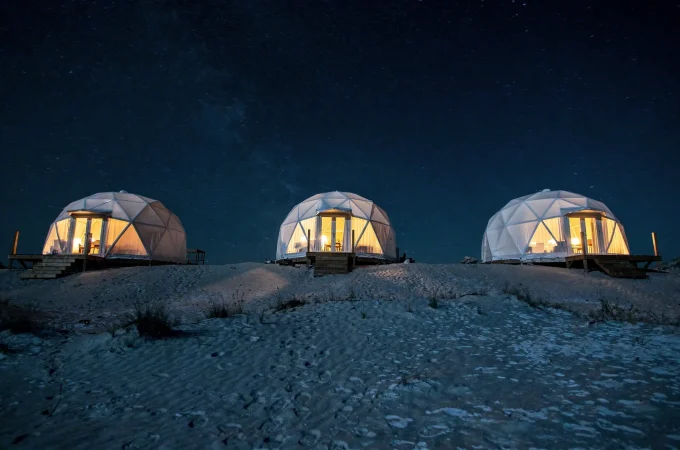
Dome tent temperature at night follows the desert air outside unless the camp adds insulation and heating. Clear desert skies let heat escape fast after sunset, so a thin dome can turn cold by midnight. However, an insulated dome with a heater and heavy bedding stays comfortable. This guide explains how camps manage both heat and cold.
Table Of Content
- Dome Tent Temperature at Night: How Warm Is It?
- Why Desert Nights Get So Cold
- Where a Dome Tent Loses Heat
- How Camps Keep Dome Tents Warm
- Why a Dome Tent Can Stay Hot After Sunset
- How Camps Keep Dome Tents Cool
- Dome Tent Temperature by Season
- How to Manage Dome Tent Temperature as a Guest
- FAQ
- Do dome tents get cold at night in the desert?
- Why is the desert cold at night?
- Do desert dome camps have heating?
- Why is my dome hot after sunset?
- What should I wear in a dome tent at night?
Dome Tent Temperature at Night: How Warm Is It?
At night, a dome tent is only as warm as its walls, floor and heating allow. A single-layer fabric dome loses heat almost as fast as the air cools outside. Meanwhile, an insulated dome with a liner, a raised floor and a heater can stay close to room temperature.
So the answer depends on the build, not the shape. Before you book, ask what the walls are made of and how the camp heats the dome. Our guide to the desert dome camp covers the common builds.
Why Desert Nights Get So Cold

Desert nights get cold because dry air and clear skies let heat escape quickly. During the day, the sand stores heat from the sun. After sunset, the ground releases it straight up into a cloudless sky, a process called radiative cooling.
Dry air also holds little moisture, so it keeps little warmth. As a result, the gap between day and night can be wide, a pattern known as diurnal temperature variation. In the Arabian Peninsula, winter nights can feel cold even after a warm afternoon.
Where a Dome Tent Loses Heat
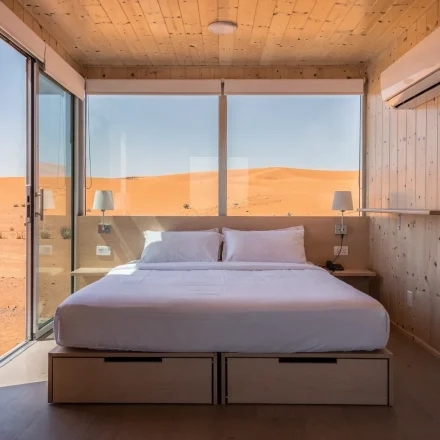
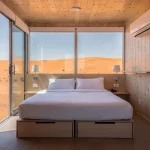
Most heat leaves a dome tent through its walls, its window, its floor and the gaps around the door. Thin fabric lets warmth pass straight through. Similarly, a large clear window acts like a cold panel once the sun goes down.
The floor matters too, because cold sand draws heat from anything that touches it. Therefore, a dome on a raised timber deck feels warmer than one placed directly on the sand. Small gaps at the door and vents also let warm air escape upward.
How Camps Keep Dome Tents Warm
Camps keep domes warm with insulation, heaters and bedding. To begin with, many fit a quilted inner liner inside the frame, which adds thermal insulation. Next, they raise the floor on a deck and cover it with rugs.
Heating usually comes from an electric radiator or a reverse-cycle air conditioner. In addition, good camps add heavy duvets and extra blankets in winter. Heating is still less common than cooling, though. In Desert Booker’s database of 50 desert properties, 18 mention air conditioning but only 7 mention any heating.
Why a Dome Tent Can Stay Hot After Sunset
In summer, a dome can stay hot for an hour or two after sunset. A large clear window traps sunlight during the day, much like the greenhouse effect. Then the floor, furniture and bedding slowly give that heat back.
So the early evening can feel warmer inside than outside. Opening vents and the door at dusk lets the trapped heat out. After that, the dome usually cools with the night air.
How Camps Keep Dome Tents Cool
Camps keep domes cool with shade, reflective covers and air conditioning. For example, some stretch a shade sail over the dome or place it beside a dune. Others fit a reflective outer layer that turns the sun away.
Most desert dome camps still rely on air conditioning in warm months. In fact, all 3 dome camps in our database describe it. Read whether glamping tents have air conditioning for how cooling works in fabric stays.
Dome Tent Temperature by Season
| Season | Night feel outside | What the dome needs |
|---|---|---|
| Winter | Cold, sometimes near freezing in open desert | Liner, heater, heavy duvet |
| Spring and autumn | Mild to cool | Light blanket, sometimes a fan |
| Early summer | Warm | Air conditioning, open vents at dusk |
| Peak summer | Hot, little cooling at night | Strong air conditioning; many camps close |
How to Manage Dome Tent Temperature as a Guest

You can manage dome tent temperature with a few simple steps. First of all, ask whether the dome has a heater, air conditioning or both. Then ask for extra blankets before the night turns cold.
Pack warm layers, socks and a hat for winter nights. For more on bedding and power, see glamping camp features. Keep the door zipped or closed after dark, because warm air escapes fast. Finally, close the window curtain if the dome has one, since clear panels lose heat quickly.
FAQ
Do dome tents get cold at night in the desert?
Yes, without insulation or heating. Insulated domes with a heater stay comfortable.
Why is the desert cold at night?
Because dry air and clear skies let the day’s heat escape quickly after sunset.
Do desert dome camps have heating?
Some do, often through a heater or a reverse-cycle air conditioner. Ask before winter stays.
Why is my dome hot after sunset?
The clear window traps sunlight, so the floor and furniture release heat for a while after dusk.
What should I wear in a dome tent at night?
In winter, wear warm layers and socks. Also ask the camp for extra blankets.