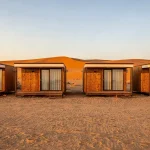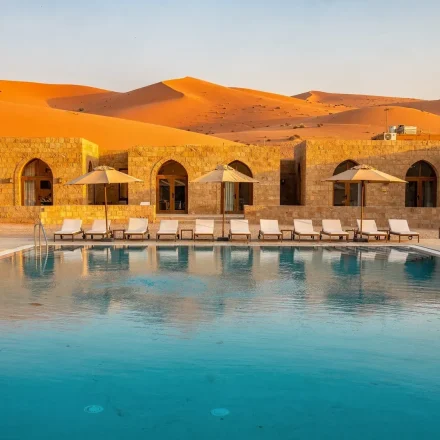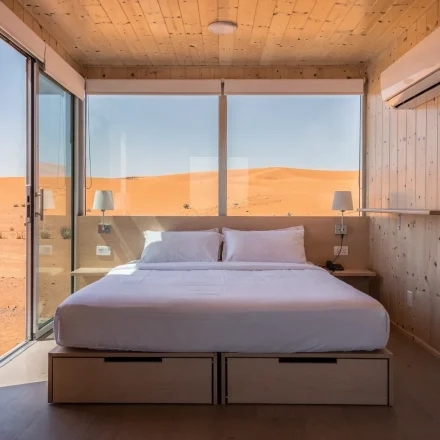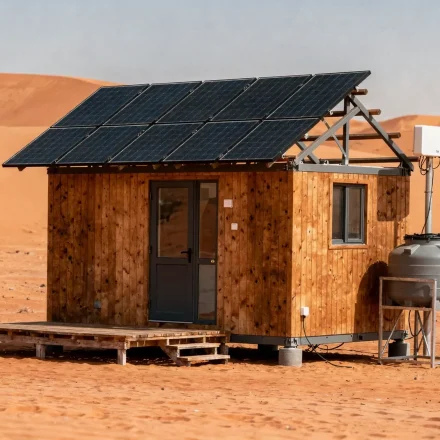
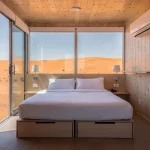
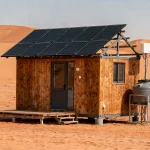

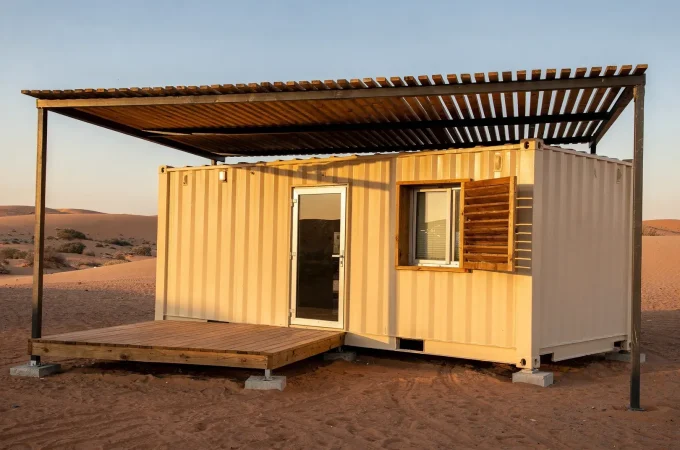
A desert container stay is a guest room built inside a converted steel shipping container. Comfort depends almost entirely on insulation, shade and ventilation, because bare steel heats fast in the sun and turns cold at night. Well-built units add an insulated lining, a shade roof and air conditioning. This guide explains what to check.
Table Of Content
- What Is a Desert Container Stay?
- Why Steel Boxes Get Hot in the Sun
- Insulation: The Layer That Makes It Livable
- Shade Roofs and Raised Floors
- Ventilation and Condensation
- Is a Desert Container Stay Comfortable in Summer?
- Container vs Tent vs Modular Cabin
- What to Check Before Booking a Desert Container Stay
- FAQ
- Do shipping container stays get too hot in the desert?
- Are container stays cold at night?
- Why do containers get damp inside?
- Is a container stay quiet?
- How common are container stays in the desert?
What Is a Desert Container Stay?
A desert container stay is a room made from a standard shipping container, fitted with a bed, windows, a bathroom and cooling. Builders cut openings in the steel, line the inside and set the box on footings. The result is a compact cabin that a truck can deliver to remote sites.
The idea comes from shipping container architecture, which reuses boxes as homes, cafes and offices. However, the type is still rare in the desert. In fact, none of the 50 desert properties in Desert Booker’s database is a container stay. For the wider modular family, read our guide to glamping pods in the desert.
Why Steel Boxes Get Hot in the Sun
Steel boxes get hot because thin steel absorbs sunlight and passes heat straight inside. The roof takes the strongest sun, so it heats first. As a result, an unlined container can feel like an oven by midday.
The same steel also loses heat fast after sunset. So a bare container swings from hot to cold far more than a stone room. That is why the lining, not the box, decides comfort.
Insulation: The Layer That Makes It Livable

Insulation is the single most important feature of a container stay. Builders fit spray foam, rigid foam boards or mineral wool inside the steel, then cover it with timber or panels. This thermal insulation slows heat moving in by day and out by night.
However, gaps matter as much as thickness. Steel frames and fixings can carry heat around the insulation, a weak point known as a thermal bridge. Good builds cover the whole shell, including the roof and floor, without bare steel showing inside.
Shade Roofs and Raised Floors
A separate shade roof is the second key feature. It sits above the container with an air gap, so the sun hits the shade first. Meanwhile, hot air escapes through the gap instead of soaking into the steel.
Light paint helps too, because pale colours reflect more sunlight than dark ones. In addition, raising the box on footings lets air pass underneath. Therefore, a shaded, pale and raised container stays far cooler than a dark one on the sand.
Ventilation and Condensation
Ventilation keeps a container fresh and dry. Without it, warm air and moisture build up inside the closed box. At night, that moisture can form droplets on any cold steel surface once it drops below the dew point.
For this reason, good units add a roof vent, windows on two sides and a bathroom fan. Then air can cross the room and carry moisture out. If you see damp spots or rust stains in photos, ask how the camp handles condensation.
Is a Desert Container Stay Comfortable in Summer?

A desert container stay can be comfortable in summer, but only with insulation, shade and a working air conditioner. Most units also use a wall-mounted split system. Because the room is small, one unit usually cools it quickly.
The weak point is power. Remote sites that run on generators may limit cooling at night. So ask whether air conditioning runs all night, and whether the camp has backup power.
Container vs Tent vs Modular Cabin
| Factor | Container stay | Canvas tent | Timber modular cabin |
|---|---|---|---|
| Shell | Steel box, lined | Fabric | Timber or panel walls |
| Heat without insulation | Very high | High | Moderate |
| Holds warmth at night | Good when lined | Poor | Good |
| Noise from wind | Low | Higher | Low |
| Condensation risk | Higher on bare steel | Low | Low |
| Can move to a new site | Yes, by truck | Yes, packed | Yes, by truck |
What to Check Before Booking a Desert Container Stay
Before booking a desert container stay, check four things. To begin with, look for an inside lining with no bare steel. Next, look for a shade roof or deep shade over the unit.
Then confirm air conditioning, its hours and the power source. Finally, check for windows on two sides or a roof vent. For a different approach to heat, compare it with an adobe desert stay, which uses thick walls instead.
FAQ
Do shipping container stays get too hot in the desert?
Unlined ones do. However, insulated units with shade and air conditioning stay comfortable.
Are container stays cold at night?
Bare steel loses heat fast, but a good lining keeps the room warm.
Why do containers get damp inside?
Moisture forms on cold steel at night. So good units add vents and full insulation.
Is a container stay quiet?
Usually, yes, because steel walls with insulation block most wind noise.
How common are container stays in the desert?
Still rare. None of the 50 properties in Desert Booker’s database is a container stay.