


Go to Sir Bani Yas Island and you will almost certainly see one. That is remarkable, because the Arabian oryx was wiped out in the wild barely fifty years ago, and the UAE now holds more of them than any other country.
Table Of Content
- The Number That Makes This a Success Story
- Back From Extinct in the Wild
- How to Identify One
- The Unicorn Illusion, Explained
- Why the Coat Is White
- Why Gravel Plains Rather Than Dunes
- Drinking Without Water
- How the UAE Brought Them Back
- Where to See Arabian Oryx in the UAE
- Timing Matters More Than People Expect
- Watching Them Responsibly
- Explore More
- FAQ
- Where is the best place to see an Arabian oryx in the UAE?
- How many Arabian oryx are there today?
- Are Arabian oryx dangerous?
- Why is the oryx linked to unicorn legends?
- Is the species still endangered?
- How long are an Arabian oryx’s horns?
The Number That Makes This a Success Story
Two figures matter here, and they measure different things. Mixing them up is the most common mistake in coverage of this species.
The IUCN Antelope Specialist Group counts wild animals. Its assessment puts roughly 1,220 oryx living wild across Israel, Jordan, Oman, Saudi Arabia and the UAE, of which about 850 are mature. A further 6,000 to 7,000 live in captivity worldwide.
The UAE figure counts both together. According to the country’s Ministry of Climate Change and Environment, the national population reached 8,016 animals in 2023, with 5,679 of those in Abu Dhabi. So the UAE total is large precisely because it includes managed reserves, not only free-ranging herds.
Back From Extinct in the Wild
Hunting with rifles and vehicles removed the last wild Arabian oryx by the early 1970s. Zoos and private collections held the only survivors.
Reintroduction began in 1980. Then in 2011 the species became, in the Antelope Specialist Group’s words, the first animal to revert to Vulnerable status after previously being listed as Extinct in the Wild.
Note the exact wording, since it often gets stretched. The oryx was first, not the only one. Przewalski’s horse followed a similar path off the same list.
How to Identify One

Four features settle it quickly.
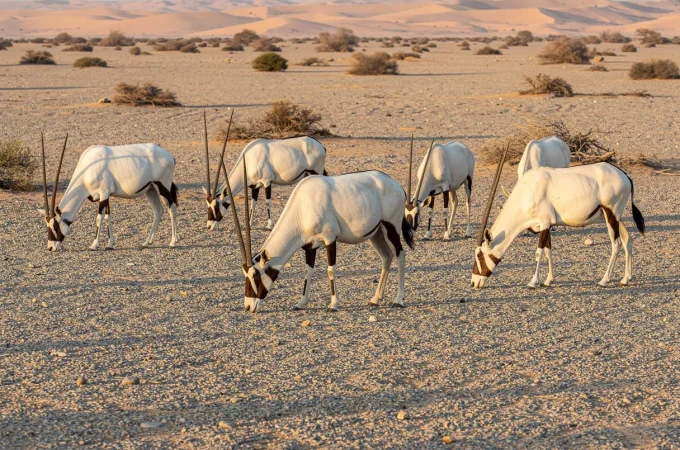
Height comes first: about a metre at the shoulder, with a distinct hump. Next, the coat reads near-white with sharply cut dark brown markings on the face and legs. Then the horns, which run straight and ringed, typically between 50 and 75 centimetres on both sexes.
Finally, compare it against the Arabian sand gazelle. That animal is tan rather than white, noticeably smaller, and carries curved horns instead of straight ones.
The Unicorn Illusion, Explained

Stand exactly side-on to a resting oryx and something odd happens.
Because both horns are straight and set close together, they overlap from that angle into what looks like one long spike. Writers and naturalists have long pointed to this effect as a likely source of unicorn stories across the region.
Treat it as a strong hypothesis rather than settled fact. Still, once you have seen the alignment yourself, the idea becomes hard to dismiss.
Why the Coat Is White
The colour is working, not decorative.
A pale coat reflects a large share of incoming solar radiation, so the animal absorbs less heat than a dark-coated mammal standing in the same spot. As a result, oryx tolerate open midday conditions that push other species into shade.
Their physiology helps too. Like other desert antelopes, they use a network of blood vessels at the base of the skull that cools blood heading to the brain, which lets core body temperature drift upward without damaging the brain itself.
Why Gravel Plains Rather Than Dunes
Ask most visitors where to look and they point at the dunes. That instinct is wrong.
Oryx favour open gravel plains, and two reasons explain it. First, stony flats support the sparse grasses and shrubs they graze far better than a deep sand sea does. Second, flat open ground gives long sightlines, so a herd spots approaching danger early.
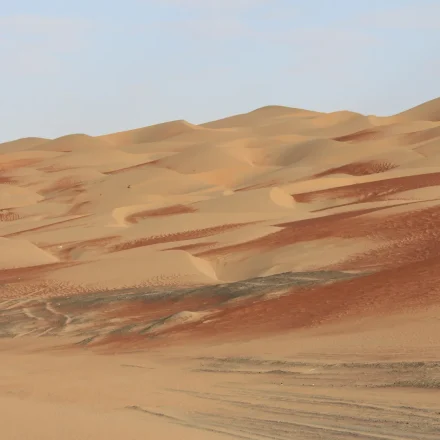
A maze of soft ridges would remove both advantages at once. If you want to understand the terrain difference properly, the Rub’ al Khali shows the opposite extreme.
Drinking Without Water
In good conditions, an oryx can go long stretches without drinking anything at all.
Moisture comes from the plants it grazes, plus metabolic water produced by digestion itself. Consequently the herd can range far from any waterhole, which is exactly what a species living on scattered desert vegetation needs.
That independence has limits, of course. Drought still hurts them, because it removes the plants the whole system depends on.
How the UAE Brought Them Back
Sheikh Zayed bin Sultan Al Nahyan began a breeding programme at Al Ain, then extended the effort to Sir Bani Yas Island in the late 1970s.
Those animals eventually supplied reintroductions elsewhere. Today the island reserve works alongside the Environment Agency in Abu Dhabi, breeding oryx and transferring them out to repopulate other sites.
Conservation biologists now cite the programme routinely as one of the clearest large-mammal recoveries anywhere.
Where to See Arabian Oryx in the UAE

Sir Bani Yas Island is the headline option. Reached by a short ferry from the Abu Dhabi mainland, it holds a herd reported at over 700 animals and runs guided safari drives through a genuinely large reserve.
Al Ain Zoo offers the alternative. Viewing there is closer and effectively guaranteed, with no ferry and no dependence on where a herd happens to be grazing.
Choose according to what you want. A reserve drive feels closer to an East African game drive, whereas a zoo visit trades that unpredictability for certainty.
Timing Matters More Than People Expect
Book the early-morning or late-afternoon drive at Sir Bani Yas rather than a midday slot.
Herds graze most actively in the cooler hours, so sightings come more easily then. Light behaves better too, since low sun models the white coats instead of flattening them.
Plenty of first-time visitors learn this only after booking the wrong slot once. For wider planning, the UAE desert travel guide covers seasons and transfers in more depth.
Watching Them Responsibly
Keep the distance your guide sets, and stay in the vehicle unless told otherwise. Photograph from the vehicle or from designated points, and never feed them.
These rules protect the animals rather than the visitors. Herds that learn to associate people with food lose the wariness that keeps them clear of vehicle traffic, while approaching on foot triggers stress responses that disrupt grazing for hours afterwards.
Given how narrowly this species avoided disappearing, that cost is not worth a closer photograph.
Explore More
UAE Country Hub · Rub’ al Khali · Liwa Oasis · UAE Desert Travel Guide
FAQ
Where is the best place to see an Arabian oryx in the UAE?
Sir Bani Yas Island for a guided reserve sighting, or Al Ain Zoo for a closer and effectively guaranteed view. The island offers atmosphere, while the zoo offers certainty.
How many Arabian oryx are there today?
The IUCN Antelope Specialist Group counts roughly 1,220 in the wild across five countries, including about 850 mature animals, plus 6,000 to 7,000 in captivity worldwide. Separately, the UAE reported 8,016 animals nationally in 2023, counting managed and wild together.
Are Arabian oryx dangerous?
No. They are grazing herbivores and avoid people. Nevertheless, those horns are long and sharp, so keeping the distance your guide sets remains sensible.
Why is the oryx linked to unicorn legends?
Because its two straight horns overlap into what looks like a single spike when the animal is viewed exactly side-on. Many writers treat that optical effect as the likely origin of the regional story.
Is the species still endangered?
It is listed as Vulnerable, which is a real improvement on Extinct in the Wild. Even so, the recovery stays fragile, since habitat loss and illegal hunting both continue.
How long are an Arabian oryx’s horns?
Typically 50 to 75 centimetres, on both males and females. Figures of a metre or more circulate online, though the IUCN specialist group gives the shorter range.