

A single mountain range can be the entire reason a desert exists on its far side. Rain shadow deserts form for one reason: something upwind took the water first.
Table Of Content
- The Mechanism
- What the Windward Side Gets Instead
- How Big Does the Mountain Range Need to Be?
- Worked Example: The Mojave
- Worked Example: Argentina’s Patagonian Desert
- Why Rain Shadow Deserts Can Form at Any Latitude
- Not Every Rain Shadow Makes a Desert
- What to Expect on the Ground
- Related Topics
- FAQ
- Can a rain shadow desert exist without a nearby mountain range?
- Is the Mojave’s aridity entirely explained by rain shadow?
- Why is Patagonia such a clear example of this mechanism?
- How much drier is the leeward side compared with the windward side?
- Do taller mountain ranges create stronger rain shadows?
- Can a rain shadow desert also be a cold desert?
- What is a rain shadow in simple terms?
- Does the wind direction have to stay constant for a rain shadow to form?
The Mechanism

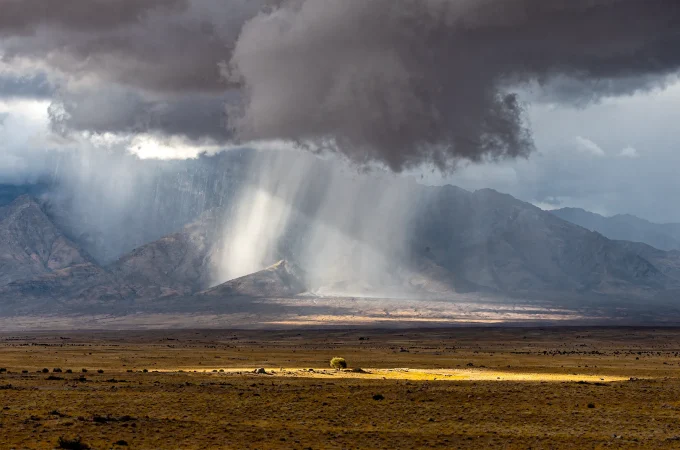
Moist air moves inland off an ocean. A mountain range stands in the way. The range forces that air upward.
Climbing air cools. Cooling air cannot hold its moisture, so it condenses into cloud and falls as rain or snow. All of that happens on the windward side, the side facing the ocean.
By the time the air crosses the peaks it has already lost most of its water. Then it descends the far side, and descent compresses and warms it. This is the same adiabatic heating that drives Subtropical High-Pressure Deserts. Warm air holds moisture rather than releasing it, so almost nothing falls on the leeward side.
The result is a dry strip immediately downwind of a wet mountain range. National Geographic’s rain shadow entry puts it plainly: the mountains block the rain-bearing weather, and the land behind them turns to desert.
Two things make this mechanism unusually easy to see. The wet side and the dry side sit right next to each other. The barrier causing the difference is visible from both.
What the Windward Side Gets Instead
Every rain shadow has a mirror image. The same lift that dries the leeward side soaks the windward one.
Geographers call this orographic precipitation, meaning rain caused by terrain rather than by a weather front. Some of the wettest places on Earth sit on windward mountain slopes for exactly this reason. The Olympic Peninsula in Washington State holds temperate rainforest on its western side. Cross the ridge and rainfall collapses.
That contrast is why rain shadow deserts feel so abrupt. You can drive from forest to scrubland in under an hour. Subtropical deserts do not work like that. Their boundaries fade gradually over hundreds of kilometres.
It also clears up a common confusion. A rain shadow desert is not dry because the region lacks water. The region has plenty. The mountains simply take it first.
How Big Does the Mountain Range Need to Be?
There is no single threshold. Three things decide how strong the effect is.
Height matters most. A taller range forces air higher, cools it further, and strips more moisture out before it crosses. The Andes and the Himalaya produce some of the most extreme rain shadows on the planet.
Orientation matters almost as much. A range running across the prevailing wind blocks the most moisture. A range running parallel to it barely interferes.
Distance from the moisture source matters too. A coastal range intercepts air that is still saturated. A range hundreds of kilometres inland receives air that has already dropped much of its load.
Get all three at once and the effect is dramatic. Miss one and you get a slightly drier valley instead of a desert.
Worked Example: The Mojave
The Mojave Desert in the southwestern United States owes much of its aridity to rain shadow. Pacific moisture has to cross several ranges before it reaches the basin.
Death Valley, inside the Mojave, sits behind more than one barrier. National Geographic notes that it lies in the rain shadow of the Pacific Coast Range and the Sierra Nevada at the same time. Each range strips more water from the air.
That stacking is why Death Valley records some of the lowest rainfall totals in North America. It also holds the highest air temperature officially on record at 56.7 °C, though many climatologists question the 1913 reading. The 5 Types of Deserts covers that record and the dispute around it.
The Mojave is not purely a rain shadow desert. Its latitude and continental position contribute too. Most real deserts run on more than one mechanism at once.
Worked Example: Argentina’s Patagonian Desert
Patagonia is the cleanest large-scale demonstration of this mechanism anywhere.
The Andes intercept almost all the moisture arriving from the Pacific. East of the range, the Patagonian steppe stays persistently dry. It sits far outside the subtropical belt, so the Hadley cell explains nothing here. The mountains do the dominant share of the work.
Patagonia is also famously windy. The same terrain that creates the rain shadow channels and accelerates the descending air. Desert Winds, Sandstorms and Haboobs covers what that does to a landscape.
The contrast across the range is severe. Chilean Patagonia on the western side holds temperate rainforest and glaciers. Argentine Patagonia on the eastern side holds dry steppe. The distance between them is small.
Why Rain Shadow Deserts Can Form at Any Latitude
The subtropical mechanism is locked to a band near 30° latitude. This one is not.
A rain shadow desert forms wherever a big enough range sits between a moisture source and the land behind it. Latitude is irrelevant. That is why rain-shadow arid zones turn up from the Mojave’s mid-latitudes to Patagonia’s far south.
The Tibetan Plateau shows the same process at extreme scale. The Himalaya block the monsoon, and the plateau behind them stays arid despite the enormous rainfall just to the south. Deserts of Asia covers that region.
Some deserts combine this mechanism with others. The Gobi sits behind mountain barriers and deep inside a continent at the same time. Continental Interior Deserts covers the second half of that story.
Not Every Rain Shadow Makes a Desert
Rain shadows are common. Deserts are not.
Most rain shadows produce a valley that is simply drier than the slope facing the weather. The effect shows up in vineyards, in farmland, and in vegetation changes long before it produces anything anyone would call arid.
A rain shadow only produces a desert when the reduction pushes annual precipitation below the threshold set out in Desert Definition and Classification. That usually needs a very tall range, a strong prevailing wind from one direction, and no second moisture source arriving from another.
So the mechanism is a spectrum, not a switch. Rain shadow deserts sit at the far end of it.
What to Expect on the Ground

These deserts often sit higher than subtropical ones. The same forces that built the mountain range shaped the surrounding land, so the terrain varies more. Desert Geology and Landforms covers the resulting features.
Elevation changes what you should pack. Nights get genuinely cold, and many rain shadow deserts qualify as cold deserts rather than hot ones. Snow falls across the Great Basin and Patagonia in winter.
Vegetation is usually sparse scrub rather than bare sand. Sagebrush, bunchgrass and low shrubs dominate. The landscape reads as empty rather than dramatic at first, and it rewards a slower look.
The best part is the contrast. You can often see the wet side and the dry side from one place, since the barrier causing the difference sits between them.
Related Topics
How Deserts Form · Subtropical High-Pressure Deserts · Continental Interior Deserts · Desert Geology and Landforms · World Deserts Atlas
FAQ
Can a rain shadow desert exist without a nearby mountain range?
No. The mechanism requires a range sitting between a moisture source and the dry zone. Without the barrier, something else is causing the aridity.
Is the Mojave’s aridity entirely explained by rain shadow?
Largely, but not completely. Its latitude and continental position contribute as well. Most real deserts run on several reinforcing factors rather than one isolated cause.
Why is Patagonia such a clear example of this mechanism?
It sits far outside the subtropical high-pressure belt, so the Hadley cell cannot explain its dryness. The Andes account for almost all of it, which makes the case unusually clean.
How much drier is the leeward side compared with the windward side?
It varies by range and moisture source. The gap can be extreme. Some rain-shadow regions receive a small fraction of the rainfall recorded a short distance away on the windward slopes.
Do taller mountain ranges create stronger rain shadows?
Generally yes. A taller range forces air higher, cools it more, and strips out more moisture before it crosses. Orientation to the prevailing wind matters almost as much as height.
Can a rain shadow desert also be a cold desert?
Yes. Rain shadow deserts at high elevation or high latitude often qualify as cold deserts too. The mechanism explains dryness, not temperature.
What is a rain shadow in simple terms?
It is the dry strip of land directly behind a mountain range. The range catches the rain on its windward side, so the land on the far side receives very little.
Does the wind direction have to stay constant for a rain shadow to form?
It helps a great deal. A strong, steady prevailing wind from one direction produces the sharpest rain shadows. Where wind direction shifts through the year, moisture can arrive from another side and soften the effect.