
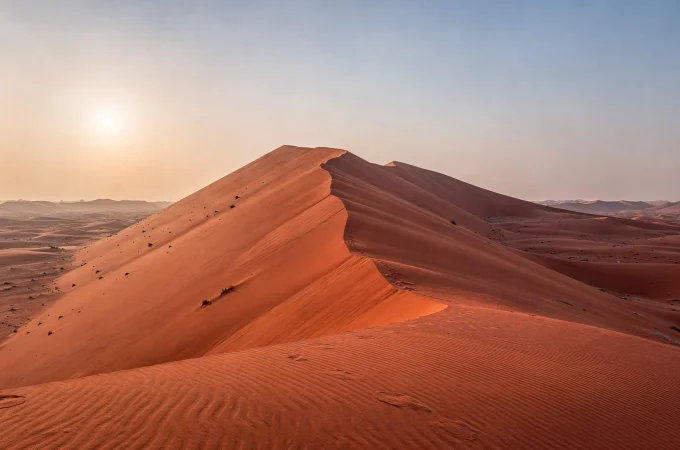
650,000 square kilometers, larger than the whole landmass of France, spread across four Middle Eastern countries. The UAE’s northern slice of the Rub al Khali sits under three hours from Dubai or Abu Dhabi. Even so, it holds some of the tallest and most intimidating sand formations in Arabia. Here is what sets this stretch apart from the country’s coastal and gravel deserts.
Table Of Content
- Overview of the Rub al Khali in the UAE
- Landscape and Nature
- Climate
- Wildlife
- Geology and Landforms
- Flora
- Getting There and Survival
- Experiences and Camps
- Who Is This Desert For?
- FAQ
- Is the Empty Quarter the same as Liwa?
- Can I drive into the dunes without a guide?
- What is the biggest safety risk?
- When is the best time to visit?
- How far does the UAE share of the desert extend?
Overview of the Rub al Khali in the UAE
The UAE’s share sits in the far southwest, anchored by the historic Liwa basin. Rocky outcrops and gravel plains dominate other regions of the country. This one is different: a true erg, an unbroken sand sea.
According to Britannica’s entry on the Rub al-Khali, the full sand sea covers about 250,000 square miles, roughly 650,000 square kilometers. It spans a large structural basin mainly in Saudi Arabia, and its outer edges reach Yemen, Oman, and the UAE.
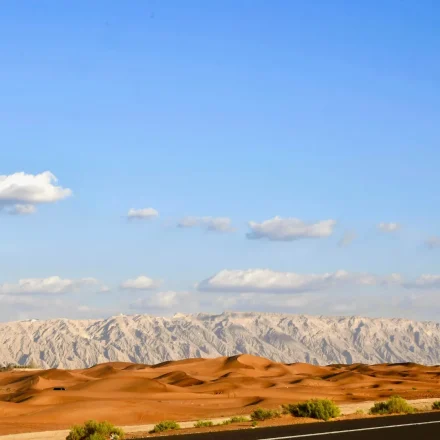
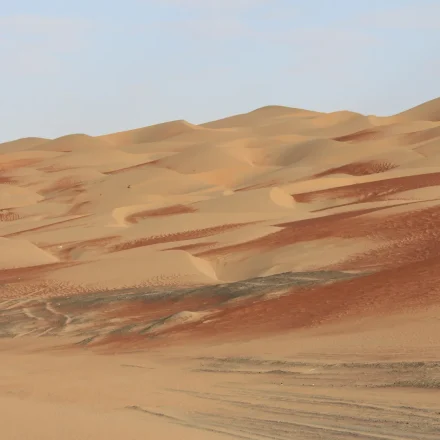
Inside the UAE border, dune heights regularly pass 200 meters. These formations run in long parallel ridges shaped by the prevailing wind. In fact, the wind holds its direction so consistently that the ridge line often gives a more reliable bearing than a phone with a dead battery.
Landscape and Nature

The defining landform here is the linear mega-dune. These dunes run for several kilometers with almost no break. Each carries a steep, unstable slip-face on the sheltered side.
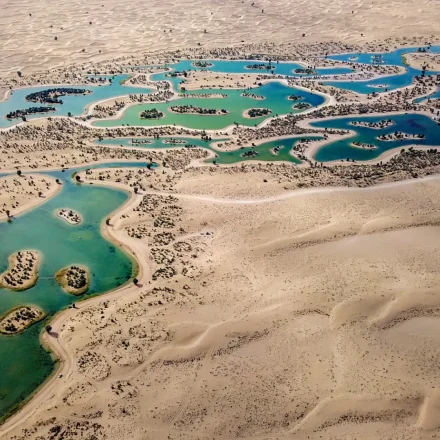
The true interior has no permanent water, no seasonal lakes, and almost no plants once you pass the outer margins. Sand and sky are all that remain, which is exactly why landscape photographers come.
What separates these ridges from random sand build-up is their regularity. From above, the parallel pattern stays visible for tens of kilometers in one unbroken direction. It is a physical record of winds that have worked this basin for thousands of years.
Between the ridges, the sand forms a hard-packed crust. That crust carries vehicle weight far better than a loose slip-face. As a result, experienced guides route their vehicles along the troughs instead of crossing the crests.
Climate
Between June and September, temperatures regularly pass 45 °C. Travel becomes genuinely dangerous in that window. The practical season runs from October to April, when days sit in the mid-20s to low 30s °C.
However, winter nights fall close to freezing. First-time campers often pack for daytime heat alone, and this is the single most common planning mistake.
The day-to-night gap is far wider in the deep interior than near the coast. Because the open sand sea holds little humidity and no buildings to trap heat, a December afternoon at 27 °C can drop to single digits by dawn.
Spring also brings shamal wind events. These sandstorms cut visibility to near zero within minutes, so operators reschedule deep-dune trips rather than risk a stranded convoy.
Wildlife
The extreme dryness limits how much life the desert supports. Still, specialised species hold on: the Arabian sand gazelle, the reintroduced Arabian oryx, and the small nocturnal Rüppell’s fox. Because the deep interior is too harsh for larger mammals, most gather near the outer margins.
The transition zone between the sandy erg and the northern gravel plains gives the best chance of a sighting. It offers sparse grazing and firmer ground, so professional guides plan wildlife routes around it. For fuller accounts, see the desert animal adaptations guide and the Arabian Oryx profile.
Smaller night wildlife leaves a clear record on the sand. At dawn you can read the looping tracks of beetles, the straight lines of sand geckos, and the paired prints of foraging foxes.
Geology and Landforms
This region is a classic erg. Rock and gravel deserts cover most of the world’s arid zones, yet this one is built almost entirely from wind-driven sand.
At the margins of the basin, the prevailing winds shift. Consequently, the long linear ridges give way to complex star dunes with several radiating arms.
Flora


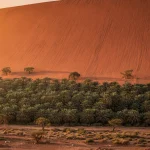
Plant life stays very limited in the deep dunes. Scattered Ghaf trees survive mainly at the margins, above old underground water channels. For more on these species, see the Ghaf Tree guide and the desert plant adaptations guide.
Away from those pockets, vegetation drops to almost nothing. A few hardy, salt-tolerant grasses grip the firmer trough crust. Nothing grows on the moving faces of the dunes.
Getting There and Survival

Reaching the gateway towns needs no special vehicle. Entering the sand sea is a different matter. A standard rental sedan is useless past the paved margin, and visitors regularly assume road-like conditions carry on into the dunes.
| Category | Details |
|---|---|
| Airport Access | Abu Dhabi International (2 hours) / Dubai International (2.5 hours) |
| Key Gateway | Liwa town (final services and fuel) |
| Road Conditions | Paved highways to the desert edge; soft sand beyond |
| Emergency Support | Liwa Hospital and local police station in Liwa town |
| Connectivity | Strong signal at the margins; highly unstable in the deep interior |
| Navigation | Carry a dedicated GPS device and offline topographic maps |
Experiences and Camps
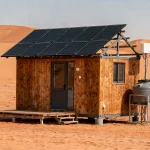
The deep interior supports dune driving, camel trekking, sandboarding and stargazing. Multi-day camel caravans trace historic Bedouin trading routes, with support vehicles carrying water and emergency communications.
Stargazing benefits from the total absence of light pollution. The Milky Way reads here in a way it never does near the coast. To compare options, see the Experience Hub and the Camp Hub.
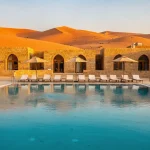
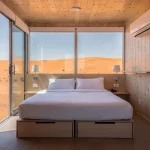
Lodging runs from basic desert camps to high-end resorts such as Qasr Al Sarab. Budget camps deliver a raw, close-to-nature night. By contrast, the luxury properties add private pools and fine dining against the same dune backdrop.
Who Is This Desert For?

This desert suits adventure travelers, photographers, and experienced off-roaders who want real isolation. Families and first-time visitors should stay with guided day tours, or base themselves at the developed resorts on the desert edge.
FAQ
Is the Empty Quarter the same as Liwa?
No. Liwa is the oasis settlement at the northern edge. The Empty Quarter is the continuous sand sea that runs on across the borders.
Can I drive into the dunes without a guide?
It is strongly discouraged. The terrain is complex, recovery is difficult, and mobile signal drops off quickly once you leave the main tracks.
What is the biggest safety risk?
Heat and dehydration. Always carry surplus water and proper off-road recovery gear.
When is the best time to visit?
The cooler months between October and April, ideally in early morning or late afternoon.
How far does the UAE share of the desert extend?
It covers the southwestern corner of the country and forms the northern tip of the wider Arabian sand sea.