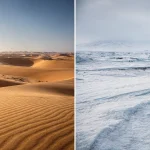


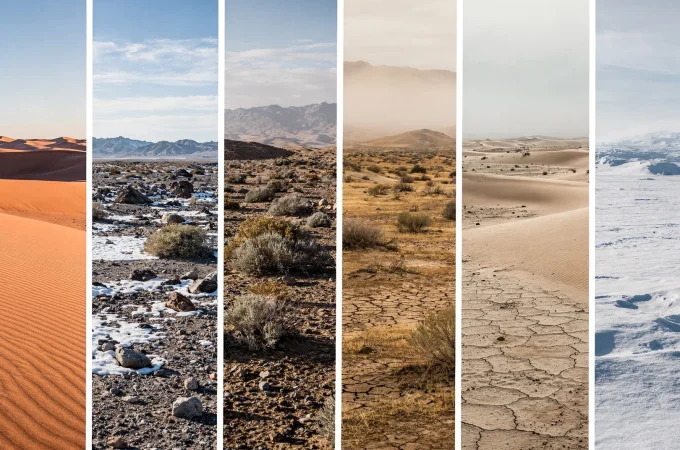
There are 5 types of deserts, and the two largest are the ones you would least expect. Hot, cold, semi-arid, coastal and polar all meet the same precipitation test. On the ground, they look almost nothing alike.
Table Of Content
- Hot Deserts
- Cold Deserts
- Semi-Arid Drylands
- Coastal Deserts
- Polar Deserts
- A Note on Cold Versus Polar
- Why the 5 Types of Deserts Look So Different
- Related Topics
- FAQ
- Which desert type is the largest?
- Can one country have more than one desert type?
- Is a coastal desert the same thing as a cold desert?
- Do all five types receive the same amount of sunlight?
- Which desert type is most common globally?
Hot Deserts

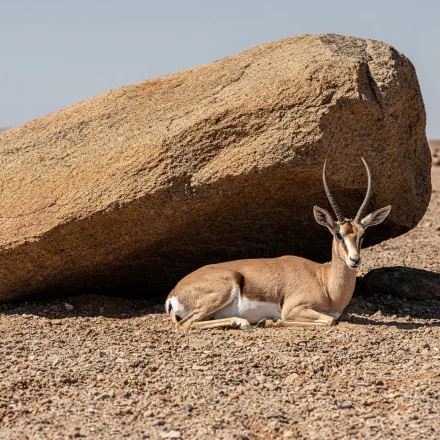
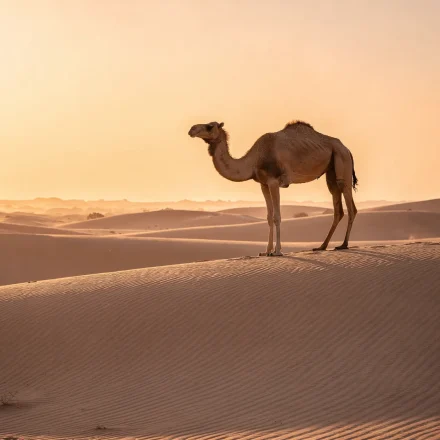
This is the popular image. Scorching days, often 35 to 45 °C, mild-to-cool nights, and very little vegetation.
The Sahara and the Arabian Desert are the defining examples. Both form through the subtropical high-pressure mechanism covered in Subtropical High-Pressure Deserts. At roughly 30° latitude, descending air loses its moisture and suppresses rainfall almost year-round.
The highest air temperature on record belongs to this type: 56.7 °C at Death Valley in 1913. The World Meteorological Organization still lists that reading as valid. A number of modern climatologists question its accuracy, given the instruments and conditions of the time.
Hot deserts dominate the imagery, despite being one type out of five.
Cold Deserts

Cold deserts get real winter snowfall. They still count as desert, because total annual moisture stays low.
The Gobi and North America’s Great Basin are the standard examples. Their dryness comes from continental-interior distance from ocean moisture, which Continental Interior Deserts covers in detail. Nearby mountain ranges often add a rain-shadow effect on top of that.
Gobi winter lows can fall below −40 °C. Summer highs at the same location can pass 40 °C, which makes the seasonal swing one of the widest on the planet.
Semi-Arid Drylands

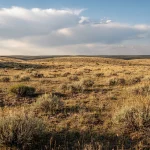
This is the mildest of the five. It sits at the wetter edge of the arid classification, in the UN’s 0.20 to 0.50 Aridity Index band covered on Desert vs Semi-Arid vs Steppe. Expect warm summers, cooler winters, and noticeably more vegetation than true hot or cold desert.
One point of precision matters here. Scientifically this band falls under the broader UN drylands category rather than desert proper. This Hub groups it with desert for practical trip planning, not because the classification says so.
North America’s Great Basin and parts of southern Africa’s Kalahari show these characteristics across large stretches.
Coastal Deserts

Cold ocean currents chill the air moving onshore. That chilled air suppresses rainfall while still producing dense fog.
Chile’s Atacama and Namibia’s Namib are the two most-cited examples. Coastal Fog Deserts covers the mechanism first.
Many sources call the Atacama the driest non-polar desert on Earth. That title is separate from “largest”, which belongs to the type below. Some of its weather stations have gone decades at a time without measurable rainfall.
The Namib, meanwhile, ranks among the oldest deserts anywhere. It has held arid conditions for tens of millions of years.
Polar Deserts

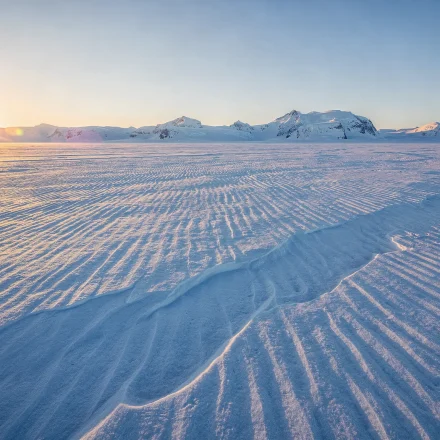
Polar deserts are the largest type by area and, by many measures, the driest. Antarctica and the Arctic qualify on precipitation grounds despite their ice cover, as Polar Deserts explains.
Antarctica alone covers roughly 14 million km². That is close to the combined area of the Sahara, Arabian, Gobi and Kalahari deserts. Its interior Dry Valleys have gone without meaningful precipitation for millions of years.
A Note on Cold Versus Polar
Sources disagree on whether cold desert and polar desert are one category or two. Some treat polar as a subtype of cold desert. Others separate them by latitude and ice cover.
This Hub keeps them split. Antarctica’s ice-sheet scale and near-total absence of vegetation set it meaningfully apart from a snow-covered but vegetated cold desert like the Gobi.
Neither the Köppen system nor the UN’s Aridity Index requires that split, and What Is a Desert? covers both scales. It is a convention rather than a rule, which is exactly why sources handle it differently. National Geographic’s “Not All Deserts Are Sandy” covers the Gobi as a cold desert and Antarctica as a polar one, treating them separately for the same reason.
Why the 5 Types of Deserts Look So Different
Each type’s formation mechanism shapes what a visitor actually sees. A hot desert gives clear skies and dramatic sunsets. A cold desert gives snow-dusted ground in winter. A coastal desert gives near-daily fog rolling over red sand. A polar desert gives none of the imagery the word suggests.
None of that is arbitrary. It traces directly back to the mechanism covered in How Deserts Form.
This is also the single biggest reason two desert trips on two continents can feel like unrelated experiences. Someone expecting a Sahara-style dune sea, who lands instead in a coastal fog desert or a snow-flecked cold desert, is not wrong to be surprised. The label alone does not tell you which of the five you booked.
Related Topics
What Is a Desert? (Precipitation and the Aridity Index Explained) · How Deserts Form
FAQ
Which desert type is the largest?
Polar deserts. Antarctica covers roughly 14,000,000 km², and the Arctic roughly 13,900,000 km². Both exceed the Sahara at about 8,600,000 km², which is the largest hot desert, according to Britannica.
Can one country have more than one desert type?
Yes. The United States alone holds hot desert (Sonoran, Mojave), cold desert (Great Basin) and semi-arid land inside its southwestern desert region.
Is a coastal desert the same thing as a cold desert?
No. A coastal desert gets its dryness from a cold ocean current chilling onshore air. A cold desert gets its dryness from distance to the ocean. The two mechanisms can produce similar temperatures for completely different reasons.
Do all five types receive the same amount of sunlight?
No. Polar deserts run months of continuous daylight or darkness depending on season. That light regime is unlike any of the other four, and it is part of why they look the least desert-like while still qualifying on precipitation.
Which desert type is most common globally?
Hot and semi-arid land together cover the largest area at inhabited latitudes. Even so, polar deserts alone out-cover every hot desert on Earth once Antarctica and the Arctic count as one type.