

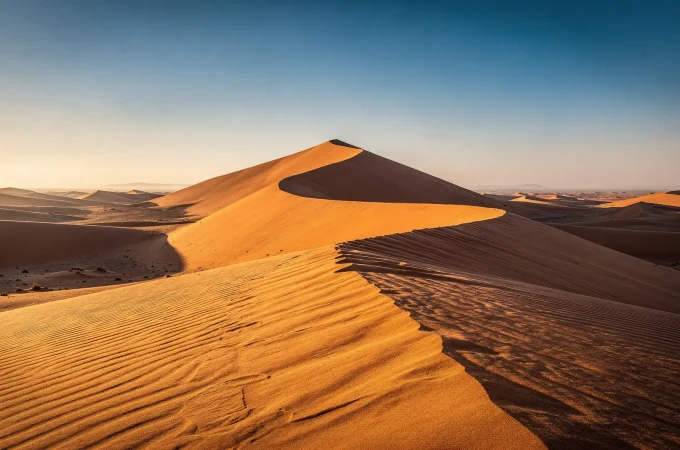
A dune is not just a pile of sand. Its shape is a readable record of the wind that built it, and understanding how sand dunes form means reading that record backwards.
Table Of Content
- How Dunes Form
- Saltation: How a Grain Actually Moves
- The Four Dune Types You Will Actually See
- Barchan
- Transverse
- Linear
- Star
- A Note on Naming
- Three Less Common Types
- Simple, Compound and Complex
- Worked Example: The Rub’ al Khali
- Why Dune Shape Is Not Random
- An Honest Framing Note
- What This Means for Visiting a Dune Field
- Related Topics
- FAQ
- What is the difference between an erg and a dune field?
- Do dunes move?
- How fast can a sand dune move?
- Which dune type is the tallest?
- Can more than one dune type appear in the same sand sea?
- What is the largest sand desert in the world?
- Why do some sources list five dune types and others four?
- What does a dune’s shape tell you about the wind?
How Dunes Form
Wind lifts loose sand grains and carries them until something makes them settle. An obstacle will do it. So will a drop in wind speed, or simply enough sand piling up in one spot.
Repeat that for long enough and a dune appears. Crucially, its shape does not depend on sand and wind in general. Instead, it depends on the specific pattern of the wind.
The sand itself often comes from far away. Much of the material in any given erg eroded off rock elsewhere, travelled long distances over long timescales, and only then settled into the shapes visible today.
Saltation: How a Grain Actually Moves
Sand does not float on the wind the way dust does. Instead, it bounces.
A grain lifted by the wind travels a short arc, lands, and knocks other grains into the air. Those grains bounce too. Geologists call this saltation, from the Latin for leaping, and it moves most of the sand in any desert.
As a result, sand transport happens in a shallow layer close to the ground. Stand on a dune during a windy afternoon and you will feel it stinging your ankles while the air at head height stays perfectly clear.
That low, dense stream is what builds a dune. Because it hugs the surface, the resulting shape responds very precisely to wind direction.
The Four Dune Types You Will Actually See

Barchan
Crescent-shaped, with horns pointing downwind. Barchans form where wind blows steadily from one direction across a firm surface with limited sand.
They also travel fast. USGS records a group of dunes in China’s Ningxia Province migrating more than 100 meters a year between 1954 and 1959, with similar rates measured in Egypt’s Western Desert.
Transverse
Long wave-like ridges running perpendicular to a strong, steady wind. Unlike barchans, transverse dunes need abundant sand, which is the main difference between the two.
A single transverse field can run for tens of kilometers in parallel ridges. The largest examples on record sit in China’s Taklimakan Desert, where crest-to-crest widths average more than 3 kilometers. Deserts of Asia covers that region.
Linear
Straight or gently curving ridges, far longer than they are wide. Some run more than 160 kilometers.
Despite appearances, linear dunes usually form where wind arrives from two roughly opposing directions rather than one. They generally sit in parallel sets, separated by corridors of sand, gravel or bare rock.
For anyone on foot, they are the friendliest type. Travel along the ridge line, and you avoid climbing entirely.
Star
Pyramid-shaped mounds with three or more arms radiating from a high center. Because wind arrives from many directions, star dunes grow upward instead of spreading sideways.
They dominate the Grand Erg Oriental in the Sahara. Meanwhile, the tallest known examples sit in the southeast of China’s Badain Jaran Desert, where USGS puts them at up to 500 meters and calls them possibly the tallest dunes on Earth. The Namib has famous star dunes too, though not at that height.
A Note on Naming
Sources disagree slightly on how many dune types exist, and the reason is worth knowing.
USGS groups barchan and transverse together under a single heading: crescentic. Both form under wind from one direction, and both place their slip face on the concave side. Sand supply is the only real difference.
Most teaching and travel material splits them anyway, since they look and behave differently on the ground. This page splits them for the same reason. Even so, a geologist would call both of them crescentic.
Three Less Common Types
Parabolic dunes are U-shaped, with the nose leading downwind and the arms trailing behind, held in place by vegetation. That makes them the mirror image of a barchan, whose horns point the other way. They occur mainly in coastal and partly vegetated settings, and the longest known trailing arm runs 12 kilometers.
Dome dunes are low circular mounds with no clear slip face. Rare, and generally found at the far upwind edge of a sand sea, where wind and sand supply have not yet built anything more defined.
Reversing dunes are less a shape than a condition. Wherever wind periodically reverses direction, any of the types above can develop major and minor slip faces pointing opposite ways.
Simple, Compound and Complex

There is a second layer to dune classification, and it carries the most information of all.
Simple dunes have the minimum number of slip faces that define their type. Compound dunes are large dunes with smaller dunes of the same type riding on top. Complex dunes mix two or more types, and a star dune sitting on the crest of a crescentic one is the most common combination.
Here is why that matters. According to USGS, a simple dune indicates a wind regime that has not changed in strength or direction since the dune formed. Compound and complex dunes indicate that it has.
So the dune records more than the current wind. It records whether the wind ever changed.
Worked Example: The Rub’ al Khali

Arabia’s Rub’ al Khali, the Empty Quarter, is the largest continuous body of sand on Earth. It covers roughly 650,000 km² across Saudi Arabia, Oman, the UAE and Yemen, while its largest dunes reach around 250 meters.
Note the exact claim, though. Largest sand sea, not largest desert. That second title belongs to the polar deserts covered in Polar Deserts.
Several dune types coexist inside it, because wind patterns shift across an area that size. Linear corridors run through some zones, whereas isolated star clusters build in others. The whole sand sea sits inside the belt described in Subtropical High-Pressure Deserts.
Why Dune Shape Is Not Random

With a little practice, you can read a region’s wind from its dunes.
A field of barchans means strong, steady wind from one direction. Star dunes mean wind arriving from many. Linear ridges mean two competing directions rather than one.
The record runs deeper than the surface, too. Where a dune face has been cut open, internal layering shows which direction dominated at different points in the dune’s history, since every shift in wind leaves its own bed of sand at its own angle.
Desert Winds, Sandstorms and Haboobs covers the wind events doing this work in the present. The dune itself is the archive.
An Honest Framing Note
Sand seas are spectacular. They also cover a minority of total desert area worldwide.

Rock and gravel terrain covers far more ground, as Rock Deserts and Stone Pavements sets out. Meanwhile, Desert Landforms puts both in context alongside the other four landform types. National Geographic makes the same point.
Worth knowing before you assume a desert destination will be dune-covered. Plenty are not.
What This Means for Visiting a Dune Field
Dune type changes the difficulty of a visit more than most people expect.
Barchan fields leave open corridors between the crescents, so routes between dunes stay relatively clear. Star dune fields are harder work, because the radiating arms never line up in one direction.
Linear fields sit in between. Walking along a ridge is easy, whereas crossing them means climbing every single one.
For a dune trek or a sandboarding trip, therefore, that difference is worth checking in advance. The same activity can be considerably more demanding in one dune type than another.
Related Topics
Desert Landforms · Rock Deserts and Stone Pavements · Desert Winds, Sandstorms and Haboobs · How Deserts Form · World Deserts Atlas
FAQ
What is the difference between an erg and a dune field?
An erg is specifically a large sand sea, meaning an extensive and continuous dune field. Smaller isolated formations are simply dune fields. The word comes from Arabic and geographers use it worldwide.
Do dunes move?
Many do. Wind erodes the windward face and deposits sand on the leeward side, so the whole form migrates. Rates vary with size and wind strength, though small crescentic dunes move fastest of all.
How fast can a sand dune move?
Faster than most people assume. USGS documented a group in China’s Ningxia Province moving more than 100 meters a year over a five-year period.
Which dune type is the tallest?
Star dunes, since multidirectional wind lets sand pile upward rather than spread sideways. The tallest known reach roughly 500 meters in China’s Badain Jaran Desert.
Can more than one dune type appear in the same sand sea?
Yes. Large ergs such as the Rub’ al Khali show several types across different zones, because wind patterns vary even within one continuous body of sand.
What is the largest sand desert in the world?
The Rub’ al Khali, at roughly 650,000 km². It is the largest continuous sand sea, which is a different title from largest desert overall.
Why do some sources list five dune types and others four?
Because USGS groups barchan and transverse dunes together as crescentic, while most other material separates them. Both form under single-direction wind, and sand supply decides which shape appears.
What does a dune’s shape tell you about the wind?
A great deal. Single-direction wind builds crescentic dunes, two opposing directions build linear ridges, and many directions build star dunes. Furthermore, a simple dune means the wind never changed, whereas compound and complex dunes mean it did.