
87% of the UAE is desert. Yet almost none of the tourists who visit ever see more than the first few kilometers of it. Most desert safaris run a loop within 45 minutes of Dubai. However, the rest of the country, Liwa, the Empty Quarter and Al Ain’s gravel plains, sits a half-day drive away and stays nearly empty. This UAE desert travel guide covers the full picture, not just the loop.
Table Of Content
- Why Visit the UAE for Desert Travel?
- Geography & Desert Landscape
- Desert Overview
- How the Three Compare
- Signature Wildlife
- Desert Flora & Ecosystem
- Desert Culture
- Desert Tourism in the UAE
- Visitor Information
- Signature Experiences
- Camp Styles
- Best Time to Visit
- Is This Destination Right for You?
- FAQ
- Do I need a visa?
- Is the desert safe for solo travelers?
- Can I visit without a tour?
- Which UAE desert is best for a first visit?
- How hot does it get?
- Is the whole country desert?
Why Visit the UAE for Desert Travel?

No other desert destination pairs a remote sand sea with this level of access. Fly into Dubai in the morning, and you can be inside the Rub’ al Khali by afternoon. The road is paved the entire way. An ultra-luxury resort waits at the end of the drive, if that is what you want. By contrast, Morocco, Namibia and the Australian Outback all demand more travel time and self-reliance for similar scenery. That gap is the whole story.
Strongest fit: first-time desert travelers, luxury travelers who want the experience without the hardship, and short-trip travelers adding a desert day to a city trip. Weaker fit: anyone chasing deep wilderness isolation. For that specific need, Namibia remains better.
The trade-off is worth stating plainly. What the UAE gives up in raw isolation, it makes back in reliability. So a first-time visitor here is choosing between a guided experience with a paved road home and a remote expedition elsewhere that demands real self-reliance. Neither option is better in the abstract. Still, most people booking a first desert trip never realise they are making that choice at all.
Geography & Desert Landscape

The UAE sits on the northeastern edge of the Arabian Peninsula, between Saudi Arabia and Oman. Its livable desert season runs from October to April. Most of the desert mass lies in Abu Dhabi’s Al Dhafra region, which is the UAE’s share of the Rub’ al Khali. Smaller pockets reach Dubai’s southern edge and the gravel plains near Al Ain. Liwa, the main gateway town, sits roughly 2.5 hours from Dubai and 2 hours from Abu Dhabi city.
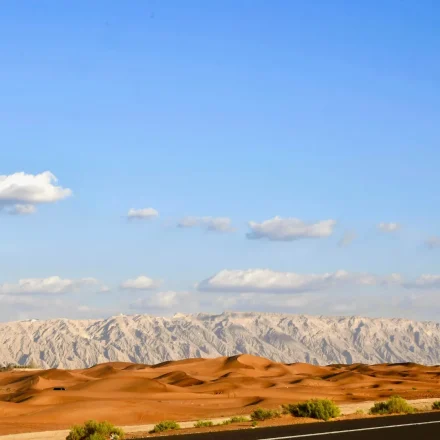
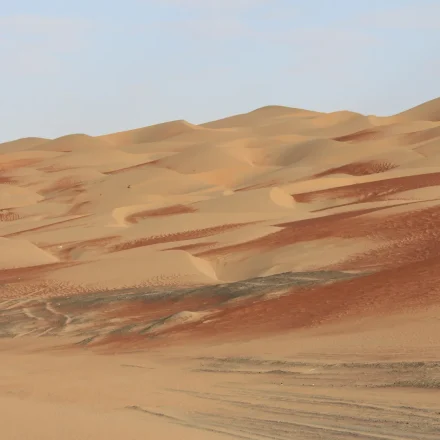
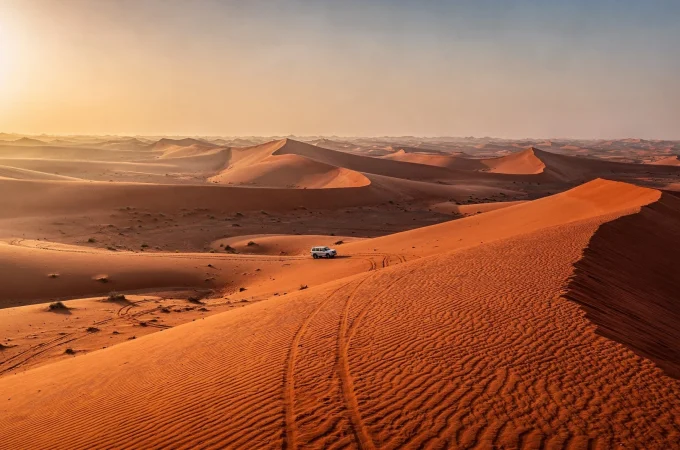
One detail most guides skip: Liwa’s dunes run a deeper red than the paler sand near Dubai. The cause is iron-oxide concentration in the underlying rock, not lighting.
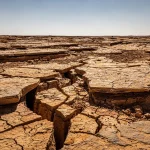
Also, the country’s desert is not one continuous landscape. Dubai and Sharjah’s fringes are flatter and paler close to the coast. Al Ain sits on gravel plains and low rocky outcrops rather than dunes at all. Only well inside Al Dhafra does the terrain turn into the towering red erg most people picture. In other words, the postcard image and the most-visited image are two different places.
Desert Overview

Rub’ al Khali (Empty Quarter): Britannica puts the full sand sea at roughly 650,000 km², the largest contiguous sand desert on Earth. Dunes on the UAE side exceed 200 meters. This is the deep-interior experience: linear mega-dunes running for kilometers with barely a break. Vegetation is almost absent past the outer edge. Still, the silence is the part that is hard to find anywhere else within a few hours of a major airport. Full guide
Liwa Oasis: the developed gateway, with the near-300-meter Tal Moreeb dune and paved roads to the door. Here a 100-kilometer curve of date-palm villages sits directly against the dune wall. As a result, it works as the practical base for the wider Empty Quarter without giving up hotels, fuel or phone signal. Full guide
Al Ain offers a gentler day-trip alternative on gravel plains. The terrain is flatter and rockier, so it is not a smaller version of the other two. In addition, Al Ain Zoo runs the country’s original Arabian Oryx breeding program. That makes it the easiest single stop for desert scenery plus a guaranteed wildlife sighting.
How the Three Compare
With one day, pick Al Ain. It is closest, gentlest, and the wildlife is guaranteed. With a weekend, pick Liwa, where the dune scale is real and the comfort holds. Finally, the full Empty Quarter experience needs a guided multi-day trip into the deep interior. There, the infrastructure that makes the rest of this destination so easy thins out.
Signature Wildlife

The UAE holds the world’s largest Arabian Oryx population, around 8,000 animals, recovered from extinction in the wild. Full Arabian Oryx guide. Oryx tolerate midday heat that would drop most desert mammals. The reason is a blood-cooling network at the base of the skull, which keeps the brain several degrees cooler than the body. Sand gazelles, Rüppell’s foxes and the saker falcon round out the signature species. Desert animal adaptations
The recovery began on Emirati soil. Sir Bani Yas Island’s history, documented by Abu Dhabi’s Environment Agency, traces back to a handful of animals sheltered there in 1971. That was the same year the Arabian oryx was declared extinct in the wild everywhere else on the Peninsula.
Desert Flora & Ecosystem
The Ghaf tree anchors the ecosystem. Its taproot reaches 30 meters down for groundwater nothing else can touch. In parts of Al Dhafra’s older aquifers, that water fell as rain long before anyone was counting. Full Ghaf Tree guide · Desert plant adaptations
Beneath a mature Ghaf’s canopy, ground temperature runs measurably cooler than open sand a few meters away. Because of that difference, birds, reptiles and insects cluster there through the hottest hours. A single tree becomes a small ecosystem in an otherwise empty stretch of desert.
Desert Culture

The coffee ritual, the majlis and falconry all descend from Bedouin nomadic tradition rather than tourism invention. Falconry in particular carries international recognition. UNESCO’s Intangible Cultural Heritage listing names it a living human heritage practised across the Arab world for millennia. Moreover, the UAE was among the founding nations that pushed for its original inscription. Full Desert Culture guide
Desert Tourism in the UAE
Short desert-safari excursions from Dubai and Abu Dhabi are the most-booked tour category in the country. Multi-day Liwa trips form a smaller but faster-growing segment. Guiding, camp standards and paved gateway access rank among the most developed of any desert destination worldwide. Consequently, a remote sand sea becomes a same-day booking.
That investment shows up in checkable ways. Access roads are graded and maintained year-round rather than seasonally. Guide licensing standards go further than most competing destinations formally require. Camp density around Liwa alone rivals entire countries elsewhere. None of this changes the desert itself. However, it changes how much planning and risk tolerance a visitor needs to bring.
Visitor Information
Safety: heat and dehydration are the real risks, not crime.
Entry rules: as of 2026, visa-on-arrival covers many nationalities for 30 to 90 days. Standard 60- and 90-day tourist visas apply otherwise, plus a 5-year multiple-entry option open to all nationalities. New for 2026, full-stay health insurance is compulsory. Applications also require a colour scan of the passport’s full cover page. That step is easy to miss, and it is the most common rejection reason this year. Because terms vary by nationality, confirm current requirements against the UAE government’s visa information portal before booking.
Cultural rules: dress modestly at cultural and religious sites, and ask before photographing people.
Signature Experiences

Camel Riding · Dune Bashing · Sandboarding · Guided Stargazing · Experience Hub
Dune bashing stays the most-booked format because it asks nothing of the guest. A driver handles the technical part entirely. For that reason, it converts far better with first-time desert travelers than sandboarding, which demands more physically.
Camp Styles
Luxury, Bedouin, Eco, Family and Wild/Expedition. Camp Hub
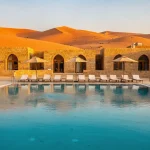
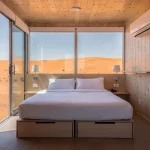
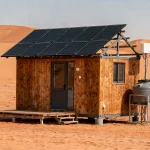
Each style maps to a traveler priority rather than a price tier. Luxury means resort-level comfort inside the dunes. Bedouin means a culturally grounded evening programme. Eco means verified sustainability practices. Family means shorter, better-supported formats. Wild/Expedition means the deep-interior experience described above.
Best Time to Visit
October to April brings high 20s to low 30s °C by day, with cold nights in December and January. Between June and September, temperatures regularly top 45 °C. October and April offer the clearest trade-off. Crowds thin out compared with peak winter, yet the days stay comfortable enough to spend outdoors without planning around the hottest hours.
Is This Destination Right for You?

If you want a real desert without giving up comfort or a week of vacation, the UAE is close to unbeatable.
- Adventure travelers: dune bashing, sandboarding, multi-day treks.
- Luxury travelers: the world’s densest cluster of ultra-luxury desert resorts.
- Photographers: dramatic scale, dark skies, the Ghaf’s singular silhouette.
- Families: short, well-supported formats built for first-timers.
- Nature lovers: a conservation comeback story, viewable close-up.
FAQ
Do I need a visa?
Most nationalities qualify for visa-on-arrival or an e-visa. Still, terms vary by nationality, so confirm the specifics before booking.
Is the desert safe for solo travelers?
Yes. Heat and dehydration are the main risks.
Can I visit without a tour?
Liwa is reachable by ordinary rental car. However, the dunes beyond it are safer with a guide.
Which UAE desert is best for a first visit?
Liwa Oasis.
How hot does it get?
Regularly above 45 °C between June and September.
Is the whole country desert?
No. 87% is desert or arid terrain, although the visible landscape varies between the coastal cities, Al Ain’s gravel plains and Al Dhafra’s true sand sea.